


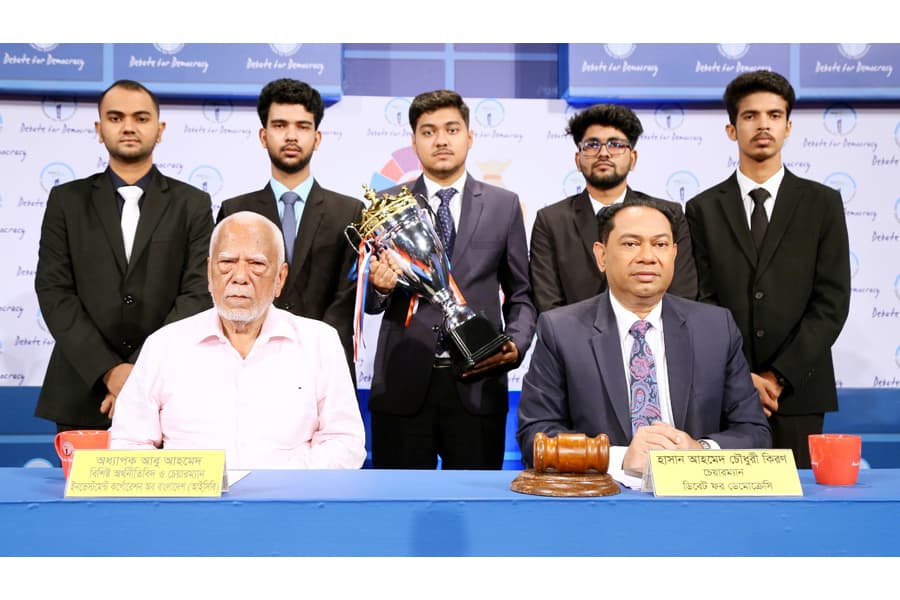
Eminent economist and Chairman of Investment Corporation of Bangladesh (ICB), Professor Abu Ahmed, on Saturday said Prime Minister Tarique Rahman's visits to China and Malaysia will serve as a "game changer" for the country's economic recovery.


The high-level visits would play a crucial role in securing development assistance, attracting fresh foreign investments, and generating domestic employment, he said at a shadow parliament debate competition held at the Bangladesh Film Development Corporation (BFDC) in the capital.
The event, titled "This budget is capable of restoring the shattered economy," was organised by Debate for Democracy, according to UNB.
Defending the size of the national budget, the ICB chief remarked that a large budget is not inherently flawed. "An elected government has every right to propose a large budget to implement its development programmes. However, the key lies in enhancing implementation efficiency, and this government must be given adequate time to steer the economy toward recovery," he said.
Reflecting on past financial indiscretions, Prof Ahmed alleged that major business houses during the previous autocratic regime could not operate without satisfying the government, turning commerce into a landscape dominated by irregularities, corruption, and partisan interests.
He further criticised past mega-infrastructure projects, including the Padma Bridge Rail Link, the Bangabandhu Sheikh Mujibur Rahman Tunnel (Karnaphuli Tunnel), Payra Port, and the Rooppur Nuclear Power Plant, claiming they were initiated without a proper assessment of national interests.
"The current government has adopted a conservative approach toward mega projects, prioritising human resource development instead. While we could not see any light at the end of the tunnel in the past, we are now optimistic. The despair is lifting," he added.
To keep the momentum of the economy, Prof Ahmed stressed the urgency of creating an investment-friendly environment, pointing out that Bangladesh's corporate tax rates are higher than those of competing regional economies like India, Vietnam, Laos, Cambodia, and Singapore. "If we cannot rationalise our tax rates to match these nations, we will fail to attract foreign direct investment," he warned.
Chaired by Hasan Ahmed Chowdhury Kiron, Chairman of Debate for Democracy, the programme also highlighted ongoing industrial vulnerabilities.
In his speech, Kiron alleged that the previous Awami League government weaponised overvalued mega projects to build a "plunder-based economy," asserting that 25 per cent to 30 per cent of those expenditures were fraudulent.
He called for the rationalisation of deeply bleeding projects to curb further state wastage.
Expressing concern over the investment climate, Kiron revealed that over 500 industrial factories closed down in the last two years due to a severe shortage of gas, electricity, and production capacity, leaving more than 150,000 workers unemployed.
"Even financial loans cannot save these factories if basic utility services like gas and electricity are unavailable. Bureaucratic red tape must also be dismantled through swift deregulation to restore investor confidence," Kiron said.
He described the current fiscal year's budget as a courageous and unique initiative framed amid boundless limitations, urging the government to expand the tax net rather than overloading existing taxpayers to avoid trapping the nation in debt.
Debaters from Dhaka College won the shadow parliament competition, defeating the team from BGMEA University of Fashion and Technology (BUFT).
At the conclusion of the event, trophies, crests, and certificates were distributed to the participants.