


Although a significant number of people in the society are aware of the provision requiring 33 per cent women’s representation within political parties by 2030, they believe that political parties are not taking sufficient action to fulfil this obligation, according to a study.
The study found that 87.3 per cent of respondents are aware of the provision requiring 33 per cent women’s representation within political parties.
Among those surveyed, 72 per cent stated that the provision is not being effectively implemented. Stakeholders also expressed mixed views regarding the role and institutional capacity of the Bangladesh Election Commission (EC) in monitoring and enforcing compliance with the RPO.
“Only 1.4 per cent of respondents believe that the Election Commission has adequate capacity to ensure implementation of the provision, while 9.9 per cent consider its capacity to be partially sufficient.”
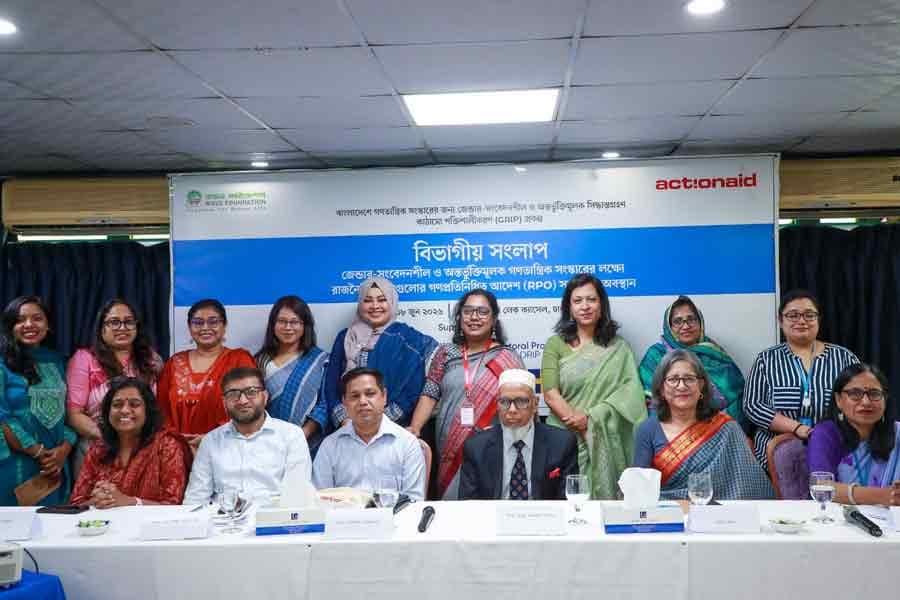
These findings were presented on Monday at a divisional dialogue in Dhaka, where the results of a study titled “Political Parties’ Position on the Representation of the People Order (RPO)” were shared. The dialogue was jointly organised by Wave Foundation and ActionAid Bangladesh, according to a statement.
The study was conducted under the Gender Responsive and Inclusive Participation (GRIP) Project, implemented as part of the United Nations electoral assistance initiatives BALLOT and DRIP. The research was carried out by Sanaia Fahim Ansari, while Consultant Mansura Akhtar presented the study findings at the event. The research drew on the views of 191 stakeholders from 11 districts across six divisions of the country.
At the beginning of the programme, Morium Nesa, Lead, Women’s Rights and Gender Equity, welcomed participants and outlined the objectives of the dialogue.
Participants stressed that women’s political representation should not be confined to reserved seats or quota-based arrangements alone. Instead, women’s effective participation must be ensured at all levels of decision-making. To achieve this, equal importance must be given to political commitment, social awareness, and institutional reform.
The study identified several key barriers preventing women from actively participating in politics and assuming leadership roles within political parties.
Among respondents, 60.6 per cent identified patriarchal party culture as a major obstacle, while 56.3 per cent cited a lack of political commitment. Family and social pressures were highlighted by 49.3 per cent of respondents, and 45.1 per cent pointed to the absence of democratic practices within political parties. Meanwhile, 39.4 per cent viewed limitations in the Election Commission’s monitoring and follow-up mechanisms as a contributing factor.
The barriers are even more challenging for young women seeking to engage in politics. According to the survey, fear of insecurity and online violence is the most significant obstacle. Respondents also identified male-dominated political culture, negative social attitudes, limited opportunities within political parties, and economic constraints as factors that complicate young women’s participation in mainstream politics.
The dialogue presented a series of specific recommendations aimed at strengthening gender-responsive and inclusive democratic reform.
First, participants urged the Bangladesh Election Commission to conduct regular audits of political parties to assess compliance with gender-related provisions and to ensure the publication of mandatory annual reports containing gender-disaggregated data on women’s representation and candidate nominations.
Second, women’s participation should extend beyond general committee positions and be ensured within key decision-making and policy-setting bodies, including party nomination committees.
The dialogue also called for transparent and accountable nomination processes. Participants proposed introducing state-funded incentives for political parties that nominate higher numbers of women candidates in direct elections and reducing nomination fees for women candidates.