


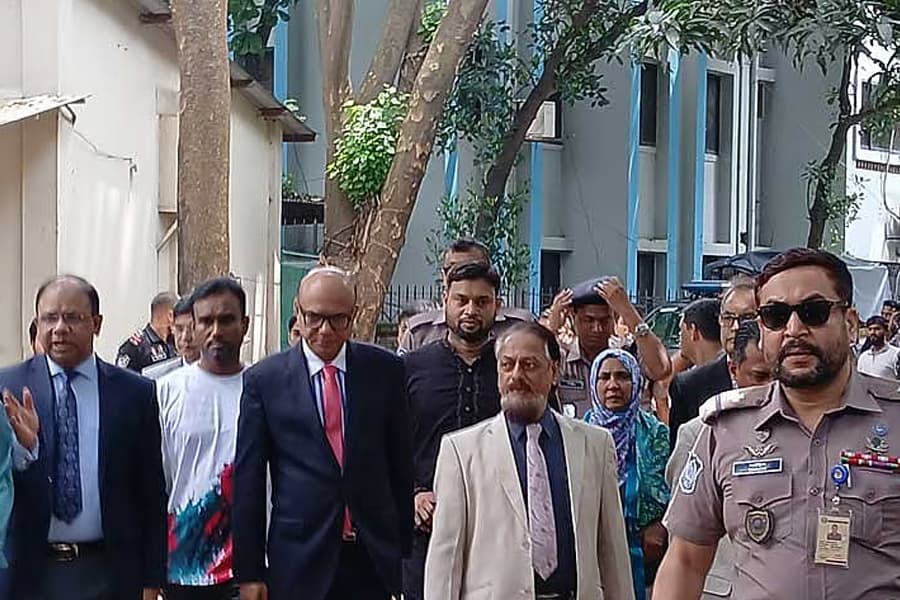
Judges of the International Crimes Tribunal (ICT) have toured an alleged secret detention centre run by the Rapid Action Battalion (RAB) during the Awami League government's tenure.


The judges inspected the Task Force for Interrogation (TFI) cell at RAB-1 Headquarters in Dhaka's Uttara around 11am on Saturday, reports bdnews24.com.
ICT-1 Chairman Justice Golam Mortuza Mozumder, flanked by member judges Safiul Alam Mahmud and Mohitul Haque Enam Chowdhury, led the visit, joined by the prosecution team under Aminul Islam, defence lawyers, investigators, human rights activist Nur Khan Liton, Mayer Daak Coordinator and MP Sanjida Tulee, and journalists.
Chief Prosecutor Aminul said afterwards that Section 539-B of domestic law, Rules 7 and 73 of the Rome Statute, and Rule 46 of the tribunal's Rules of Procedure empower judges to inspect crime scenes, with the tribunal granting the visit following the prosecution's application.
"A trial cannot rest on documents and testimony alone. Inspecting the crime scene is a vital strand of the judicial process," he added.
Branding the TFI cell a "brutal torture chamber", the chief prosecutor said it comprised 29 rooms of varying dimensions, including an unusually cramped basement cell where an average-sized person could not lie flat.
“Evidence shows detainees were blindfolded, shackled and confined here for days, months, even years, and subjected to torture.”
Aminul said BNP leader Salahuddin Ahmed and Barrister Mir Ahamd Bin Quasem Arman, both victims of enforced disappearance, had been held in the cell.
While some detainees were eventually released across different cases, many others were killed, he said, adding that more than 250 disappearance victims, including Ilias Ali, remain untraced to this day.
He said detainees were never produced before a magistrate within 24 hours, nor were their families notified, violating Article 33 of the constitution and Sections 161 and 167 of the Code of Criminal Procedure.
"Unlawful detention, murder and enforced disappearance all constitute crimes against humanity," he said.
Many might dismiss "Ayna Ghor" as myth, Aminul said, but it was very real, and the facility laid bare the character of the previous government and its architects.
"Everyone bearing superior responsibility, those who executed commands on the ground, and the political forces that enabled these crimes must be brought to justice," he said.
Alleging attempts to destroy evidence, he said a wall had been erected to conceal the site, behind which the 29 rooms and the so-called basement death cell were later discovered.
“The role of those involved in concealing or destroying evidence is also under investigation.”
Defence lawyers, however, pushed back against the chief prosecutor's account after the visit.
Tabarak Hussain, representing seven RAB officials, argued TFI was not a fixed location but a multi-agency task force in which RAB's role was confined to secretariat duties.
"TFI cannot be equated with any specific building," he said, rejecting the Article 33 violation claim.
Citing the formal chargesheet, he added that detainees were handed to law enforcers or courts within 24 hours, and that whether torture occurred there was a matter for the court to determine.
Whether torture occurred there, the lawyer said, was a matter for the court to determine.
According to him, such cramped cells are standard in security and provost units for temporarily holding detainees.
He also noted that members of the Commission of Inquiry on Enforced Disappearances had reported not hearing the aircraft or train sounds they expected at regular intervals during their own visit, casting doubt on whether the site was genuinely the “Ayna Ghor”.
"It could well be an abandoned building," he said.
Another defence lawyer ABM Hamidul Mishbah said a failure to produce a detainee within 24 hours might warrant departmental action but could never amount to a crime against humanity.
"There must be a trial, but it must be a fair one. The actual culprit must be identified and punished, and no innocent person should be convicted -- that is the bedrock of justice.”
He added that no evidence had yet surfaced showing his clients violated human rights.
Mishbah said the site inspected bore no resemblance to victims' accounts, though the visit would aid the defence's preparations.
State-appointed lawyer Amir Hossain voiced doubt over whether the site visited was genuinely the alleged Ayna Ghor.
"As a defence lawyer, I believe it may have been built later," he said.
The tribunal had granted the judicial visit following an application from the chief prosecutor on Jul 21, aimed at making the trial more “transparent and impartial” and helping judges grasp the situation on the ground.
The chief prosecutor said a second facility, housed at DGFI's office in Dhaka Cantonment, is scheduled for inspection next Saturday.
Testimony continues in a crimes against humanity case against 17 people, including 12 serving and former army officials, over alleged enforced disappearance and torture at the TFI cell.
The trial began on Dec 23 last year.
Among the suspects are ousted prime minister Hasina, former home minister Asaduzzaman Khan, and former RAB director general Benazir Ahmed.