


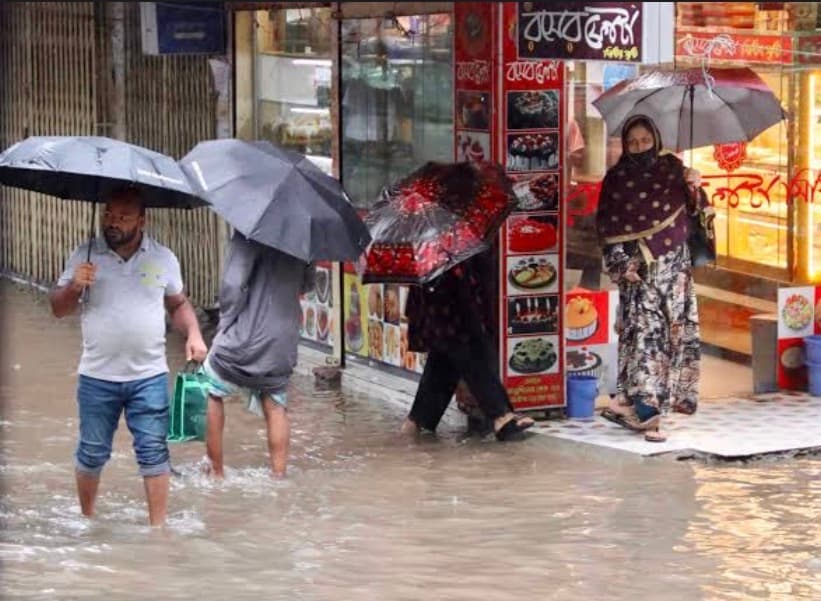
Every monsoon brings out the same distressing reality of Dhaka --- the capital of the country continues to be woefully ill-prepared for dealing with rain. It does not require a heavy downpour for hours to incapacitate the city; a moderate rain for an hour is enough for that, inundating roads, halting transportation, shutting offices and businesses and keeping millions of people stranded.
The consequences of waterlogging go far beyond temporary inconvenience. It intensifies traffic snarls leading to huge costs in terms of productivity. Businesses incur revenue losses while offices and educational institutions find it difficult to function normally. The cost of all these reversals amounts to billions of taka annually.
The question is what makes a capital city so vulnerable that even only 30-35 millimeters of rainfall renders it incapable of functioning properly. Waterlogging in Dhaka has been conveniently attributed to the effects of climate change or heavy rains. However, it is not quite right to put forward such an argument as it would be an attempt to shift the blame away from the root cause of the problem. Rain might set the ball rolling but it is only human intervention which leads to the crisis.
The second most populous city after Jakarta having more than 36 million inhabitants residing in its metropolitan area, Dhaka has grown faster than its infrastructure. Residential areas, malls and offices have developed rapidly where there were once wetlands and lowlands. But drainage systems have not kept up with it. Natural capacity of the city to drain off rainwater has gradually decreased.
Even more harmful impact on Dhaka has been caused by the destruction of canals of the city. Before being turned into a modern city, Dhaka had numerous canals which were connected to surrounding rivers and served as drainage systems helping disposal of rainwater quickly. Most of these canals do not anymore exist and the remaining ones are filled with garbage or illegally encroached upon. The result is obvious - the rainwater that once flowed into the river naturally now accumulates on roads and neighbourhoods.
The authorities cannot avoid responsibility for the consequences. There has been no proper coordination among government agencies concerned in the planning process for many years. One agency builds a road while another pulls it out to lay down utility lines, then comes another that starts doing its job in drainage but fails to complete it for months or even years. This lack of coordination has affected the drainage system of Dhaka badly.
According to surveys, there are over 140 water logging spots in the capital and in each rainy season, new spots prone to waterlogging are discovered. It is worrying that places which did not see any flooding just a few years ago go under water when there is moderate rainfall.
However, focusing only on the authorities' failure would hide another truth. The residents of Dhaka have played a big role in worsening the problem. Every day, tonnes of solid waste are generated all around the city. Much of this never makes its way to designated waste disposal facilities. Instead, plastic bags, food packages, bottles, building material and domestic garbage are simply dumped into drainage systems and water channels, blocking a substantial portion of the city's drainage network.
Citizens must act responsibly to ensure that they do not contribute to waterlogging in the capital while the government has an equal obligation to make sure that conditions for such responsible behaviour exist. An effective waste collection system, proper recycling mechanisms, regular public awareness drives and strict law enforcement cannot be compromised under any circumstances. Otherwise, no significant change can be expected from citizens.
When flooding happens in Dhaka city every monsoon, people and the authorities concerned talk a lot about solving the problem. But almost everyone forget the issue after the season is over and the city people are destined to face fresh flooding next season. In fact, both the government and city population have a critical role here; they need to make bold steps, including a shift in civic culture, to solve the problem. Otherwise, flooding will keep occurring every monsoon leaving the citizens to suffer and the economy to incur losses.
rahmansrdk@gmail.com