The traffic light at Shahbagh had barely turned red when seven-year-old Mim ran toward a line of waiting vehicles with a basket of roses balanced on one arm.
Horns were loud across the intersection as people remained focused on their phones. Rickshaws squeezed between buses and private cars. In that moment, Mim moved from one window to another, repeating, "Please take a flower, miss. Brother, one rose? At least buy one for your girlfriend."
Some shook their heads. Some avoided eye contact. Meanwhile, some reached for their wallets.
A few moments later, the signal turned green, and the vehicles rolled away. Mim stepped back onto the pavement and waited for the next red light. The cycle continues even at night. On a good day, she earns around 200 Tk.
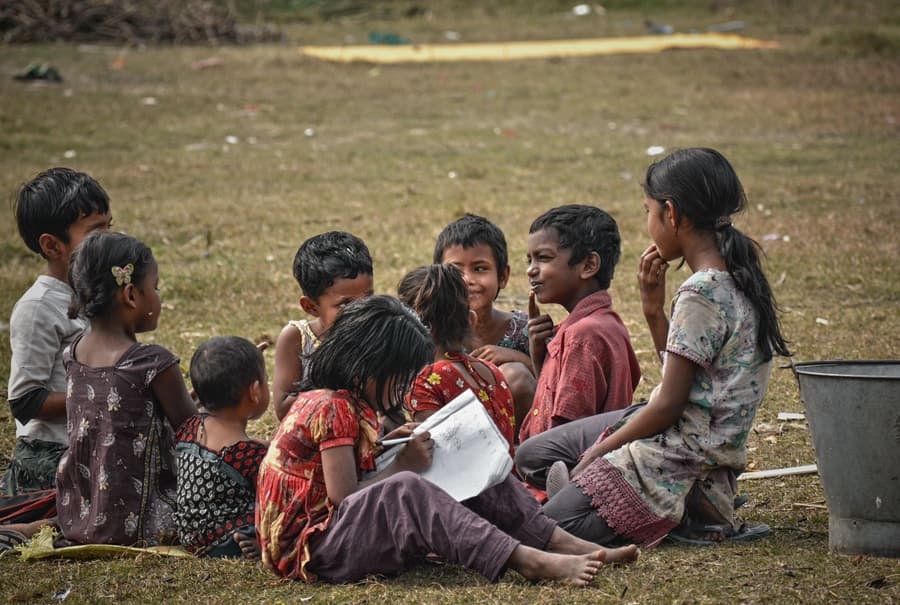
Children like Mim can be seen almost everywhere across Dhaka. When people think of street children, they often assume they are beggars or substance users. While this perception is partly true for some cases, not all street children beg or use drugs; many work and take risks to survive. These children sell flowers, collect recyclable waste, wash vehicles, work in tea stalls, and perform countless other informal jobs that keep parts of the city moving.
In another part of Dhaka, 12-year-old Hasan walks the streets with a large sack over his shoulder, searching for plastic bottles, cardboard, aluminium cans, and other recyclable materials. Whatever has value goes into the sack.
In the evening, once he feels he has collected enough, he heads to a nearby scrap shop. There, the waste is sorted, weighed and bought for a small amount of money. Later, the plastic passes through traders and recycling businesses before eventually returning to the market as new products.
Hasan does not know where the materials go after he sells them. He only knows that a heavier sack means more money. "Some days I collect a lot. Some days I don't," said Hasan.
Across Dhaka, many street-connected children sell flowers, collect recyclable waste, wash vehicles or carry goods. Their work supports small businesses and Dhaka's informal economy, yet their contribution is rarely recognised.
They work long hours, in unsafe conditions, to get through the day. This is why their economy remains invisible.
People notice the flowers, the clean streets or the recycled products. They rarely notice the children whose labour helped make those things possible.
Living with risk
For children like Mim and Hasan, work is part of everyday life. So is risk.
Mim spends her day moving through traffic trying to approach waiting vehicles. She had to step aside when the lights change. In this case, one wrong step can lead to an accident.
Even though Hasan's workplace is different, the dangers remain. As he collects recyclable waste and handles broken glass, dirty plastic, and medical waste with his bare hands, he is vulnerable to cuts, infections, and skin diseases.
Many children also face harassment and violence while working in public spaces.
According to the National Child Labour Survey 2022, around 3.54 million children aged 5 to 17 are engaged in work, while nearly 1.78 million are in child labour.
More than 1.07 million children continue to do hazardous work that threatens their health and safety. Although hazardous child labour has declined since 2013, the overall number of working children has not improved much.
UNICEF's 2024 study estimates that more than 3.4 million children in Bangladesh are living in street situations without parental care.
The study found that poverty and the work search remain the main reasons children end up on the streets. Many reported experiencing violence and exploitation while sleeping in public places without proper shelter.
What is being done?
Child labour has been an ongoing problem in Bangladesh for a long time. To address it, the government has taken various steps over the years.
The government has enacted laws and launched programmes to keep children in school, protect them from hazardous work, and support children at risk.
The Department of Social Services now works with children who need protection. The government has also increased the number of social workers in many areas. People can also call the Child Helpline at 1098 if they see a child in need of help.
Many NGOs are also working with these children. They provide education, healthcare, temporary shelter, counselling and different kinds of training. Some organisations also help children return to school or to their families. They also try to support low-income families so that children do not have to work.
These efforts have helped many children. Some went back to school, while others received protection or reunited with their families.
But the problem is still visible. Every day, children are still being found working, selling flowers or collecting waste on the streets of Dhaka.
This has raised a difficult question. If laws exist, programmes continue, and organisations have been working on the issue for years, why do children remain such a visible part of Dhaka's informal economy?
Why does the problem persist?
Despite years of government programmes and support from development organisations, street-connected children remain common in Dhaka. The reason is that child labour is not only a child protection issue. Rather, it is also closely linked to poverty, education and the informal economy.
According to UNICEF, economic hardship remains one of the biggest reasons children enter the workforce.
When families lose income or struggle to meet daily expenses, children are often expected to contribute financially. Children who leave school are also much more likely to start working, which makes it harder for them to return to education later.
The nature of street work also makes the problem difficult to solve. Unlike factories or large businesses, children work at traffic signals, markets, roadside shops and waste collection points scattered across the city. These workplaces are informal, making regular inspections and enforcement of labour laws challenging.
As a result, while some children leave the streets through rehabilitation programmes, others continue to arrive for the same reasons: poverty, the need to earn an income and limited opportunities.
This means that rescuing children from the streets is only part of the solution. Unless the conditions that push them into work are addressed, the cycle is likely to continue.
The International Labour Organisation also argues that eliminating child labour requires more than enforcing labour laws. It recommends expanding social security for vulnerable families, improving access to education and creating decent employment opportunities for adults so households do not have to depend on children's earnings.
These findings suggest that unless the economic and social conditions that push children into work are addressed, many are likely to be replaced by others facing the same hardships. For children like Mim and Hasan, the challenge is not only leaving the streets but also having a realistic alternative to return to.
maksudasiddiquemaya@gmail.com