


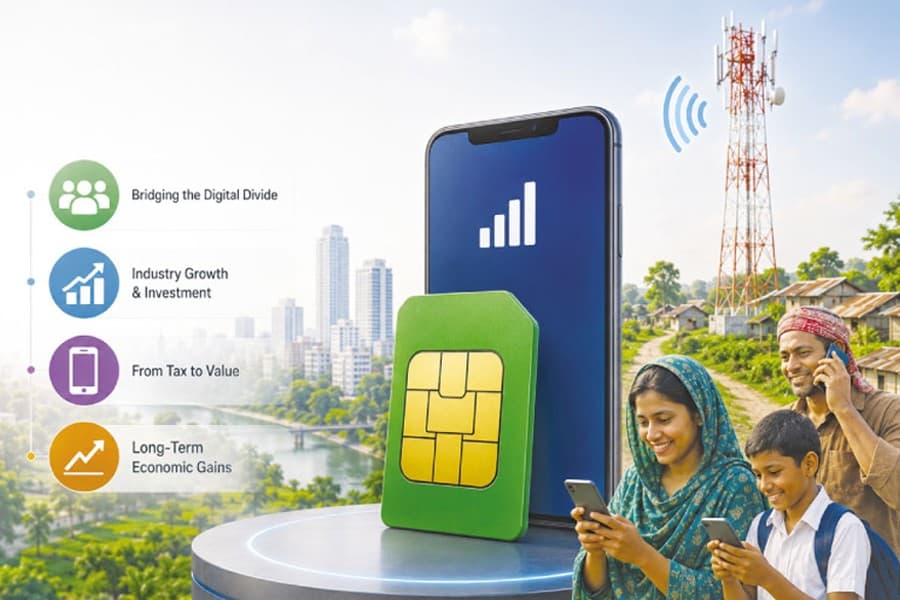
For more than two decades up till now, buying a mobile-phone connection in Bangladesh would come with an unusual price tag: a government-imposed SIM tax that every new subscriber had to pay before making a single call or sending a single message. A remedy is, hopefully, in sight.


The levy had survived multiple technological revolutions -- from basic voice services to smartphones, mobile banking, digital commerce and the rise of artificial intelligence. While the telecommunications industry repeatedly argued that connectivity should be treated as an essential service rather than a luxury product, the tax remained in place, adding a fixed cost to every new connection.
That may finally be changing.
In a landmark move, the proposed national budget for fiscal year 2026-27 seeks to abolish the longstanding SIM tax, replacing it with a standard 15-percent value-added tax (VAT) on the actual sale prices of SIM cards and e-SIMs. Industry leaders have hailed the decision as one of the most consequential reforms for Bangladesh's digital economy in recent years, arguing that it could help connect millions of citizens left out of the digital ecosystem.
The policy shift comes at a crucial moment for Bangladesh, where digital transformation has become a central pillar of economic development. Despite rapid expansion of mobile internet services, a substantial segment of the population -- particularly in rural and low-income communities -- remains disconnected from the fastest-growing knowledge economy.
According to telecom operators, the SIM tax acted as an upfront barrier that disproportionately affected first-time users. While the cost may have appeared modest in urban middle-class households, it often represented a significant expense for rural families, students and low-income working people.
"The removal of the SIM tax can help bring the nearly 40 per cent of the population that remains unconnected into the digital ecosystem, enabling greater access to education, healthcare, financial services and economic opportunities," says Shahed Alam, Chief Corporate and Regulatory Officer of Robi Axiata PLC.
For policymakers seeking to bridge the digital divide, the implications could be far-reaching.
Mobile connectivity increasingly serves as the gateway to public services, online learning, telemedicine, digital payments and e-commerce. Lower entry costs could encourage millions of new users to acquire mobile connections, especially in regions where affordability remains a challenge.
The budget proposal also represents a significant modernization of Bangladesh's telecom taxation framework.
Rather than imposing a flat fee regardless of the actual value of a SIM card, the government intends to align mobile connections with the standard tax regime applied across much of the economy.
"The decision to convert the VAT on mobile SIM cards to a standard value-based system is a timely and welcome initiative," says Lt Col. Mohammad Zulfikar (Retd.), Secretary -General of the Association of Mobile Telecom Operators of Bangladesh (AMTOB). "Under this proposal, the existing specific tax on SIM cards will be withdrawn and replaced with a 15- percent VAT
The reform arrives alongside another measure that has attracted attention from investors: the introduction of a five-year tax-policy framework designed to provide greater predictability businesses of sorts have so far sought.
Telecommunications executives say such policy certainty is critical for an industry that requires billions of dollars in long-term infrastructure investments.
"These measures will help accelerate digital inclusion, attract investment, and further advance the country's digital transformation," says Taimur Rahman, Chief Corporate and Regulatory Affairs Officer of Banglalink. "The vision to increase the ICT and telecom sector's contribution to GDP to 10 per cent within the next five years reflects Bangladesh's strong digital ambitions."
Yet industry leaders caution that waiver of the SIM tax alone will not solve all of the sector's challenges.
While operators welcome the move, they argue that Bangladesh's telecommunications industry continues to face one of the heaviest tax burdens among comparable markets. Corporate income taxes, spectrum-related charges and supplementary duties continue to absorbing significant resources that could otherwise be invested in network expansion and technological upgrades.
Tanveer Mohammed, Chief Corporate Affairs Officer of Grameenphone, has described the budget's five-year tax roadmap as a positive signal for investor confidence but suggested that broader reforms are necessary to unlock the sector's full potential.
Industry groups, including AMTOB, have urged policymakers to pursue additional measures such as rationalising corporate tax rates, removing VAT on network spectrum and revisiting supplementary duties on Over-The-Top (OTT) services that rely on telecom infrastructure.
Behind the enthusiasm surrounding the reform lies a difficult fiscal calculation.
For years, the SIM tax has generated immediate and predictable revenue for the government. Eliminating that income source creates a short-term budgetary cost at a time when fiscal resources remain under pressure.
Economists, however, argue that the government is effectively making a long-term bet on digital growth.
Telecom operators believe the gains could outweigh the losses.
As more citizens come online, demand for data services, digital transactions and online content is expected to rise sharply, creating a virtuous cycle of connectivity and economic participation.
The proposed abolition of the SIM tax, therefore, represents more than a simple fiscal adjustment. It signals a broader shift in how Bangladesh views connectivity itself -- from a taxable commodity to a foundational component of national development.
Whether the policy ultimately succeeds will depend on what comes next. Continued investment in infrastructure, regulatory certainty and further tax rationalisation may be needed to sustain momentum.
But for millions of Bangladeshis who remain on the wrong side of the digital divide, the message is already clear: connecting to the digital world may soon become more affordable than ever before. In a country increasingly defined by its digital ambitions, that could prove to be one of the most important budget decisions of the year.