



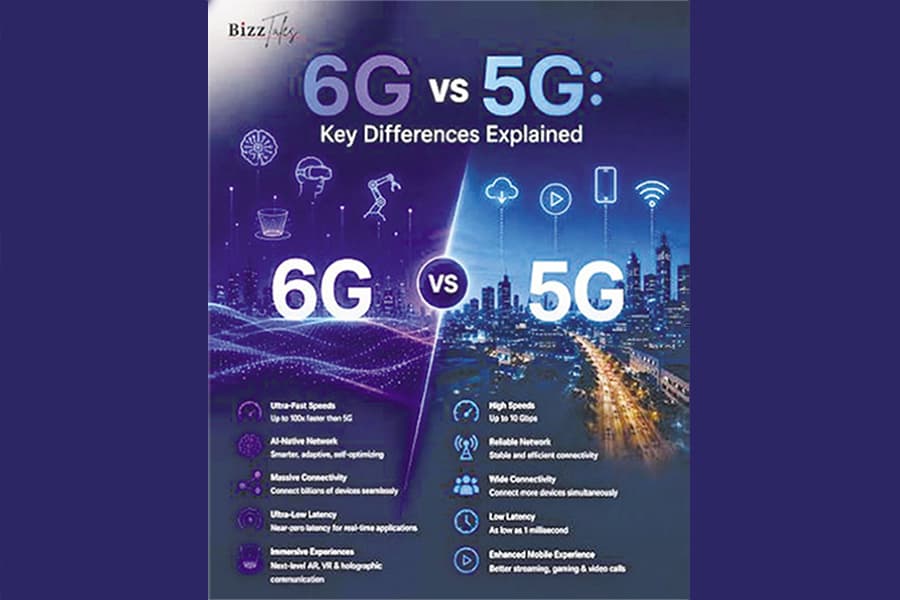
As Bangladesh prepares for the next phase of digital transformation, the debate over future mobile spectrum is becoming increasingly important. While commercial 5G deployment is still in its early stages, the upper 6 GHz (U6GHz) spectrum band-6425 to 7125 MHz-is emerging globally as a critical resource for 5G-Advanced (5G-A) and the eventual transition to 6G. For Bangladesh, timely planning around this spectrum could determine how effectively the country supports artificial intelligence (AI), smart industries and data-intensive digital services over the coming decade.
Positioned between today's mid-band spectrum and millimetre-wave frequencies, U6GHz offers an attractive balance of wide coverage and high capacity. It can deliver significantly greater network throughput than existing mid-band frequencies while maintaining better propagation characteristics than higher-frequency spectrum, making it particularly suitable for densely populated urban centres such as Dhaka, Chattogram and Gazipur.
The importance of U6GHz extends well beyond faster mobile broadband. Global network traffic is changing rapidly as AI-powered services become mainstream. Applications such as generative AI assistants, intelligent cloud computing, industrial automation, extended reality (XR), autonomous systems and machine-to-machine communications are generating unprecedented volumes of both downlink and uplink traffic.
According to International Data Corporation (IDC), the global AI market is projected to exceed US$631 billion by 2028, growing at a compound annual rate of 27 per cent. As AI adoption accelerates across financial services, software, manufacturing, healthcare and retail, communication networks will increasingly carry continuous exchanges between devices, cloud platforms and AI engines rather than simply serving human users.
This shift presents new challenges for mobile operators. Traditional 5G networks were largely designed around heavy downlink demand, where users consume video and online content. However, AI-native applications require strong uplink performance as devices constantly upload images, sensor data, video streams and contextual information to cloud-based AI models before receiving intelligent responses.
This evolution sits at the heart of 5G-Advanced, standardised under 3GPP Release 18. The new generation of mobile technology integrates AI across the radio access network and core network, enabling intelligent traffic management, distributed computing and machine learning capabilities throughout the network architecture.
For Bangladesh, these developments have important strategic implications.
The country's rapidly expanding digital economy is already driving exponential growth in mobile data consumption. Government initiatives promoting Smart Bangladesh, digital financial services, e-commerce, cloud computing and Industry 4.0 will further increase network demand in the coming years. Existing spectrum resources, particularly the widely used 3.5 GHz band for 5G, may eventually prove insufficient to support future AI-driven traffic growth.
Rather than replacing existing spectrum, U6GHz would complement current 5G deployments by providing an additional high-capacity layer. This multi-band approach allows operators to improve user experience in densely populated locations while maintaining nationwide coverage through lower-frequency bands.
Several countries have already begun preparing for this transition. The United Arab Emirates recently became the first country to commercially deploy U6GHz mobile services, demonstrating how early spectrum planning can accelerate 5G-Advanced deployment. The initiative supports the country's ambition to build a 10-gigabit intelligent society while laying the groundwork for future 6G technologies.
For Bangladesh's mobile operators, additional mid-band spectrum could become increasingly valuable as enterprise digitalisation expands. Manufacturing, logistics, healthcare, ports and transport are expected to adopt greater levels of automation, requiring highly reliable, low-latency wireless connectivity capable of supporting real-time data exchange between machines, sensors and cloud platforms.
Consumer services are also evolving rapidly. AI-enabled smartphones, wearable devices, smart glasses and always-on digital assistants continuously generate data for cloud-based processing. Industry forecasts indicate these applications may increase uplink traffic several times over compared with today's typical mobile usage patterns.
U6GHz is therefore expected to play an important role in strengthening what the industry increasingly describes as "Super Uplink" capability-supporting higher upload capacity, lower latency and more consistent network performance in dense urban environments.
Looking beyond 5G-Advanced, U6GHz is also widely regarded as a bridge towards 6G. International discussions on future spectrum planning increasingly identify the upper 6 GHz band as a strong candidate for supporting AI-native wireless networks capable of delivering intelligent, adaptive and highly automated communications.
For Bangladesh, spectrum policy decisions made over the next few years will influence the country's long-term digital competitiveness. As regulators, operators and industry stakeholders consider future spectrum allocations, aligning national planning with global technology trends could help ensure that Bangladesh remains prepared for the next generation of mobile connectivity.
Ultimately, U6GHz should not be viewed merely as additional radio spectrum. It represents a strategic investment in the infrastructure that will underpin AI-driven innovation, digital industries and smart public services. As Bangladesh advances towards 5G-Advanced and eventually 6G, early consideration of U6GHz could help build networks capable of supporting the country's increasingly intelligent and connected digital future.