



Long and inefficient food supply chains are significantly widening the gap between Farmgate and retail prices of essential commodities, contributing to persistent food inflation and weakening consumers' purchasing power, according to a new study by the Centre for Policy Dialogue (CPD).


The study, titled The Food Price Chain: Markets, Margins and Intermediaries in Bangladesh, was unveiled on Thursday at the Brac Centre Inn during a dialogue organised by the CPD.
Commerce Minister Khandaker Abdul Muktadir attended the programme as the chief guest.
The event was also attended by Consumers Association of Bangladesh (CAB) President AHM Shafiquzzaman, BIDS Professorial Fellow Professor Dr M A Sattar Mandal, former BIDS Research Director Dr M Asaduzzaman and Bangladesh Garments Sramik Sanghati President Taslima Akter Lima, among others.
CPD Executive Director Dr Fahmida Khatun chaired the session, while Senior Research Associate Foqoruddin Al Kabir presented the findings.
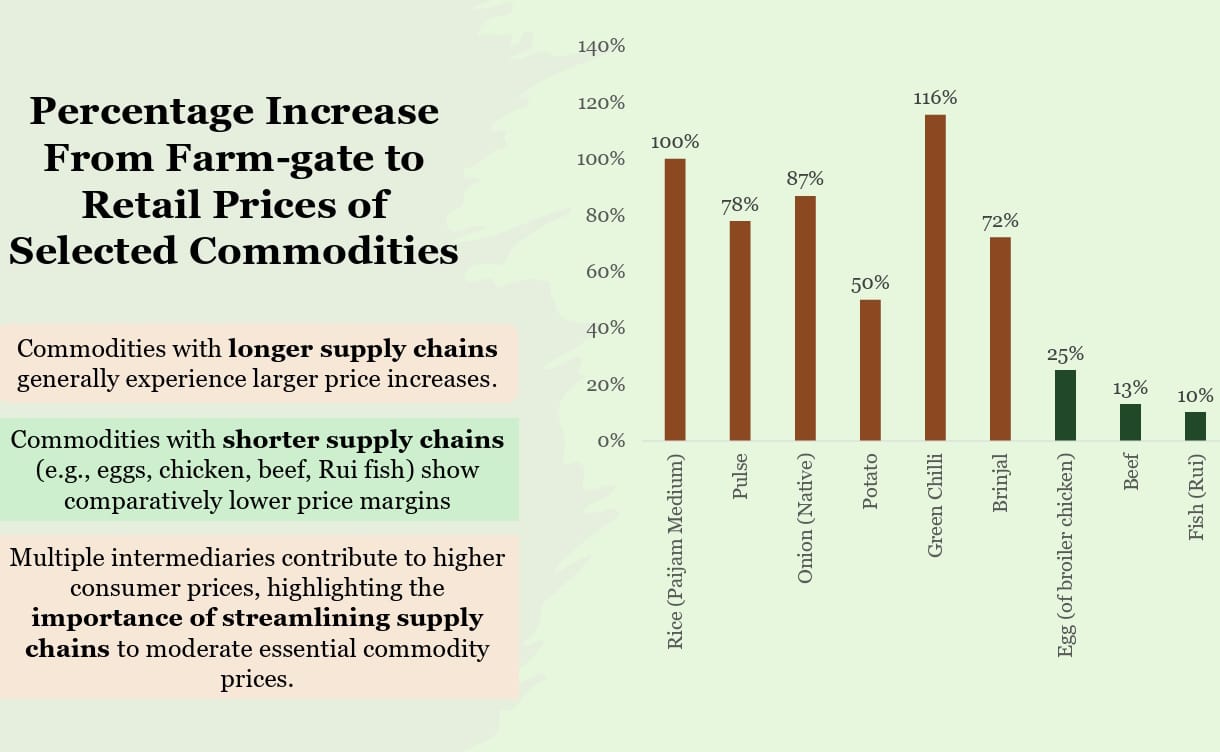
The study found that retail prices of medium-quality rice increase by around 100 per cent from the farm gate to the consumer.
Green chilli recorded the highest price escalation at 116 per cent, followed by onion at 87 per cent, lentil at 78 per cent, brinjal at 72 per cent and potato at 50 per cent.
In contrast, commodities with relatively shorter supply chains experienced lower price increases, including eggs at 25 per cent, chicken at 22 per cent, beef at 13 per cent and rui fish at 10 per cent.
According to the report, longer supply chains generally result in larger price increases, underscoring the need to streamline marketing channels.
The CPD found that retailers rely heavily on urban aratdars (wholesalers and commission agents) to source six of the 10 essential commodities, increasing market concentration, creating imbalances in bargaining power and contributing to price volatility.
It identified supply shortages, trader collusion and hoarding as the most frequently cited reasons for high food prices. However, it cautioned that the study does not establish that intermediaries or market concentration alone are responsible for excessive prices.
The report also examined the growing impact of food inflation on household welfare.
It noted that despite increases in nominal wages, inflation has eroded real earnings, reducing workers' purchasing power and forcing many families to cut consumption, exhaust their savings or borrow to meet daily expenses.
Food remains the largest component of household expenditure, accounting for 59 per cent of the consumer price index basket, while more than 60 per cent of households spend at least half of their income on food.
The burden is greatest on low-income families, with the poorest 5.0 per cent of households spending nearly 60 per cent of their total expenditure on food, compared with 28.9 per cent among the richest 5.0 per cent.
To improve market efficiency, the CPD recommended reducing unnecessary layers in food supply chains, strengthening competition in wholesale markets, improving price transparency, expanding storage and cold-chain facilities, lowering production costs for farmers, and taking stricter action against proven cases of hoarding, collusion and other anti-competitive practices.
tonmoy.wardad@gmail.com