
Bangladesh's skyline is rising at an unprecedented pace, but while thousands of lifts are installed each year, the regulatory framework responsible for ensuring their safety has failed to keep pace.
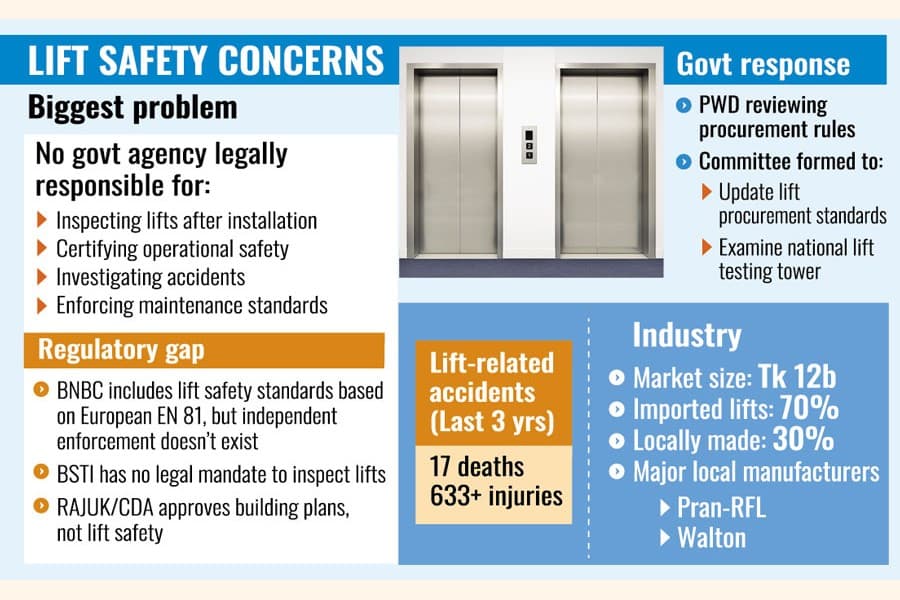
No government agency is legally responsible for inspecting lifts throughout their operational life or verifying that they continue to comply with safety standards after installation.
Although the Bangladesh National Building Code (BNBC) prescribes technical requirements based largely on the European EN 81 safety standards, enforcement remains fragmented, with responsibility divided among several agencies but no single regulator accountable for passenger safety.
The findings are based on interviews with manufacturers, engineers, government officials, and industry associations, together with a review of the BNBC, government procurement discussions, and the existing regulatory arrangements.
Industry executives say the absence of an independent inspection regime has created a regulatory vacuum in a market increasingly supplied by a mix of internationally certified products, locally manufactured lifts, and systems assembled from imported components.
They emphasise that local assembly is not inherently unsafe.
Rather, they argue that without mandatory inspection and certification, building owners have little independent assurance that every lift entering service complies with recognised safety standards.
"There is no comprehensive regulatory framework overseeing the entire life cycle of a lift," says Moinul Islam, chief operating officer of Property Lift, the lift manufacturing business of Pran-RFL Group.
"It remains largely unregulated. No dedicated authority is responsible for monitoring installations, investigating failures, or taking enforcement action where standards are not met."
For millions of Bangladeshis who use lifts every day, the consequences can be severe.
A review of newspaper reports by The Financial Express found at least 17 people had died and more than 633 others had been injured in lift-related accidents over the past three years.
Industry executives believe the actual number is likely to be higher because many non-fatal incidents are never formally reported.
Executives say fatalities tell only part of the story.
Many users, including women, children, and the elderly, experience severe psychological trauma after becoming trapped inside malfunctioning lifts or during power failures.
"The impact goes beyond deaths and injuries," says Md Mahmudur Rahman, chief business officer of Walton Lift and Elevators, a leading local lift manufacturer.
"Many passengers suffer lasting trauma after lift failures. Yet there is no dedicated authority responsible for ensuring proper maintenance, after-sales service, technician training, or regular safety inspections."
As Bangladesh continues to urbanise, lifts have become essential infrastructure rather than luxury equipment.
Yet unlike many countries where specialised regulators conduct periodic inspections and certify lifts throughout their operational lives, Bangladesh relies largely on manufacturers, installers, and building owners to ensure compliance once installation has been completed.
For industry participants, each accident raises the same question: who was responsible for ensuring the lift was safe before its doors opened to the public?
The lift industry here is now estimated to be worth around Tk 12 billion, driven by rapid urbanisation, rising land prices, and strong demand for high-rise residential and commercial buildings.
Industry estimates suggest around 70 per cent of the lifts sold in the country are imported, while the rest are manufactured locally, primarily by Pran-RFL Group and Walton.
International brands from Finland, Spain, Korea, China, and other countries compete alongside domestic manufacturers and a growing number of smaller assemblers.
The expanding market has increased competition and widened consumer choice, but it has also exposed weaknesses in the country's regulatory framework.
Industry executives say the debate over lift safety begins long before a product is installed in a building.
Unlike many electrical appliances, a lift is a complex engineering system whose safety depends on the performance of dozens of interconnected mechanical and electronic components.
Braking systems, guide rails, traction machines, door interlocks, overspeed governors, controllers, and emergency rescue devices must function together under different operating conditions throughout the lift's life.
Before entering the market, internationally recognised manufacturers subject new lift models to extensive testing to verify their compliance with safety standards.
Those tests are carried out in specialised testing towers, where engineers evaluate braking performance, free-fall protection, overspeed operation, emergency stopping systems, vibration, load capacity, and other critical safety features.
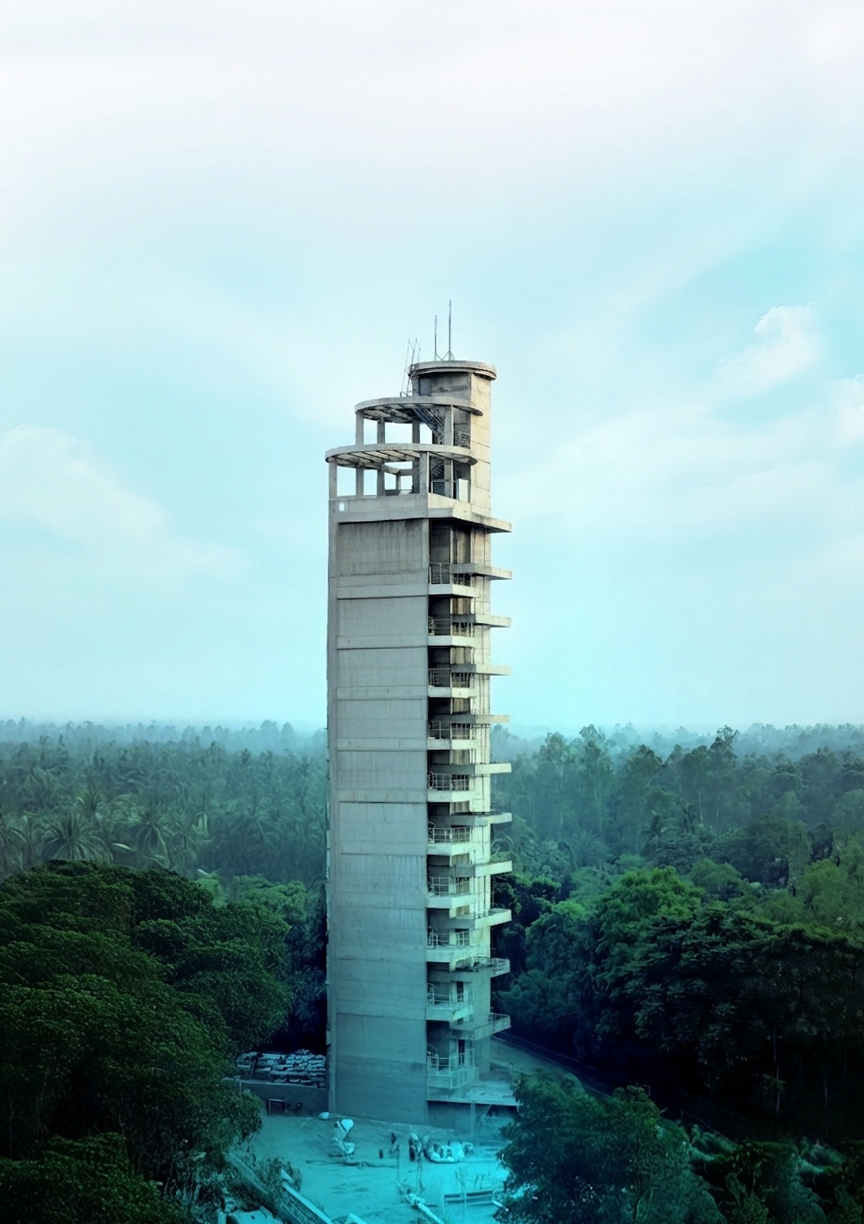 Lift testing tower of Walton Lift
Industry executives estimate that building a modern testing tower requires an investment of at least Tk 200 million, as well as a large site, placing such facilities beyond the reach of many smaller operators.
At present, only a handful of domestic manufacturers, including Pran-RFL Group and Walton, have invested in testing towers as part of their manufacturing operations.
Many smaller businesses, by contrast, operate primarily as assemblers.
They import motors, controllers, doors, guide rails, and other components from different overseas suppliers before assembling the finished lift locally.
Industry executives stress that assembly itself is not unusual as global manufacturers also source components internationally.
"The issue is not whether a lift is assembled locally," one executive says. "The issue is whether an independent authority verifies that the completed system meets recognised safety standards before passengers begin using it."
Without mandatory inspection and certification, consumers have little means of distinguishing between lifts that have undergone comprehensive engineering tests and those assembled with more limited quality assurance.
Manufacturers who have invested heavily in testing facilities argue that the current regulatory framework places compliant producers and less-regulated operators on an uneven competitive footing. The rapid expansion of the industry has also given rise to another concern.
Executives from several authorised distributors have told The Financial Express that some operators assemble lifts from components sourced from different countries before marketing the finished products under internationally recognised brand names.
According to industry participants, the practice allows developers to purchase lifts at significantly lower prices than fully imported systems supplied through authorised distributors.
"There are many unethical practices in the market," says Enamul Kabir, chairman of Khan Brothers, the authorised distributor of Sigma lifts in Bangladesh.
He alleges that some businesses use internationally recognised brand names even though the lifts are assembled locally from components imported from multiple countries.
"A building owner may believe an internationally manufactured lift has been installed," Kabir says. "In reality, only some components may have originated from that manufacturer, while the rest were sourced elsewhere and assembled locally."
He says his company identified several such cases but did not pursue legal action against those involved.
Industry executives argue that the absence of an independent certification authority makes it difficult to verify product origin and compliance with safety standards before lifts enter service.
They say an effective regulatory framework should require manufacturers and suppliers to provide documentary evidence of product certification and conformity with the BNBC before installations are approved.
Without such oversight, they argue, purchasing decisions depend largely on marketing claims rather than independent verification.
BNBC contains detailed provisions governing lift installation and safety, incorporating many of the technical requirements of the European EN 81 standard.
Developers must also obtain approval for building plans from urban development authorities, such as Rajdhani Unnayan Kartripakkha (RAJUK) in Dhaka or the Chattogram Development Authority (CDA), before construction begins.
Industry participants say the problem is not the absence of technical standards but that of an institution responsible for enforcing them after installation.
Officials at the Bangladesh Standards and Testing Institution (BSTI) say the agency currently lacks the legal authority to inspect or certify every lift installed in the country.
"We inspect certain engineering products, but the government has not given us the mandate to regulate lifts," says Arafat Hossain, a deputy director at BSTI.
Urban development authorities approving building plans also say lift safety falls outside their responsibilities.
Bangladesh has at least 11 urban development authorities, including RAJUK and CDA.
Their primary role is to ensure that buildings comply with approved designs and planning regulations rather than inspecting lifts after installation.
"We verify whether a building has been constructed according to the approved design," says Md Abul Hasnat, public relations officer at CDA. "We do not inspect lifts or determine whether they comply with the Bangladesh National Building Code."
The result, industry executives say, is a fragmented regulatory framework in which compliance depends largely on manufacturers, installers, and building owners rather than independent inspection.
The regulatory gap has also become apparent in government procurement.
The Public Works Department (PWD), one of the country's largest purchasers of lifts and escalators, accounts for an estimated 10 per cent of the annual demand through hospitals, office buildings, and other public infrastructure.
Officials familiar with the matter say the department recently reviewed its procurement framework to end lengthy procurement procedures and the absence of comprehensive guidelines for evaluating different categories of lifts.
The review concluded that the existing Schedule of Rates (SOR) required updating to reflect technological advances and changing market conditions.
A committee has since been formed to recommend revisions to procurement rules and examine the feasibility of establishing a national lift testing tower.
Industry executives welcomed the initiative, arguing that an independent testing facility would strengthen safety oversight while improving confidence in locally manufactured products.
Despite regulatory concerns, Bangladesh's domestic lift manufacturing industry has expanded rapidly.
Property Lift, a strategic business unit of Pran-RFL Group, invested about Tk 2.0 billion in a manufacturing facility at Palash in Narsingdi, while Walton has also invested in manufacturing and testing infrastructure at Chondra in Dhaka.
According to the company, a locally manufactured six-passenger lift costs Tk 1.8-2.0 million, compared with about Tk 3.0 million for a comparable imported model.
Its Managing Director RN Paul says the company manufactures lifts in accordance with internationally recognised standards and plans to expand exports to neighbouring countries, the Middle East, and Africa.
Industry executives say stronger domestic manufacturing could reduce import dependence, conserve foreign exchange, and create skilled jobs.
But they argue that long-term growth will depend as much on regulatory credibility as manufacturing capacity.
The government has enacted legislation establishing the Bangladesh Building Regulatory Authority (BBRA), which is expected to oversee the enforcement of BNBC in areas outside the jurisdiction of urban development authorities.
However, the authority is yet to become operational, and industry participants say its mandate should explicitly cover lift inspection, certification, and enforcement.
jasimharoon@yahoo.com