


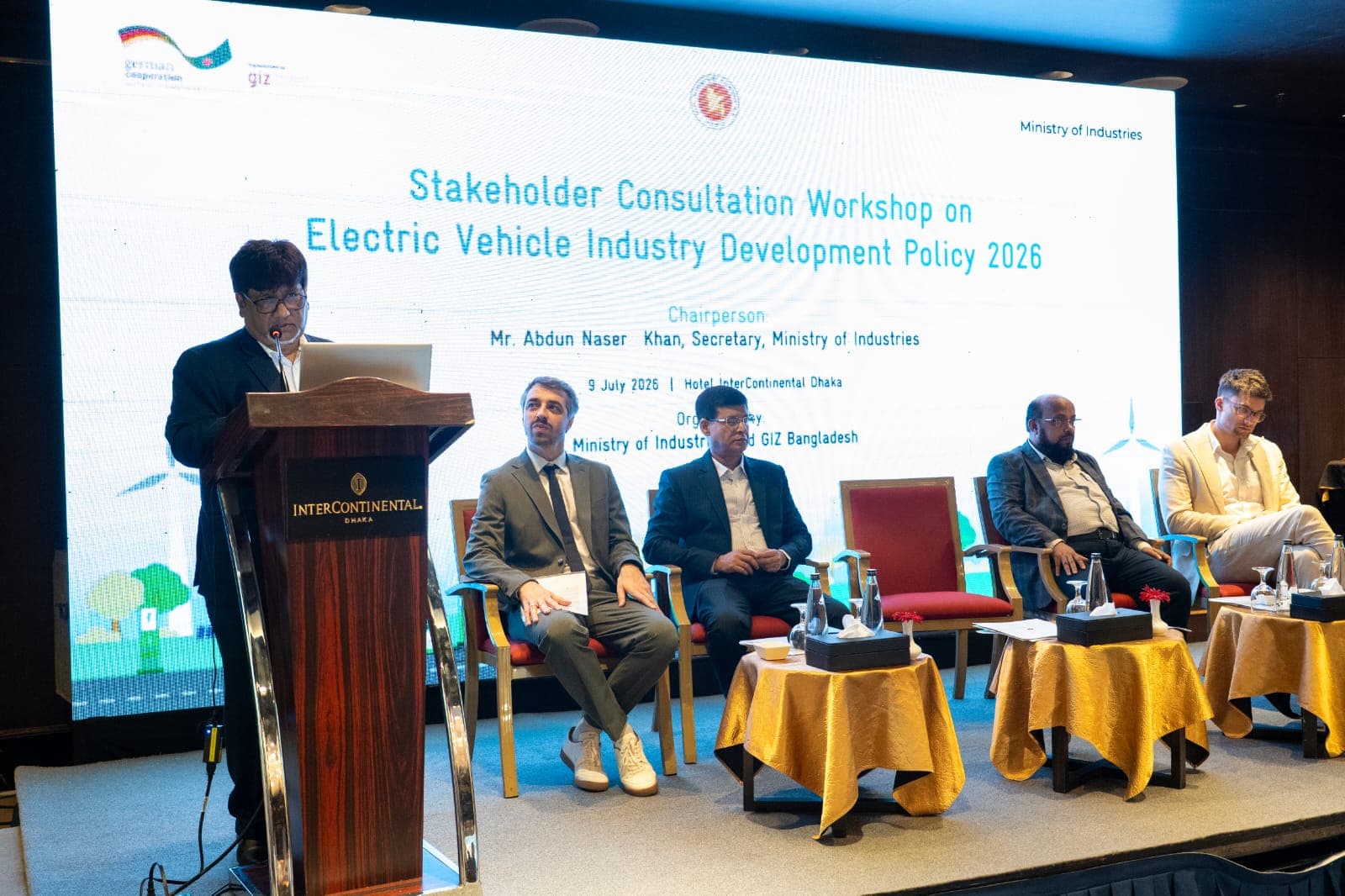
To develop a structured roadmap for Bangladesh's rapidly growing electric vehicle (EV) sector, the Ministry of Industries, in collaboration with GIZ Bangladesh, hosted a milestone Stakeholder Consultation Workshop on the Electric Vehicle Industry Development Policy 2026 today (Thursday).


The consultation focused heavily on optimizing industrial and regulatory frameworks to meet the government’s ambitious goal of 30% EV penetration across transport modes by 2030, a directive formalized under the Electric Motor Registration and Operation Guideline 2023, according to a media release.
With road transport accounting for 81% of the country’s transport sector emissions, a regulated transition to e-mobility has become both an environmental and economic imperative.
Presiding over the workshop, Abdun Naser Khan, Secretary of the Ministry of Industries, said, “If Bangladesh fails to prepare adequately today, we will not only miss out on an emerging industrial sector, but also risk falling behind in the Global Value Chain (GVC). It is precisely this reality that inspired the Ministry of Industries to craft a forward-looking, comprehensive policy framework. Our target is not merely to become an importer of electric vehicles. Our ultimate goal is to establish Bangladesh as an EV manufacturing nation.”
Representing German Development Cooperation, Jannis Hussain, Deputy Head of Cooperation at the German Embassy, and Mark Gombert, Country Director of GIZ Bangladesh, highlighted Germany’s ongoing commitment to supporting Bangladesh's transition toward sustainable mobility.
Through the ‘Transition to Sustainable E-Mobility’ (Trans2SMo) project, commissioned by the German Federal Ministry for Economic Cooperation and Development (BMZ) and implemented by GIZ, technical and advisory support is being provided directly to the Ministry of Industries in formulating the EV Policy.
Under the proposed policy framework, the Total Tax Incidence (TTI) on electric motorcars imported in Completely Built-Up (CBU) condition will be fixed at 37% until 2030, while the TTI across all EV categories imported in Completely Knocked-Down (CKD) condition will be fixed at 15.25% until 2035 to encourage local assembly and manufacturing. This complements key fiscal incentives, such as a 10-year income tax exemption for institutions establishing EV charging stations.
The event concluded with a strong emphasis on continuous mass transport modernization and public-private synergy.
Moving forward, the collaborative network of the Ministry of Industries, the Power Division under the Ministry of Power, Energy and Mineral Resources, the Road Transport and Highways Division, BRTA, NBR, LGD and other stakeholders will continue driving the necessary technical, industrial, and administrative executions.
AKM Benjamin Riazi, Additional Secretary (Policy, Law and International Cooperation), and Md. Nuruzzaman, Additional Secretary (Administration), Ministry of Industries, also spoke at the event attended by automotive industry leaders, climate experts, and international development partners, the release adds.