



Bangladesh’s banking sector has arrived at a critical crossroads. Currently, the financial landscape is strained by a triad of systemic challenges: high non-performing loans, a widening capital shortfall, and the crowding out of private investment by heavy government borrowing. These challenges are not isolated incidents but rather the cumulative result of prolonged gaps in governance, enforcement, and institutional accountability.
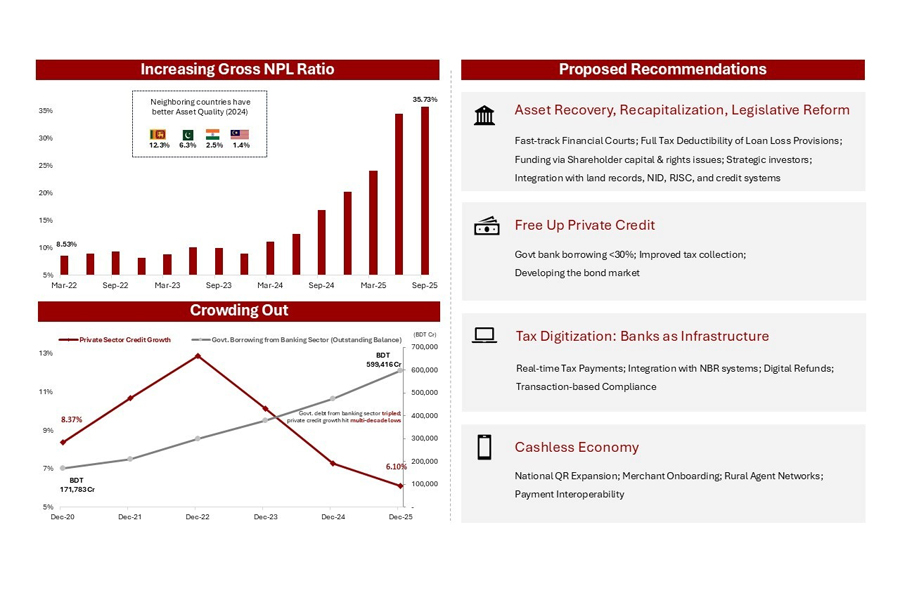
As of September 2025, Bangladesh’s Gross NPL ratio had escalated to 35.73%, painting a stark picture of poor asset quality. This figure is particularly concerning when viewed in a regional context, as it stands in sharp contrast to the significantly lower ratios maintained by neighbouring peers.
Banks faced a substantial loan loss provision shortfall of BDT 1.06 trillion in 2024, an increase of BDT 868.70 billion compared to the previous year. The World Bank assessed that restructuring Bangladesh’s banking system requires at least 10% of GDP for recapitalisation, which equates to BDT 5.5-6.0 trillion.
Fast forward to December 2025 from December 2020, outstanding govt. Domestic debt from the banking sector more than tripled to BDT 5.99 trillion. Meanwhile, private sector credit growth hit one of the lowest in decades at 6.03% in January 2026.
Addressing this crisis must be a national economic priority - not merely a banking sector concern. We urge the government as well as the policymakers to take timely, decisive action across several key areas. Some require budget allocations; others require legislative resolve. But all of them require political will.
First - Asset Recovery Framework
The first crucial reform must be a robust Asset Recovery Framework. Drawing on models from Malaysia, South Korea, and the Philippines, it is evident that recovery requires more than just policy; it demands independent valuation and genuine political backing to enforce accountability. Alongside preparing a unified task force, Bangladesh needs to fast-track financial courts, maintain time-bound insolvency protocols, and invest in forensic accounting and international asset tracing to recover stolen assets. Overall, operationalising this framework would require a targeted budgetary commitment of BDT 30.0 to 50.00 billion.
To support this recovery culture, allowing full tax deductibility of loan loss provisions would be critical. Ensuring banks are not taxed on unrealised income will encourage transparent NPL recognition, facilitate faster recovery, and build stronger financial stability across the banking sector.
Second - Collateral and Mortgage Reform
The second reform can be establishing a unified digital collateral registry, covering land, apartments, machinery, inventory, receivables, and shares to strengthen transparency and credit discipline. An allocation of Tk 30.0 billion is needed for digitisation and integration with land records, NID, RJSC, and credit systems, curbing multiple pledging and unlocking SME financing.
Third - Structured, Conditional Recapitalisation of Banks
A comprehensive recapitalisation of the banking sector is crucial, the majority of which should be raised from shareholders through rights issues, strategic investors, and Tier-2 instruments. Public funds, ranging from BDT 500 to 800 billion annually, may be reserved for systemic institutions only, strictly conditional on the delivery of reforms, to avoid repeating past patterns of unaccountable capital injections.
Alongside recapitalisation, reducing corporate tax on banks to 28-30% (from 37.5-42.5%) will align with global standards of tax rate, strengthen capital adequacy under Basel III, and expand lending capacity for SMEs, trade, and industry, directly supporting the budget's growth and job creation objectives.
Fourth – Employment Creation Through Banking
Beyond financing businesses, banks are key engines of job creation. An MSME and employment-linked credit framework, supported by a BDT 100 -150 billion credit guarantee fund, can provide targeted support, combining BDT 40-60 billion for interest subsidies tied to job creation and Tk 150-200 billion for industrial modernisation in textiles, focusing on synthetic and technical upgrades.
Drawing lessons from India’s PLI scheme and Tamil Nadu’s textile initiatives, structured incentives can drive large-scale employment. However, to ensure financial discipline and traceability, these funds must be channeled through commercial banks rather than direct government grants.
Fifth – Reduce Government Borrowing from Banks
Outstanding government debt from the banking sector jumped to 55.3% of domestic debt in Dec’25, up from 32.1% in Dec’20. Under these conditions, asking banks to expand SME and private sector credit is like asking someone to run with a weight tied to each leg.
Government borrowing from banks must be reduced gradually to below 30% of total borrowing. Achieving this requires stronger tax collection to narrow the fiscal gap, disciplined public spending, and accelerated development of the domestic bond market and institutional investor base.
Otherwise, private sector growth will continue to be crowded out.
Sixth – Tax Collection and Role of Banks
To curb aggressive government borrowing and mitigate the crowding-out of private investment, revenue mobilisation must become a primary fiscal priority. With Bangladesh’s tax-to-GDP ratio currently below 7.0%, the banking sector is uniquely positioned to act as a strategic partner in modernising tax administration.
A BDT 20–30 billion allocation to integrate tax digitisation directly into the banking infrastructure can create a high-impact, reciprocal partnership: the government secures a more robust revenue stream, while the banking system benefits from reduced public sector credit demand and a more liquid private lending market.
Seventh – Cashless Economy and Digital Payments Interoperability
The last reform cannot but be a shift toward a cashless, fully interoperable economy. A BDT 25-40 billion allocation should support national QR code expansion, merchant onboarding, rural agent networks, and the infrastructure required for seamless interoperability.
However, funding alone is not sufficient. Bangladesh Bank must mandate full interoperability between all mobile financial service providers and commercial banks within 18 months, using technical standards set by the central bank rather than relying on voluntary agreements among competitors.
India achieved this through its Unified Payments Interface, handling $2.5 trillion in annual transactions and 14 billion transactions per month, while Brazil saw similar success with Pix. With strong mobile penetration and an established banking infrastructure, Bangladesh now needs the regulatory mandate and investment to build these shared digital rails.
Finally, the success of the things I have mentioned hinges on the operational independence of Bangladesh Bank. Such autonomy fosters an institutional credibility that fiscal allocations alone cannot provide. By prioritising these reforms, the banking system can restore public confidence and re-establish itself as the essential foundation for sustainable growth, investment, and employment in Bangladesh.
Let’s act now or finance the fallout.
The writer is Sharif Zahir, Chairman of United Commercial Bank