
There is often a reluctance to discuss military matters in public. In mainstream discourse, far more attention is devoted to diplomacy, development and cooperation and there is nothing wrong with that preference as far as it goes. But when wars are raging on multiple fronts across the world including in Bangladesh's immediate neighbourhood and when some of those wars continue to challenge long-held assumptions about traditional warfare, it is only sensible to ask whether our own armed forces are prepared for the realities of modern conflict. After all, refusing to confront a country's military weaknesses in peacetime is an invitation to discover them in crisis.
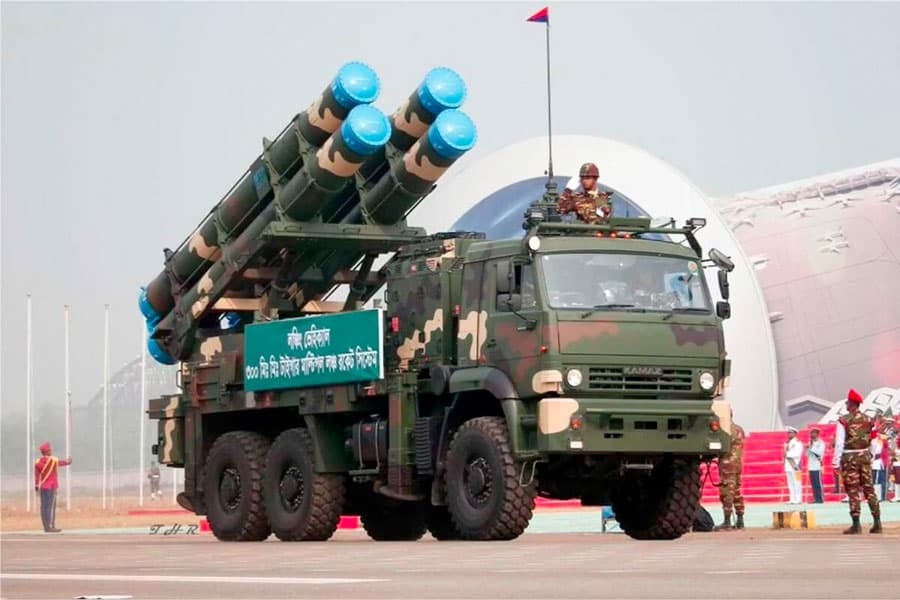
The military remains one of the few institutions in Bangladesh that commands genuine public respect. That respect, however, does not change the reality that its actual strength falls short when assessed against contemporary security challenges and operational expectations. The Independence Day parade held on March 26 after a long gap offered the public a fresh look at the equipment currently in service with the armed forces and, as expected, it drew a wave of dismay online. Such reaction was hardly surprising. Today's audiences observe modern warfare unfolding in real time where precision munitions, fifth-generation aircraft and cheap loitering drones have fundamentally changed the nature of combat. Against that backdrop, much of the hardware paraded before the nation appeared to belong to a previous era altogether. By all appearances it seemed, the 8th most populous country on earth marking 54 years of independence now fields armed forces, the technological standing of which neither projects strength nor provides a credible basis for deterrence.
There are those who would argue that ours is a peaceful country with no territorial ambitions and no quarrel with anyone, and therefore no one will threaten Bangladesh. That argument is historically illiterate. The vast majority of countries invaded throughout history did nothing to provoke the power that attacked them. This is because aggression is not primarily a response to provocation but to vulnerability. Ukraine did not threaten Russia before the invasion of 2022. Moscow simply calculated that Ukraine was sufficiently weak and moved to seize territory by force. In a similar vein, perceptions of Iranian weakness after internal unrest and decades of sanctions led the United States and Israel to launch major military operation. The political leadership in Washington and Tel Aviv believed that the government in Tehran was so enfeebled that it would last only a few days if attacked.
Apparently, that confidence was not without basis. Combined American and Israeli military budgets dwarf Iran's by a factor of at least one hundred, and their technological advantages are also similarly vast. Yet this massive asymmetry failed to produce the rapid and decisive outcome they expected, and arguably, they emerged as the larger losers. This does not mean Iran emerged unscathed. Its military installations suffered heavy damage and its armed forces absorbed significant losses. Nevertheless, Iran retained the capacity to fight back and impose costs on its adversaries. As a result, the war that was supposed to last days became a conflict the US could not bring to a close on its own terms. So how did this happen? Three reasons actually, and each carries a direct lesson for Bangladesh.
The first is Iran's domestic defence industry. Shut out of Western arms markets by sanctions for decades, Iran had no choice but to build its own. Over time, that necessity produced a state-owned industrial complex capable of manufacturing wide range of military equipment including armoured vehicles, MANPADs, UAVs, missiles and submarines. Few of these systems match the most sophisticated Western technologies but that was never the point. What mattered was that they could be produced domestically, repaired domestically and replaced domestically. That self-sufficiency in arms production changed the strategic equation entirely. Iran was able to field its weapons in large quantities precisely because it made those itself, while its adversaries found themselves burning through irreplaceable stockpiles simply to defend against them.
Second reason is education and research. The weapons Iran has today did not emerge from nowhere. They are the product of decades of deliberate investment in the scientific foundations required to build them. Iranian universities have developed advanced programmes in aerospace engineering, missile guidance systems, drone propulsion and nuclear physics, and the research produced within those institutions feeds directly into the defence industry.
The third is infrastructure built to survive attack. Missile storage sites, weapons production facilities and launch infrastructure were placed inside mountainous terrain and buried within underground complexes designed to survive sustained aerial bombardment. When two of the world's most capable air forces ran an extensive campaign against them, much of that capacity survived intact. A country that can absorb punishment and still strike back is a country that cannot be quickly defeated and that endurance, more than any single weapon or battle, is what denied the attacking powers a swift victory they had counted on.
Bangladesh has none of these three things. There is no meaningful defence industrial complex and no electronics sector oriented towards weapons development. This is, however, not necessarily a reflection of institutional shortcomings within the armed forces themselves. The Bangladesh military has demonstrated through a range of commercial and engineering undertakings that it is capable of managing large and complex projects with discipline over the long term, which means the capacity for institutional ambition is present. What is absent though is the political will to direct it towards defence production and the governmental framework to support such an effort.
Bangladesh does not need to become a military superpower, nor does it need to match the arsenals of larger neighbours. But it does need a serious reckoning with the foundations of national sovereignty, one that moves deliberately towards greater self-reliance. Iran's experience demonstrates that such a transition is achievable, even from a position of isolation and constraint. Naturally, a credible defence capacity will not emerge overnight. It will definitely not emerge without a decision made at the highest levels of government that building one is a national priority worth pursuing.
showaib434@gmail.com