
Though earnings from exports of goods and services are critical to the country's balance of payments (BoP), it is not possible to increase them significantly within a few years. The growth of exports depends on factors including the strength of export-oriented sectors, global demand, barriers to market access, the domestic business environment, and the country's trade policy. If global demand slows, a strong industry may not realise its full capacity. Also, due to supply-side constraints, higher international demand is unlikely to boost export earnings.
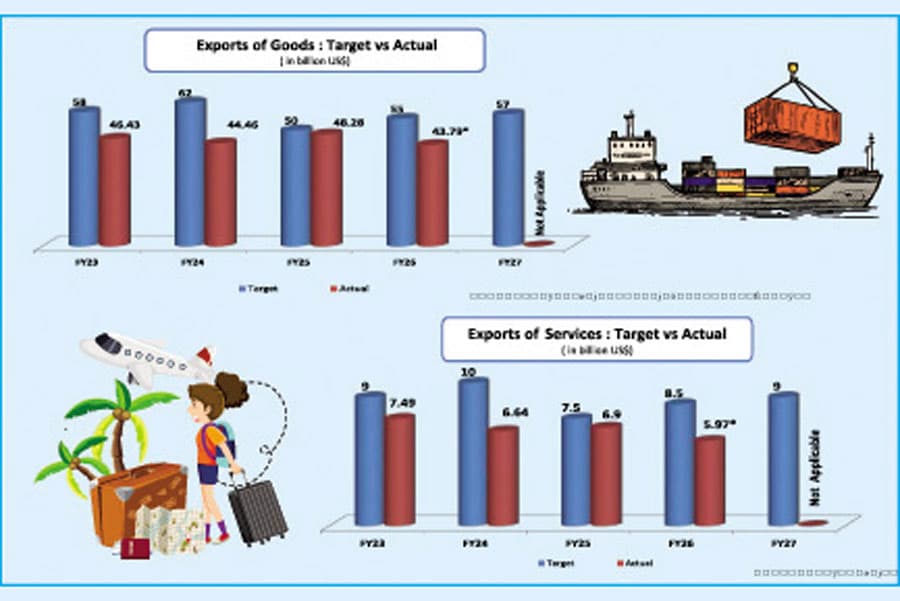
Nevertheless, there is a tradition in Bangladesh and other countries of setting an annual target for export earnings. For the current fiscal year (FY27), the government has set targets of US$57 billion in earnings from exports of goods and US$ 9 billion from exports of commercial services. Thus, the total export earnings target for the current fiscal year is set at $66 billion.
Statistics from the Export Promotion Bureau (EPB) revealed that actual export earnings did not meet targets in the last couple of years. For instance, the government set a target of $58 billion for FY23, but actual earnings from goods exports stood at $46.43 billion. In FY24, the target was $62 billion, while actual export earnings reached $44.46 billion. The autocratic regime of the now-ousted Hasina government set overambitious targets to secure political applause.
In a bid to set a rational target, the government set it at $50 billion for FY25, and final earnings from merchandise exports were $48.28 billion. The target for FY26 was $55 billion, and actual earnings in 11 months reached $43.79 billion, according to EPB. Even if export earnings in June were $5 billion, total annual exports would still fall short of the FY26 target.
There is, however, a persistent decline in exports to gross domestic product (GDP) ratio over the last couple of years. The ratio of exports of goods and services to GDP was 13.16 per cent in FY23, which fell to 10.46 per cent in FY24 and improved modestly to 11.12 per cent in FY25. It then again dropped to 10.18 per cent in FY26, according to an estimate by the Bangladesh Bureau of Statistics (BBS). This means the contribution to GDP is slowly declining, as real export growth does not keep pace with the economic growth. It also indicates vulnerability of the export sector. Finance and Planning Minister Amir Khosru Mahmud Chowdhury, in his budget speech last month, said: "Our export sector remains highly vulnerable due to an overdependence on a narrow product base and limited market diversification."
Nevertheless, it is important to set an annual target for earnings from exports, as the target reflects the country's ambition to widen the international market for its various products. It also indicates the productivity of the country's export-oriented industries, though sector-wise targets provide a better indication. For policymakers, the target serves as a performance benchmark for the external sector. For exporters, it is a yardstick for measuring their overall success.
For many years, the Ministry of Commerce has been setting annual export targets for goods. Setting the target for services started in FY22. Commercial services account for the majority of total services, while the remaining services are divided into government and other services.
Commercial services are usually divided into four broad sectors: (i) transport, (ii) travel, (iii) goods-related services, and (iv) other commercial services. The trade in commercial services refers to intangible transactions involving services or related activities across nations.
Setting the target for exports of goods is easier than for services. This is because the nature of services trade is more complicated and harder to estimate. Physical movement of goods is visible and can be counted by volume and value, whereas services are largely intangible, making them difficult to quantify. Measuring service exports requires sophisticated tools and skills.
At present, one-fourth of the global trade is trade in services. According to the World Trade Organization (WTO), last year, the value of world merchandise trade, as measured by exports, was US$26.26 trillion, while trade in services reached US$9.56 trillion. Thus, the total value of goods and services trade last year stood at $34.65 trillion.
In Bangladesh, trade in services is also growing gradually, and at present it accounts for 14 per cent of total trade on average. Exports of services stood at around $7 billion in FY25 and $6 billion in the first 10 months of FY26, as per statistics furnished by EPB. The BoP data on services trade, estimated by Bangladesh Bank, is slightly lower than the EPB data due to some adjustments.
In the coming days, trade in services will be more critical as rapid digitalisation and the expansion of artificial intelligence (AI) are changing the landscape of global trade. That's why the WTO, in its Global Trade Outlook and Statistics released four months ago, pointed out that the growth of AI-related investment, as a larger share of investment, could boost the trade intensity of growth in the near future.
The outlook report, however, projected that world trade is set to slow this year after a strong surge last year. Merchandise trade volume growth may slide from 4.6 per cent in 2025 to 1.9 per cent in 2026, but is likely to increase up to 2.6 per cent in 2027, according to the WTO's primary forecast. The volume of trade in services is also expected to grow by 4.8 per cent in the current year, from 5.3 per cent last year, though it may rise by 5.1 per cent next year. The forecast was released when the Middle-East conflict had intensified due to the US-Israel's joint attack on Iran. Taking the negative impact of the war into consideration, the report said: "Given that the Gulf region is a major exporter of both energy and fertilizers, a prolonged interruption in supply could ripple across food systems, exacerbating the effect of pre-existing export restrictions."
Meanwhile, the UN Conference on Trade and Development (UNCTAD), in its Global Trade Update (April 2026), also cautioned that global trade growth is expected to slow later in 2026 due to persistent trade tensions and rising trade costs. The report also cautioned that the ongoing conflict in the Middle East and the shipping disruptions in the Strait of Hormuz would intensify inflationary pressures. "Rising energy prices, together with higher trade costs linked to tariffs, regulatory changes and the erosion of trade rules, further cloud the outlook," it added.
The Middle East has intensified further, after a brief pause, as the United States (US) resumed attacks on Iran last week. Iran has also started to retaliate by attacking US bases and infrastructure in the region. As a result, global trade growth has come under serious threat, which may prompt many countries to adopt protectionist trade policies. This will also shrink exports from countries like Bangladesh, making the attainment of export targets more difficult in the coming days.