



Muhammad Mahmood’s article, “Global Economy in 2026,” (FE, P-4 July 26, 2026) is both timely and important. The global economy is unquestionably under severe stress. War in the Middle East, renewed pressure on energy prices, geopolitical fragmentation, high public debt, climate-related disasters, financial fragility, and uncertainty surrounding artificial intelligence have created an unusually dense concentration of risks. Developing economies, including Bangladesh, are especially vulnerable because external shocks quickly transmit to inflation, exchange rates, fiscal balances, food prices, employment, and household welfare. None of these dangers should be minimised.


The central weakness of the original article is equally clear: it mistakes vulnerability for destiny. It assembles a formidable catalogue of adverse developments and treats their coexistence as evidence that prolonged instability is becoming the global economy’s normal condition. That conclusion moves too quickly from possibility to probability and from probability to inevitability. A collection of risks, however serious, does not by itself establish the mechanism, timing, scale, or persistence of systemic breakdown.
The rebuttal therefore addresses six weaknesses that recur throughout the crisis narrative. The article converts slower growth into collapse, equates reorganisation with disintegration, traces destabilising forces while neglecting countervailing responses, turns conditional dangers into predetermined outcomes, substitutes sweeping labels for necessary distinctions, and treats economies as passive recipients of shocks. Each weakness arises from the same analytical omission: adaptation is counted too little, while adversity is counted twice.
In writing this rebuttal, this scribe employed four original analytical innovations: the Matrix Paradigm, the Orthogonal Framework, Portmanteau Journalism, and Pleonasm-Free Writing, drawn from mathematics, physics, and social science. Their purpose is not ornamental. The Matrix Paradigm treats economics, geopolitics, technology, finance, institutions, climate, space, and time as interacting coordinates. The Orthogonal Framework examines the argument from an independent axis: not merely how shocks accumulate, but how economies adapt, substitute, reorganise, and sometimes convert disruption into opportunity. Portmanteau Journalism compresses interacting processes into conceptually useful language, while Pleonasm-Free Writing keeps the analytical distinctions visible.
The missing premise is that the global economy is an adaptive system. It is neither a machine moving linearly toward collapse nor a passive container into which crises are poured. Higher prices induce substitution and new supply. Trade routes are redirected. Governments release inventories, alter tariffs and subsidies, diversify procurement, and protect vulnerable households. Firms redesign production, consumers change spending, and investors reallocate capital. These responses are neither immediate nor costless, but any forecast that counts the shocks while ignoring the adjustments is structurally incomplete.
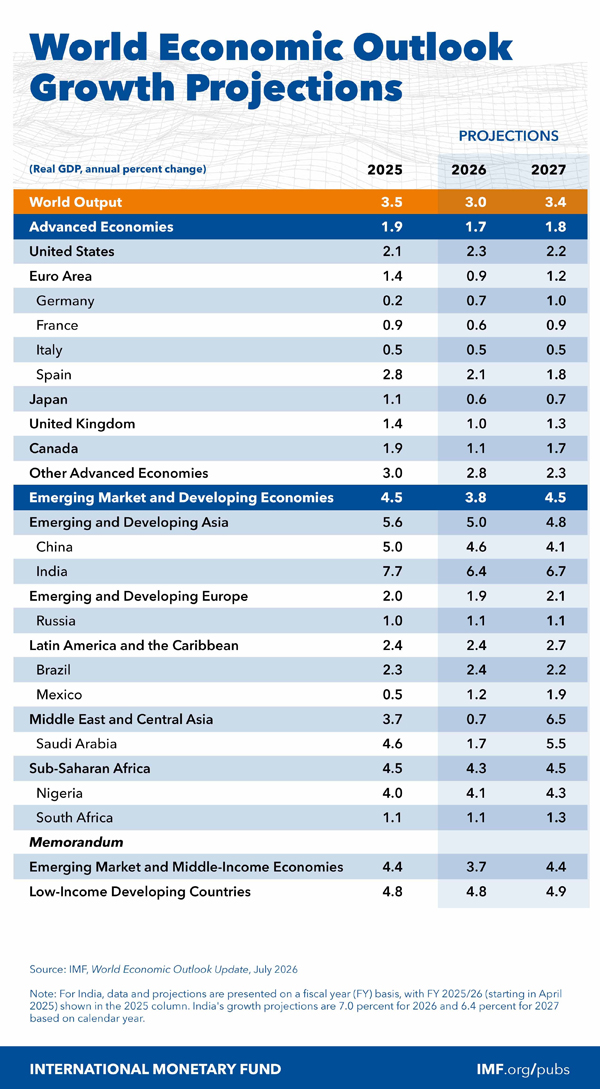
The first untenable move is to treat slower growth as evidence of global breakdown. Forecasts around 2.7 to 3.0 per cent imply deceleration from stronger periods, not a global recession comparable to 2008. They also conceal wide variation across countries and sectors. Energy-importing economies may suffer from higher fuel costs, while exporters benefit from improved terms of trade. Countries linked to technology supply chains may gain from investment even as other sectors weaken. A global average describes the centre of a distribution; it does not establish a universal condition of decline.
The second untenable move is to equate trade reorganisation with trade disintegration. Tariffs, export controls, sanctions, industrial policy, and strategic rivalry can reduce efficiency and raise costs, but fragmentation does not mean that trade disappears. Supply chains may become shorter, more redundant, or more politically aligned. Production may move from one country to another rather than vanish. The transition can be expensive and disruptive, but reorganisation is analytically different from collapse.
The third weakness is one-directional causality. The original article is strongest when it identifies feedback effects among war, energy, inflation, debt, and policy uncertainty. It is weakest when it assumes that those feedbacks operate only in a destructive direction. A Matrix Paradigm requires reinforcing and countervailing forces to be examined together. Higher energy costs can depress consumption and raise inflation, but they can also accelerate conservation, alternative sourcing, renewable investment, and technological substitution. Higher borrowing costs can weaken demand, but they may restrain speculative excess, strengthen currencies, and prevent temporary inflation from becoming embedded in wages, contracts, and expectations. The outcome depends on the relative strength, timing, and institutional transmission of both sets of forces.
Food security exposes the fourth weakness: conditional danger is presented as an accomplished global crisis. Disruption in the Strait of Hormuz can raise the prices of oil, natural gas, transport, fertiliser, irrigation, and agricultural chemicals. Food-importing countries and resource-constrained farmers may face severe pressure. These risks justify contingency planning, targeted assistance, alternative trade routes, strategic inventories, and support for vulnerable households.
But danger is not proof of inevitability. Claims that millions of farmers have decided not to plant require verifiable evidence across countries, crops, and planting seasons. Agricultural responses vary with expected crop prices, government support, credit availability, rainfall, inventories, exchange rates, trade policy, and access to substitutes. The same price increase that discourages cultivation in one region may encourage expansion in another. Exporters can redirect shipments, governments can reduce duties, and consumers can substitute among foods. These mechanisms do not guarantee safety; they show why a worldwide food crisis cannot be declared in advance without measuring the full matrix of responses.
The fifth weakness appears in the treatment of monetary policy: limitation is converted into irrelevance. Interest-rate increases impose real costs by raising mortgage payments, business borrowing expenses, debt-service burdens, and the cost of durable goods. Monetary tightening is particularly blunt when inflation originates in war, oil shortages, shipping disruption, or crop failure. A central bank cannot produce petroleum, fertiliser, or food by raising its policy rate.
Yet the limits of monetary policy do not make it fictional. Interest rates work through credit conditions, aggregate demand, exchange rates, asset valuations, saving decisions, investment, and expectations. In emerging economies, tighter policy may reduce capital flight and currency depreciation, thereby limiting the domestic amplification of imported inflation. Excessive tightening can cause recession, while insufficient action can allow temporary price shocks to become persistent. The policy problem is calibration, not proof of irrelevance.
The sixth weakness is rhetorical absolutism in place of financial differentiation. A serious critique of contemporary finance remains necessary. Banks often lend against existing property and financial assets, excessive leverage can inflate asset prices and widen inequality, and private credit and shadow banking can shift risks beyond traditional regulatory boundaries. But describing the entire financial system as a “great Ponzi scheme” substitutes denunciation for analysis. It erases the distinctions between productive and speculative lending, solvent and insolvent borrowers, regulated and unregulated institutions, legitimate appreciation and fraud. Financial systems can contain rent-seeking, leverage, and systemic danger without being reducible to one fraudulent structure.
Artificial intelligence (AI) reveals the same absolutist tendency. Overvaluation, duplicated investment, and the failure of many start-ups are plausible. A correction in technology shares could reduce wealth and confidence. But failed firms do not prove that the underlying technology lacks productive value. Railways, electricity, automobiles, telecommunications, and the internet all experienced speculation, overinvestment, and corporate failure. In several cases, infrastructure built during the boom later supported broad productivity gains. The relevant question is not whether every AI investment succeeds, but whether surviving applications reduce costs, improve logistics, accelerate research, and raise productivity across the economy.
Historical experience makes the assumption of economic passivity untenable. Pandemic shutdowns, the Russia-Ukraine war, shipping bottlenecks, sanctions, energy shortages, and rapid monetary tightening each generated forecasts of deep and lasting breakdown. Instead, supply chains were partly diversified, European energy sourcing changed, trade was rerouted, labour markets proved resilient in several economies, and inflation declined from its peaks. The adjustment was costly and unequal, but it demonstrated that disruption and adaptation coexist. History does not guarantee resilience; it does invalidate forecasts that assume no meaningful response.
For Bangladesh, the most consequential weakness is the mechanical transmission of global shocks into domestic outcomes. Higher oil, fertiliser, and food prices can worsen inflation and strain foreign-exchange reserves. Slower global demand can weaken exports and investment. Floods and landslides can destroy homes, crops, roads, and livelihoods. These vulnerabilities are real, but global conditions do not determine their domestic consequences automatically.
Institutions decide whether external pressure becomes domestic crisis. Exchange-rate credibility, banking reform, energy procurement, export diversification, agricultural support, fiscal discipline, social protection, urban drainage, and the quality of public investment determine how strongly shocks become hardship. Heavy rainfall becomes a larger economic disaster when drainage is ineffective, waterways are encroached upon, maintenance is weak, and urban planning fails. Imported inflation becomes more persistent when exchange-rate management lacks credibility, markets are concentrated, distribution is inefficient, and policy signals are inconsistent. Attributing every domestic failure to an approaching global breakdown conceals the institutional channels through which vulnerability is created or magnified.
This is the central orthogonal insight: shock exposure is not the same as shock absorption. The decisive variable is not simply the number of shocks confronting an economy, but the capacity of its institutions to absorb, redirect, and transform them. Two countries facing the same oil shock can experience very different inflation, growth, and welfare outcomes. Their divergence reflects policy credibility, fiscal space, market structure, social protection, energy intensity, and administrative competence. Vulnerability is relational, not predetermined.
The original article performs a useful service, but its conclusion exceeds its evidence. It rightly draws attention to the interaction of geopolitical conflict, inflation, debt, food insecurity, technology, and climate. Its warning should be taken seriously. What cannot be sustained is the inference that prolonged and nearly inevitable instability follows from the existence of these risks. The global economy is a multidimensional adaptive system in which destructive feedbacks coexist with substitution, innovation, investment, institutional reform, and policy response.
The world economy in 2026 is under severe stress, but stress is not collapse. Fragmentation may reduce efficiency without ending trade. Inflation may persist without becoming uncontrollable. Technology may produce speculative losses while still raising future productivity. Food systems may face dangerous pressure without entering universal breakdown. Developing countries may suffer disproportionately, yet their outcomes will still depend heavily on domestic institutions and policy choices.
Risk is real, but risk is not destiny. The correct conclusion is neither complacency nor catastrophe. It is conditional resilience: the capacity to prevent interacting vulnerabilities from becoming mutually reinforcing crises. Whether that capacity proves sufficient will be determined not by the existence of danger alone, but by the speed, quality, and coordination of adaptation across the global economic matrix.
Dr Abdullah A. Dewan is Professor Emeritus of Economics at Eastern Michigan University (USA); former physicist and nuclear engineer at the Bangladesh Atomic Energy Commission (BAEC). aadeone@gmail.com