



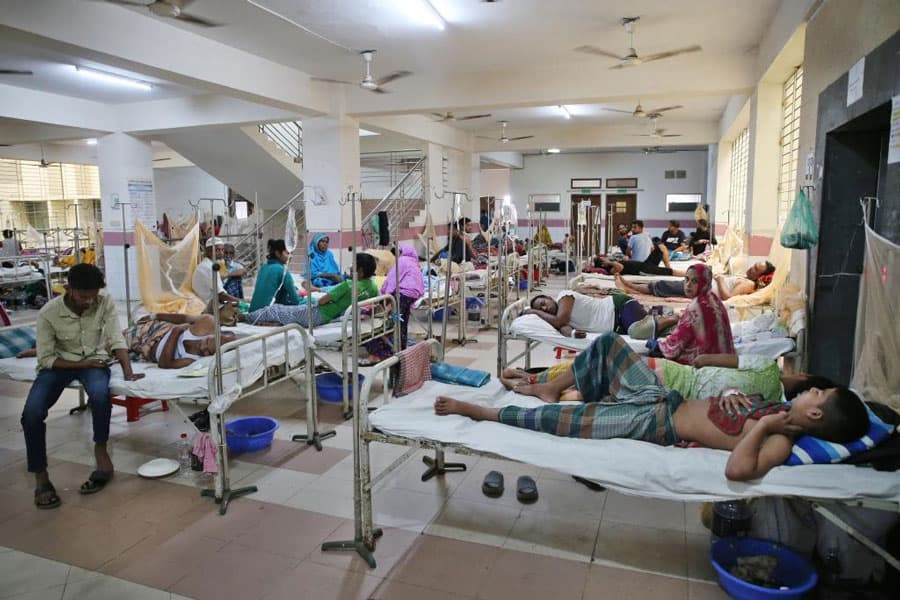
People often say, "First impressions are the last impressions," and this rings true for our healthcare system. When we visit a hospital, our assessment begins even before we see a doctor, and for good reason.
Hospital entrances are crowded, help is scarce, registration is confusing, waiting areas are packed, and washrooms are uncomfortable. Family members search for information, a cleaner passes with an overflowing bin, and the receptionist is overwhelmed. By the time patients see the doctor, their confidence turns to frustration.
Ironically, the doctor might be one of the best in the country.
This is the paradox of healthcare in Bangladesh: we focus on whether we have enough doctors, nurses, beds, or equipment, but we overlook the management problems that shape every patient's experience.
Doctors and nurses do not just provide healthcare. It comes from the whole system working together.
A hospital is one of the most complex organisations. It operates 24/7, coordinates professionals, manages costly equipment, maintains infection control, handles emergencies, protects patient records, and serves thousands under pressure.
Clinical skills alone are not enough to handle this complexity.
Dhaka illustrates this problem. Despite having the most hospitals and specialists, complaints about overcrowding, poor cleanliness, confusing processes, long waits, and uncaring service remain common. Evidence shows these issues are widespread, not isolated.
A study in December 2019 found that, among 923 patients in major hospitals, overall satisfaction was 65 per cent, compared with only 51 per cent in public hospitals. Satisfaction with the hospital environment was 56.5 per cent, reflecting concerns about cleanliness and organisation. These issues directly affect patient trust.
Another national study found that cleanliness was the biggest driver of patient satisfaction. Patients who found hospitals clean were over four times more likely to be satisfied. Cleanliness is not just cosmetic; it is essential for better care.
The problem goes deeper than how things look.
A WHO-supported review of 11 major hospitals found nearly three-quarters met only basic infection prevention standards. Nine out of ten lacked systems to monitor infection control, and only 30 per cent of staff received regular training. About half reported insufficient staffing. The problem is not a lack of medical knowledge but weak management and supervision.
This is the point where Bangladesh's healthcare debate needs to sharpen its focus on better management.
While we have long focused on training doctors and nurses-a priority that should continue-we must also develop professional hospital managers, as better management is vital to better care.
Leading hospitals worldwide rely on administrators, operations specialists, quality managers, infection control experts, and patient experience officers. Their role is to enable doctors and nurses to perform at their best, not to replace them.
After all, a hospital's quality depends on far more than its doctors alone. Receptionists, cleaners, attendants, security guards, engineers, and administrators all contribute to patient recovery. Healthcare success depends on many roles working well together. These frontline workers often receive the least attention.
Many are underpaid, poorly trained, and rarely recognised, yet they have the greatest impact on patient experience. Investing in their training and well-being is essential to improving healthcare.
Good management is just as important.
Hospitals should track waiting times, satisfaction, cleanliness, infection rates, complaints, and staff engagement with the same attention given to finances. Adopting global standards like ISO 9001 or JCI accreditation can help hospitals improve quality and patient safety through proven frameworks. Organisations improve what they measure.
Technology can help. Digital appointments, electronic records, queuing systems, online feedback, and dashboards reduce inefficiencies and increase accountability. Digital change is a management reform, not just an IT project.
Bangladesh should also improve hospitals outside Dhaka to ease pressure on the capital. This means strengthening management and service quality so patients can access basic care closer to home.
There is another important reason to talk about this: the economy.
Bangladesh spends billions of taka annually on healthcare facilities and resources. Yet preventable infections, repeated tests, delays, wasted time, and lost trust cause economic losses.
Better management offers one of the best returns in healthcare by improving how the system works, not just what it buys.
Clean wards reduce infections. Better scheduling cuts waiting times. Smarter purchasing prevents shortages. Good supervision supports staff, and clear communication reduces confusion. These improvements require leadership, robust systems, and accountability, not just new technology.
In the end, healthcare depends on trust.
Patients may forget prescriptions but remember whether staff listened, whether the wards were clean, and whether the hospital felt organised or chaotic.
Good doctors save lives. Good nurses comfort patients. But good management helps both do their jobs well, and it is time to recognise it as essential to healthcare's future.
For a long time, Bangladesh's healthcare debate has centred on how many doctors we need. In the next decade, we should also ask how well our hospitals are managed and how we can improve hospital management.
Patients heal not only through medicine but also through clean, organised, caring, and responsible systems. The future of healthcare will be shaped as much in the manager's office as in the operating room. For better care, Bangladesh must manage hospitals more effectively, and that work should begin now.
shafiqrbhuiyan@gmail.com