


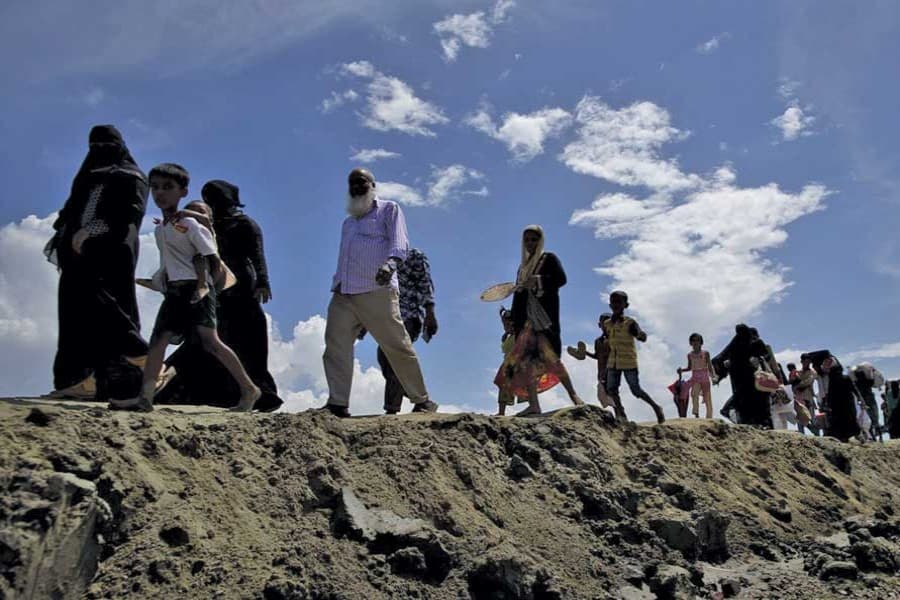
The dreadful sufferings of Rohingya Muslim population in Myanmar have set a 'textbook example' of 'Ethnic Cleansing'. The world has not seen such large-scale exodus of people (more than 0.5 million as of now) in less than two months' time in recent history. These people are victims of the most awful human rights violations for quite some time. Killings, arson, rape, torture and worst kind of degrading treatment to women and children have gone beyond imagination. The inaction of the powerful states and international organisations has shaken the conscience of men and women around the globe. The powerful states and even the responsible persons of our government are yet to dub it 'Genocide' in loud and clear terms. Thus, the essential question is: how can international law intervene in the Rohingya crisis?
Although it is denied by the rulers of Myanmar, there is hardly any doubt from objective evidence that the military in Myanmar are systematically and forcibly removing ethnic Rohingyas from their homeland. These actions have been widely condemned by many international organisations and renowned personalities of the world.
Most observers ponder on the role of international law - especially international human rights law against such atrocities. But there are problems as regards the applicability of international law. International law in this regard comprises some separate laws like international criminal law, international humanitarian law and international human rights law and so on, and these at times overlap one another.
Though the phenomenon of 'ethnic cleansing' is not rare, international law doesn't seem to have brought it under its legal purview. Actually, the term is not a legal one. The term came into being during the civil war in the former Yugoslavia in early 1990s. In essence, 'ethnic cleansing' is the idea that a minority population is persecuted, killed or forcibly removed from its territory. However, this is prohibited by many international human rights treaties such as the 1965 Race Convention. It clearly prohibits activities done on the basis of race or ethnicity. The 1984 UN Convention against Torture (UNCAT) prohibits acts of torture, inhuman and degrading treatment. The threshold crosses where persons are forcibly expelled from their homes and their possessions/properties are destroyed.
The general treaties such as the International Covenant on Civil and Political Rights (ICCPR) and International Covenant on Economic, Social and Cultural Rights (ICESCR) may be found relevant. Under these, the State may be held responsible for violation of the rights of people in such high magnitude.
'Ethnic cleansing' entails the violation of the right to life, the right to housing and food, etc. and it falls under the terms of specific rights protected by these treaties. Here international human rights law is clearly engaged but the problem is that Myanmar is not a signatory of the ICCPR, ICESCR, UNCAT, the Race Convention, although aspects of the rights in question can be considered as part of the customary international law. It can hardly be denied that what is currently going on in Myanmar goes way beyond what human rights treaties entail.
The 1948 Genocide Convention makes genocide a crime and according to Article II, genocide includes killing or causing serious bodily/mental harm to members of a large section of the population. The Convention, however, does require that this is done with the 'intent to destroy, in whole or in part, a national, ethnical, racial or religious group.' To find 'intent' and what it entails has not been an easy task for the prosecutors so far. In a case involving Serbia and Croatia at the International Court of Justice, the UN required a 'specific intent' which was a difficult task for the prosecutors to conclusively and unanimously agree upon.
Again, if it is the state, it cannot be tried other than merely blaming it under international law for policies and actions. But the individuals can be netted and held for their role. We thus enter the realm of international criminal law. The 1948 Genocide Convention requires genocide be made a crime in domestic law. Though, Myanmar is a party to the Convention, chances that members of the military of Myanmar would be prosecuted for atrocities committed against the Rohingyas appear remote.
Myanmar has clearly breached its obligations under the 1948 Geneva Convention, but there is no treaty-specific mechanism which can measure non-compliance.
Other options can be explored. Genocide is a crime of universal jurisdiction. Any State can try any individual if the State considers that individual guilty of acts of genocide. But evidential burdens and also the motive and determination for prosecution are difficult to achieve for unconnected States. Undoubtedly, there are instances of such trials. The statute of the International Criminal Court (ICC) also prohibits genocide in Article 6 and the court can try individuals responsible for it. In case of Myanmar, they are not a party to the ICC. As such, the likelihood of the Court exercising its jurisdiction with regard to the Rohingyas does not hold out much prospect. However, if the Security Council of the UN decides to refer the case to ICC, things may take a different turn. This has not happened so far. One can only look up to such a bold move.
Undoubtedly, there is a complex web of international law where responsibilities and obligations are at crossroads. All are parts of international law but the application and the role of actors, at the end of the day, will be the key. Politics and economic interests, not surprisingly, determine what would happen. Nevertheless, international law in its different manifestations may pave the way, if it is rightly called upon to do the needful.
The writer is Senior Deputy Secretary, Institute ofChartered Accountants of Bangladesh (ICAB).
nayem8467@yahoo.com