

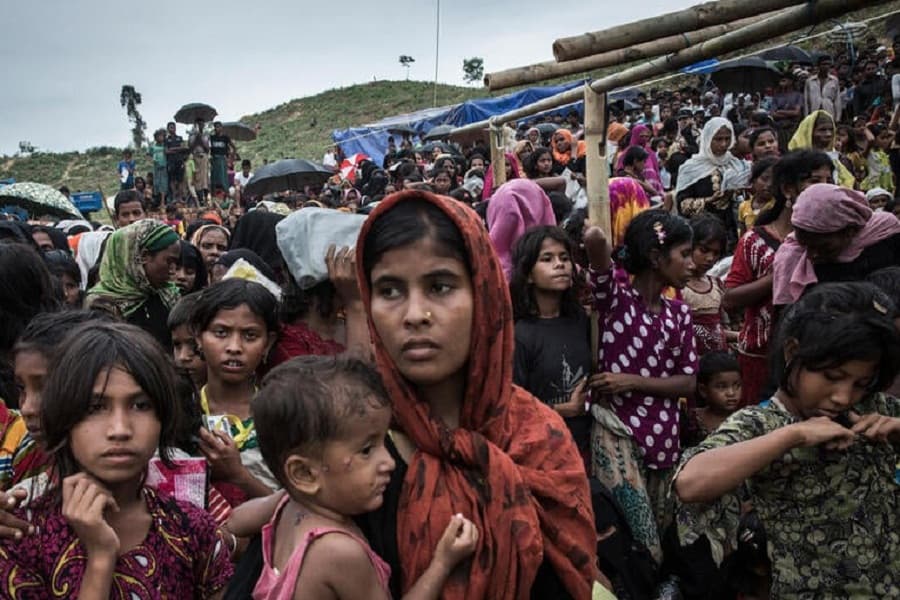
The latest story headline, 'Rohingya refugees face hunger and loss of hope after latest ration cuts' by UNHCR, raises concerns about the food security and nutrition of more than 1.1 million Rohingya refugees in Bangladesh.
To the utmost astonishment, the World Food Program (WFP) has reduced the amount of ration per person a couple of times within a span of only three months at the beginning of the year 2023.
Making the funding shortfall an issue, the WFP reduced the value of monthly food vouchers from USD 12 to USD 10 per person in March and further reduced it to only USD 8 per person in June 2023.
Thus, a Rohingya refugee can only spend 27 cents per day to meet daily food and nutrition needs. Even the UN has been forced to lay off the amount of food ration for Rohingya refugees by 17 per cent making the existing stranded situation worse.
On the other hand, the WFP insists it requires an urgent USD 125m to circumvent further reduction in the ration.
It is a million-dollar question that is 27 cents enough for a Rohingya? In the words of Morjina, 27, a single mother of three young children, "I had to reduce the portion of my children's meals – but for how long? There is not enough food available for my family and I really do not know how we will survive." (UNHCR, July 19 2023)
Ironically, donors have already shifted their attention to the European (Ukraine) crisis. They had already warned about a 20 to 30 per cent reduction in funding in 2022, including the UN as they lack funding.
We understand that geopolitics play a significant role for bilateral and multilateral donors while disbursing fund for assistance.
However, considering every single political and nonpolitical matter, it is astounding how they thought of cutting the ration. It is easily conceivable that one can survive the lack of shelter, clothing, and education, but it is impossible to fight hunger without food.
Considering their approach, one can conclude that they are not prudent enough to see the devastating repercussion of their decision.
To meet their hunger, Rohingyas could take any path from sex slavery, child marriage to the daring boat journey to nearby countries, potentially leading to crime and gender-based violence. Evidence suggests that Rohingyas consider joining armed groups as they offer Tk 5 thousand per month.
The overall result of the decision will make the existing stranded condition worse. Besides the Rohingya refugees, the victim of their geo-political decision will be the people of Bangladesh.
Bangladesh is already taking the burden of nearly a million Rohingyas. The country sacrificed its ecology and nature only to harbour the Rohingya people, and the intention of Bangladesh was only humanitarian.
With the reduced ration, Rohingya people will be forced to commit criminal activities, directly affecting the nearby people of Cox's Bazar.
According to local news, Rohingyas killed several Bangladeshi people in Cox's Bazar region, and these activities are expected to rise.
It is high time the international community should rethink their policy towards the Rohingya refugee crisis. It was not Rohingyas who were responsible for their fate, nor the government of Bangladesh or the state itself, that created the crisis. Then they should not suffer for what they did not commit.
The UN and the international community, who advocate for human rights, should come forward to resolve the issue. Either they (the international community) contribute enough to maintain a large number of refugees in Bangladesh, or they take concrete action against Myanmar so that the crisis ends right away.
It is time to through away their bias towards the West. Ukrainians are people, and so are the Rohingyas. Thus, both issues should get an identical focus on the humanitarian ground. We cannot feed one by killing the other.
In fact, the media, especially the global media, can significantly mobilise funds for the Rohingya refugees. For instance, the headline story, i.e. "Aid dwindles for Rohingya refugees as money goes to Ukraine, other crises," by the Washington Post (March 15, 2023), matters to mobilise international opinion for the cause of the Rohingya people.
Thus, the local, regional and global media must publish more coverage on the dwindling resource allocation by the international community for the Rohingya refugees.
Dr Md. Shariful Islam is an Associate Professor of International Relations at the University of Rajshahi. He is also an adjunct research fellow at the KRF Center for Bangladesh and Global Affairs, Dhaka. E-mail: shariful_ruir@ru.ac.bd