

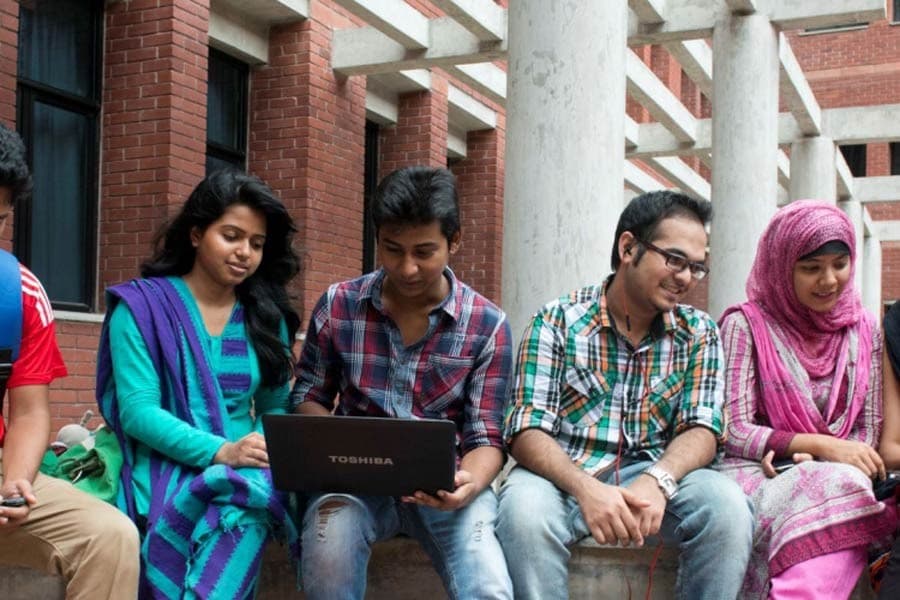
There was a time when university represented a period of intellectual exploration - a space where students could question assumptions, discover new ideas and gradually prepare for professional life. Today, that understanding is quietly changing. Across campuses worldwide, including in Bangladesh, students are expected to do far more than earn good grades. They are encouraged to publish research papers before graduation, build start-ups, learn programming regardless of their discipline, master artificial intelligence tools, complete multiple internships, volunteer, earn online certificates and maintain a polished professional presence on platforms such as LinkedIn. Education is no longer simply about "learning"; it has become an exercise in continuous self-optimisation!
None of these pursuits is inherently problematic. Research experience develops critical thinking. Entrepreneurial skills encourage innovation. Digital literacy and AI competency are becoming essential in a rapidly changing economy. The problem arises when these opportunities harden into expectations. Success is no longer defined by mastering one's discipline but by accumulating achievements across as many domains as possible. The modern student is expected to become a researcher, entrepreneur, programmer, content creator and networker - all before receiving a diploma.
This transformation reflects broader economic and technological changes rather than failures of universities alone. Labour markets have grown increasingly competitive. Employers seek graduates with diverse skills, and social media has turned professional accomplishment into public performance. Platforms such as LinkedIn encourage users to document every certificate, publication, internship, conference presentation and leadership role. Achievements that once appeared quietly on a curriculum vitae are now continuously displayed before peers, making comparison almost unavoidable.
Such visibility changes how success is experienced. Students are no longer competing only for opportunities; they are competing for attention. Every scroll through such a platform reveals another announcement of a publication, scholarship, start-up launch or prestigious internship. While these posts often celebrate genuine accomplishments, they set ever higher benchmarks for what students believe they should achieve. Gradually, education begins to resemble an endless race in which standing still, even briefly, feels like falling behind.
The consequences extend beyond stress. A large global meta-analysis, cited by the WHO and published in Nature Mental Health, found that 33.6 per cent of university students experience symptoms of depression, while 39 per cent report symptoms of anxiety. Another systematic review estimated that more than one in four students have experienced suicidal thoughts, highlighting that the pressures surrounding higher education have become a public health concern rather than merely an academic one. Rather than improving performance, chronic overload often undermines concentration, creativity and intrinsic motivation. Growing evidence also suggests that constant engagement with digital technologies can produce "technostress" - a form of psychological strain arising from the pressure to remain continuously connected, adaptable and productive. Ironically, tools designed to increase efficiency can leave students feeling that there is never enough time to do enough.
Artificial intelligence illustrates this paradox well. AI has rapidly become an indispensable educational and professional tool. It can summarise articles, assist with coding, analyse data and improve productivity across countless tasks. Students who ignore it risk missing valuable opportunities. Yet its widespread adoption has also intensified expectations. Completing assignments faster often means receiving more assignments. Saving time does not necessarily create more leisure; it frequently raises the standard for what counts as acceptable productivity. As technology lowers the cost of producing work, the definition of "doing enough" quietly expands.
Perhaps the greatest cost of this productivity culture is what students lose along the way. Publications become signals of competitiveness rather than contributions to knowledge. Networking becomes a strategy for visibility rather than meaningful intellectual exchange. Learning itself risks becoming secondary to demonstrating that learning has occurred.
The solution is not to discourage ambition or dismiss the importance of new skills. Today's graduates genuinely need digital literacy, adaptability and interdisciplinary knowledge to succeed in an uncertain labour market. Universities should continue to encourage innovation, research and entrepreneurship. However, they must also resist equating educational excellence solely with constant productivity. Not every meaningful educational experience can be quantified by certificates, publications or online endorsements. Students, too, deserve permission to learn without feeling compelled to perform every moment of that learning. Intellectual growth is rarely linear, efficient or immediately visible.
As universities prepare students for an increasingly complex future, they face an important question. Are they cultivating thoughtful graduates equipped to navigate a changing world, or are they inadvertently encouraging young people to become perpetual performers in an economy that never stops demanding more? The answer will shape not only the future of higher education but also the kind of society it ultimately serves.
The writers are studying criminology at Dhaka University.
saniyasofir13@gmail.com, ashfah257@gmail.com