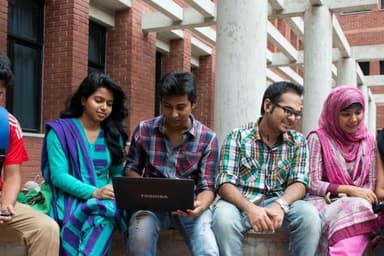

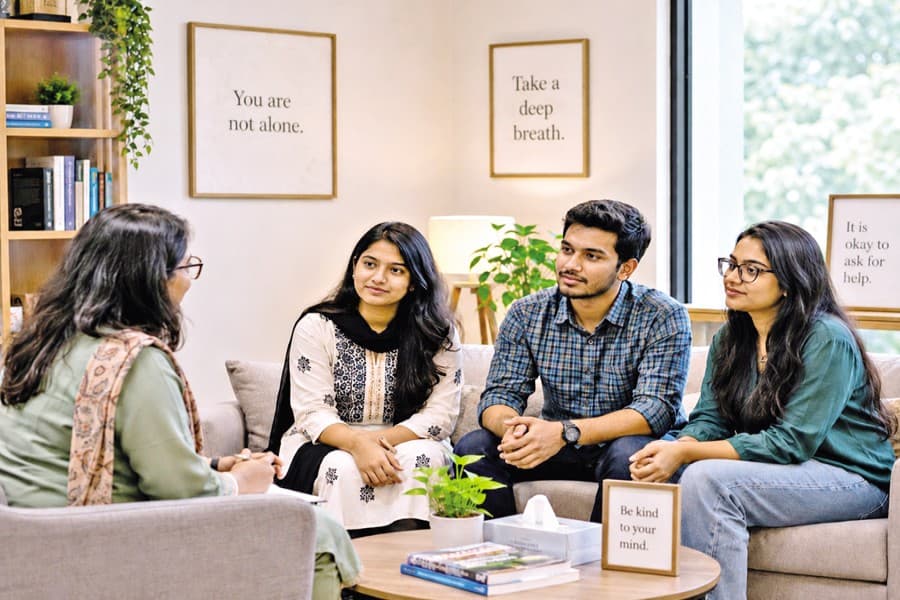
"First year at university felt like the ground had shifted under me. I was brilliant in school. Suddenly I was average, surrounded by people who seemed to have everything figured out. I stopped sleeping, eating properly. I told no one."
This is not an unusual story. Across university campuses and office floors in Dhaka, a crisis has been unfolding that rarely makes headlines because its victims have been trained, by culture and circumstance, to stay silent about it.
Mental health remains one of the most underaddressed public health challenges in Bangladesh. WHO estimates that nearly one in five people globally will experience a mental health condition at some point in their lives. In Bangladesh, where professional psychological support has historically been expensive, stigmatised, and geographically concentrated, the gap between need and access has been particularly wide. Nowhere is that gap felt more acutely than among students and young professionals navigating the most destabilising years of their lives.
The weight nobody talks about: The pressures converging on today's students are not small. Academic competition is intensifying at every transition point. There is the shock of moving from structure to sudden self-direction before most people are ready for it. They undergo financial stress, relationship breakdowns, and career confusion in a job market that offers little reassurance. Underneath it all lies the constant expectation to appear fine.
For young professionals, the weight shifts but does not lift. Employment brings its own disorientation, and the stereotypical family assumption that a stable income equals a stable mind leaves many quietly unravelling while performing competence at their desks. "A job doesn't fix what's happening inside your head," says a 24-year-old in the corporate sector.
The stigma sitting on top of this crisis makes it harder still. Many people spend months, sometimes years, recognising something is wrong before they feel permitted to name it. "I didn't even have the language for what I was feeling," recalls a final-year student. "Depression wasn't a word we used at home. We said tired, stressed; just make dua." By the time many young people finally reach out, the weight they have been carrying alone has already done considerable damage. "I knew something was wrong for almost two years before I did anything," says one postgraduate student. "I kept thinking it would pass."
The gap that is being filled: Traditional psychological services in Bangladesh have long been inaccessible to most students— too expensive, too clinical, or too detached from reality. A single session with a senior clinical psychologist can cost between Tk 2,000 and Tk 5,000 or more. For a student managing their own expenses in Dhaka, that is a huge barrier.
Some universities have introduced their own counselling services, but institutional responses have been slow, uneven, and often unknown to the very students who need them. The more dynamic response has come from outside the formal system entirely, from a growing network of independent ventures, volunteer-led helplines, non-profit platforms, and affordable professional services. These initiatives, generally run by alums and professionally trained students of DU Psychology, Clinical Psychology, Educational and Counselling Psychology departments, vary enormously in quality, structure, and intent. Not all of them are what they present themselves to be. But collectively, they represent something that did not meaningfully exist a decade ago.
The independent ecosystem: At the most accessible end sit the free helplines. Kaan Pete Roi, Bangladesh's first tele-counselling centre, offers active listening and para-counselling at no cost. Purple Line functions as a suicide prevention helpline from 4 pm to 2 am, staffed by volunteers trained in psychological first-aid. Mindspace and Pashe Achi operate on similar models, providing free crisis support through psychology student volunteers who refer callers to professional help where needed. These services do not offer therapy. They offer presence.
"I called a helpline at 1 am because I genuinely didn't know what else to do," says a 21-year-old student. "The person on the other end just listened. That was enough for that night." Several are now regularly overwhelmed with incoming calls, their volunteers stretched beyond capacity, a reflection not of failure but of how large the unmet need actually is.
Between the free helplines and conventional clinical care sits a cluster of low to mid-cost independent services. Nirban offers active listening at Tk 200 with professional therapy at higher rates, still building its infrastructure as a relatively new initiative. Identity Inclusion, a decade-old organisation, runs psychosocial support at Tk 1,000 per 90 minutes and group discussion therapy at Tk 200 to 300, primarily serving neurodivergent individuals and youths, with satisfactory but limited reach. Aanchol Foundation operates as a non-profit platform running workshops, seminars, and a weekly supervised online Listening Room, with affiliated psychologists available for Tk 600 to Tk 1,200. Its heavy social media presence has raised questions about whether visibility is being prioritised over depth of service.
At the mid-range level, Restart Mental Health, Psycoach Bangladesh, and MindWizz offer structured professional services ranging from Tk 700 to Tk 4,000 depending on session type and professional seniority. Client experiences vary, while negative experiences are significantly underreported.
Following the July 2024 uprising, the Human Rights Development Centre in Mohammadpur deployed trained psychology volunteers to communities most affected by the violence, providing free psychological first-aid and further professional therapy funded through international sources.
What users actually say: Feedback across this ecosystem is mixed. Many report feeling genuinely heard for the first time, and accessible pricing is consistently cited as the factor that made the difference. "The session cost me less than a meal at a decent restaurant," says a fresh graduate. "I don't know why I waited so long thinking I couldn't afford it."
But honest assessments surface real concerns. Session quality is inconsistent, particularly in volunteer-run services. Some organisations prioritise public image over transparent handling of client concerns. A number are led by individuals from business rather than clinical backgrounds, and the gap shows in service structures and feedback management. The lack of regulatory oversight means the term mental health service carries no guaranteed standard. "I am not sure how much I trust the reviews," admits one postgraduate student. "Only the good ones get shared."
Where this is heading: The direction is forward, but the work is far from done. Helplines are planning towards round-the-clock availability. Group therapy, art therapy, and music therapy are entering the ecosystem. A generation more willing than any before it to name what it is feeling is creating demand that is slowly forcing a response.
What exists today is not yet what Bangladesh's students need it to be. Quality is uneven, awareness is low, and the most vulnerable remain the hardest to reach. But it is considerably more than what existed five years ago. For a young person sitting alone at 2 am, not knowing how to name what they are feeling or who they are allowed to tell, that matters more than it might seem. It is, at the very least, a beginning.
tajree.m.rahman@gmail.com