
Climate change is not only making Bangladesh hotter, but it is also making households poorer.
A new global report released Sunday found that rising temperatures are creating a double financial burden for millions of Bangladeshis by reducing workers' incomes while increasing healthcare expenses.
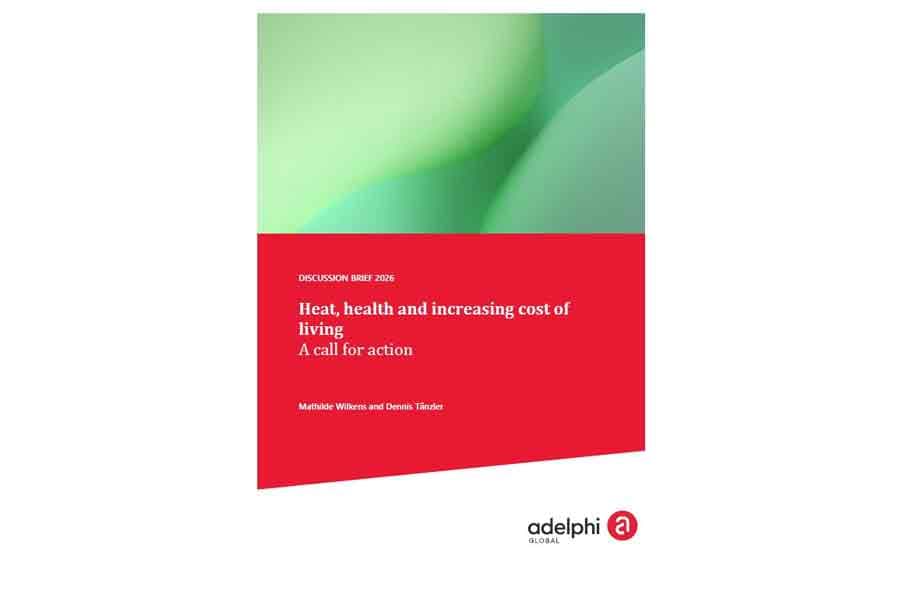
The report, Heat, Health and the Increasing Costs of Living – A Call for Action, published by adelphi global, identifies Bangladesh as one of the countries most vulnerable to the combined economic impacts of climate-driven extreme heat.
Alongside India and Nigeria, Bangladesh faces some of the highest risks as widespread informal employment, increasing health costs and limited social protection leave millions of households highly exposed.
The report is the first to examine how climate-induced heat simultaneously affects household incomes and living costs across eight countries - Bangladesh, Brazil, France, India, Indonesia, Italy, Nigeria and South Africa.
According to the analysis, workers in Bangladesh's agriculture and construction sectors are projected to lose the equivalent of 23.75 working days every year because of heat stress by 2030.
These sectors already experience some of the country's highest productivity losses, with working-hour losses expected to increase from 6.28 per cent on Sunday to 9.58 per cent by 2030 under a low-emissions climate scenario.
Across all sectors, annual working-hour losses are projected to rise from 4.24 per cent to 4.84 per cent.
These losses translate directly into reduced incomes for millions of workers, particularly those employed informally without paid leave, health insurance or income protection.
The report also highlights Bangladesh's heavy dependence on out-of-pocket healthcare spending.
In 2023, 79.3 per cent of the country's total health expenditure was paid directly by households, one of the highest rates among all countries examined.
Meanwhile, annual per capita out-of-pocket medical spending has increased by more than 830% since 2000, placing growing financial pressure on families already struggling with climate-related income losses.
Bangladesh is projected to remain among the world's most heat-exposed countries over the coming decades.
The report shows that most of the country will experience high to very high humidity-based heat risk between 2020 and 2039, with between 183 and 239 days each year exceeding 30°C in many areas.
During extreme heatwaves, productivity losses in some sectors could reach up to 50 per cent, further threatening livelihoods and economic stability.
The report warns that these impacts are particularly severe because Bangladesh's labour market is dominated by informal employment.
Nearly all women working in agriculture are employed informally, while informal employment remains extremely high across construction and other heat-exposed sectors. Without social protection, every lost working hour immediately translates into lost income.
Beyond individual households, extreme heat is also imposing substantial economic costs on the country. According to the report, Bangladesh lost an estimated US$24 billion in labour income and productivity due to extreme heat in 2024, equivalent to approximately 5.0 per cent of national GDP.
Recurrent electricity shortages during heatwaves further compound these impacts by exposing workers, factory employees and households to dangerous indoor temperatures while limiting access to cooling.
The report argues that Bangladesh can no longer treat climate adaptation, public health and labour protection as separate policy areas. Instead, it calls for a coordinated approach that places people at the centre of climate adaptation.
Among its key recommendations, the report urges governments to strengthen public health systems to reduce reliance on out-of-pocket healthcare spending, extend social protection and labour protections to workers affected by extreme heat, integrate heat-health risks into national adaptation planning, and mobilise climate finance specifically for health and worker protection.
As Bangladesh experiences increasingly frequent and prolonged heatwaves, the report concludes that protecting public health and household incomes must become central priorities within the country's climate adaptation and development agenda.
azizjst@yahoo.com