

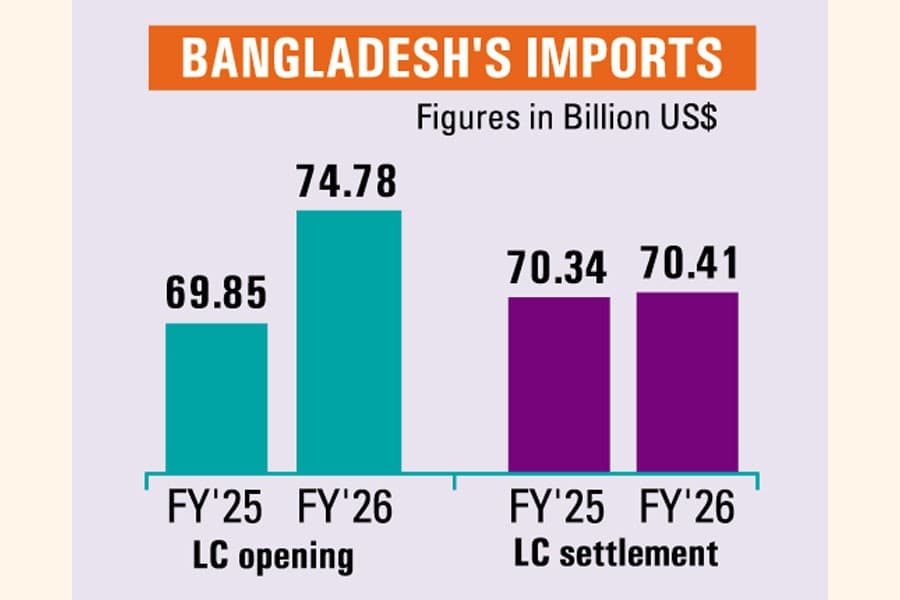
Bangladesh's overall imports remained almost unchanged at US$70.41 billion in the just-concluded fiscal year (FY) 2025-26, as businesses adopted a cautious stance amid ongoing geopolitical tensions.
The actual import in terms of settlement of letters of credit (LCs) edged up by 0.09 per cent to $ 70.41 billion in FY'26 from $70.34 billion a year before, according to the central bank's latest statistics.
On the other hand, the opening of fresh LCs, generally known as import orders, rose by 7.06 per cent to $74.78 billion during the period under review from $69.85 billion in FY'25.
"The upward trend in actual imports is likely to continue in the near term, as the government and the central bank have already taken different measures to stimulate investment, particularly in the productive sectors," a senior Bangladesh Bank (BB) official told The Financial Express (FE), explaining the latest import trends.
He also said the central bank already announced a Tk 600 billion stimulus package aimed at supporting the struggling private sector, boosting investment, and revitalising the economy.
"Proper implementation of the package will help revive sick and closed industries, leading to higher import demand in the coming months," the central banker explained.
Echoing the BB official, Md. Ezazul Islam, Director General of the Bangladesh Institute of Bank Management (BIBM), said overall imports could grow by around 10 per cent in the current fiscal year, driven by the newly elected government's expansionary fiscal policy aimed at boosting investment, particularly in the productive sectors.
He said the BB's latest growth-supportive monetary policy, reflected in its stimulus packages, along with improved political stability and stronger private-sector investment expectations, was also expected to support higher import growth. Dr. Islam, a former executive director of the central bank, made the observations while explaining the outlook. However, the value of petroleum imports rose slightly as global fuel oil prices increased amid persistent geopolitical tensions, according to the central banker.
Petroleum products import increased by 6.42 per cent to $10.68 billion in FY'26 from $10.03 billion of the previous fiscal year.
"The upward trend in fuel oil imports is likely to continue in the coming months if the ongoing geopolitical tensions persist," a senior executive of a leading private commercial bank told The FE.
He also said that most businesses were still adopting a cautious approach to expansion due to uncertainties arising from the conflict in the Middle East.
However, import of capital machinery or industrial equipment used for production dropped by more than 10 per cent to $1.80 billion in FY'26 against $2.02 billion a year ago.
Industrial raw-material import also fell by 3.33 per cent to $23.18 billion during the period under review from $23. 98 billion in FY'25, the BB data showed.
Besides, the import of intermediate goods dropped by 6.51 per cent to $4.17 billion in the outgoing FY'26 from $4.46 billion in the previous fiscal year.
siddique.islam@gmail.com