


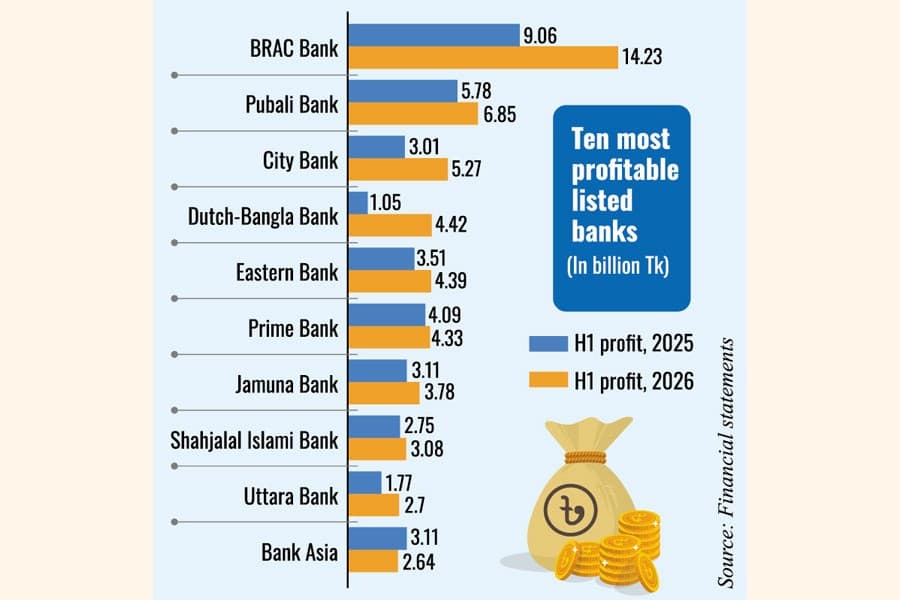
Most listed banks posted double-digit year-on-year profit growth in the first half (January-June) of 2026, buoyed by higher investment income from government securities and increased earnings from fees and commissions.


Analysts said lenders with lower non-performing loans (NPLs), strong returns from Treasury bills and bonds, steady deposit growth and sound governance outperformed their peers during the period.
However, several banks remained in the red as deteriorating asset quality and a surge in bad loans following the 2024 political transition forced them to maintain hefty loan-loss provisions, eroding profitability.
As of Thursday, 28 of the country's 36 listed banks had released their unaudited financial statements for the January-June period. Five listed banks are currently undergoing merger processes.
Among the reporting banks, 16 posted year-on-year profit growth, five recorded lower profits, six reported wider losses and one slipped into the red during the first half.
A senior banker, requesting anonymity, said the level of non-performing loans remained the key differentiator in banks' financial performance.
"Banks with high bad loans cannot generate interest income from those assets. At the same time, they have to maintain provisions against those loans, which directly reduces profit," he said.
He added that banks with lower NPLs had more room to invest surplus funds in Treasury bills and bonds, which offer risk-free returns without requiring provisions, thereby strengthening earnings.
Cash-surplus banks also benefited from increasing investments in government securities amid sluggish private sector credit growth.
Top performers included BRAC Bank, Pubali Bank, City Bank, Dutch-Bangla Bank and Eastern Bank, which reported profit growth ranging from 19 per cent to 321 per cent.
Among listed lenders, BRAC Bank recorded the highest net profit of Tk 14.23 billion in the January-June period, up 57 per cent from a year earlier, supported by strong investment income alongside higher interest earnings.
Its net interest income rose 29 per cent year-on-year to Tk 10.56 billion, while investment income increased 25 per cent to Tk 25.56 billion during the period.
The lender's earnings were further supported by its strong small and medium enterprise (SME) business and higher contributions from subsidiary bKash.
BRAC Bank also maintained one of the lowest NPL ratios in the banking sector, which declined to 2.03 per cent at the end of June from 2.27 per cent in December 2025.
Akramul Alam, head of Research at Royal Capital, said BRAC Bank had consistently managed to keep operating costs low while mobilising deposits at comparatively lower costs due to its strong market reputation, enabling it to deliver record profits.
Pubali Bank ranked second, posting a net profit of Tk 6.85 billion for the first half, up 19 per cent year on year, driven by higher investment income and increased earnings from commissions and brokerage.
Despite a nearly 20 per cent decline in net interest income, the bank's investment income rose 34 per cent to Tk 20.93 billion during the period, lifting overall profitability.
In its earnings note, the bank said business diversification through fee-based income, commission earnings and treasury investments, coupled with cost optimisation and ongoing digital transformation, contributed to its stronger financial performance.
City Bank also delivered a robust performance, with consolidated net profit surging 75 per cent year-on-year to Tk 5.27 billion.
The strong earnings were largely driven by higher returns from investments in government securities alongside growth in net interest income. Net interest income increased 17 per cent, while investment income rose 15 per cent to Tk 19.10 billion during the January-June period.
Dutch-Bangla Bank posted the highest profit growth among listed banks, with net profit soaring 321 per cent year-on-year to Tk 4.42 billion, primarily due to a sharp increase in investment income.
Although the bank's net interest income fell 21 per cent to Tk 8.72 billion, investment income jumped 52 per cent to Tk 14.22 billion during the period.
Eastern Bank also reported a strong performance, with net profit rising 25 per cent year on year to Tk 4.39 billion, supported by a 52 per cent increase in investment income.
Prime Bank also saw 6 per cent profit growth year on year to Tk 4.33 billion in January-June 2026, driven by 47 per cent growth in investment income.
Jamuna Bank, Shahjalal Islami Bank, Uttara Bank, NCC Bank, Southeast Bank, Midland Bank, United Commercial Bank, NRBC Bank, NRB Bank and SBAC Bank also reported higher profits during the first half, compared with the same period a year earlier.
In contrast, losses at IFIC Bank, National Bank, Rupali Bank, AB Bank, Premier Bank and ICB Islamic Bank widened year on year.
Islami Bank Bangladesh slipped into losses, reporting a consolidated loss of Tk 13.16 billion for the January-June period, compared with a profit of Tk 674 million in the corresponding period last year.
The bank attributed the sharp deterioration in earnings to a substantial increase in profit paid on deposits and lower investment income.
However, the bank in its earnings note said that various measures had been undertaken in line with Bangladesh Bank's guidance to improve asset quality, strengthen investment recovery and enhance income generation, which are expected to contribute positively to future earnings.
babulfexpress@gmail.com