


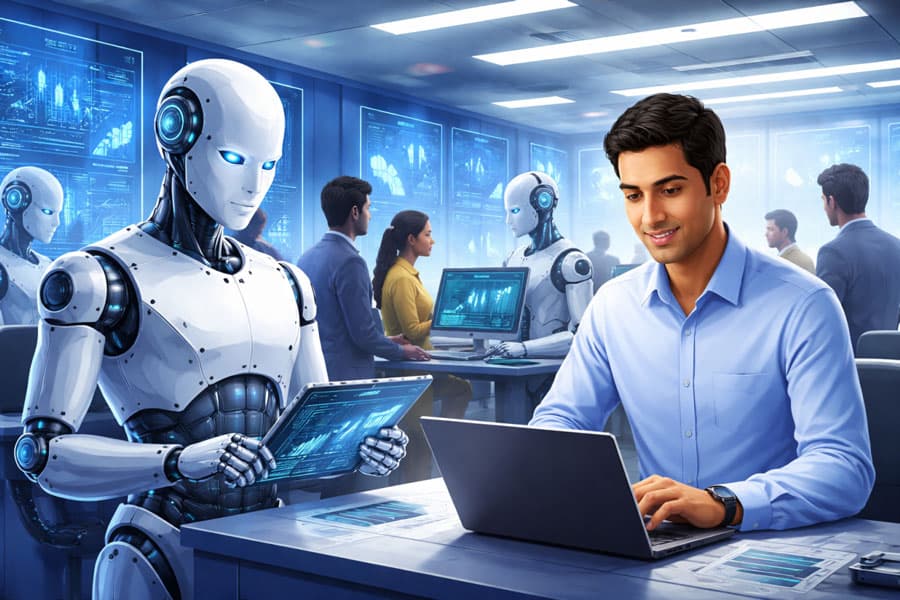


The world has undergone many transformations and the lives of people inside it have transformed many times. From the Dark Ages to the Age of Enlightenment to the Age of Science and Technology, how people lived and earned a living has acquired different meanings at different times. Times have changed needs, needs have changed livelihoods, and livelihoods have changed lives. Imagine the postmen of yesteryears who travelled on foot to deliver letters from one place to another. Remember how much effort went into letter writing, from finding pen and paper to collecting stamps to waiting for days to getting letters posted and delivered. That entire exercise can be completed within minutes by email or instant messaging. The list of professions that have long vanished into the layers of time with the advancement of technology is long. However, the march of technology is relentless, and the artificial intelligence (AI) and robotics are now the latest phenomenon transforming the nature of work more profoundly than ever.


The impact of this latest technological revolution is already visible across almost every sector of the economy. From generative AI tools such as ChatGPT, Gemini and Claude to industrial robots, autonomous vehicles and AI-powered healthcare systems, intelligent technologies are reshaping how businesses operate and how people perform their daily tasks. Tasks that once required hours of human effort can now be completed in minutes. These changes, however, have their positive side and negative side. While more work can be done within a short period of time using less manpower, how these changes will impact the labour market is a matter of concern for many. Some of the predictions indeed paint a frightening picture.
For example, a recent study by the Center for Policy Dialogue (CPD) warns that the labour-intensive readymade garment (RMG) industry will see a massive reduction in its workforce due to the rapid advancement of automation and technology-based production systems. According to the study, without timely policy support for upskilling and reskilling, automation could displace 1.2 million jobs in the RMG sector by 2041. Among this, women workers will be hit the hardest, as the study finds that nearly 60 per cent of the jobs currently held by female workers could disappear over the next one or two decades as factories increasingly adopt automation and advanced technologies to remain competitive in the global market.
The projections of some international organizations are similarly striking. Goldman Sachs Research estimates that automation could replace around 300 million jobs globally. The International Monetary Fund (IMF) also estimates that AI will impact nearly 60 per cent of jobs in advanced economies and about 40 per cent of jobs worldwide, replacing some and complementing others.
Experts however are of the view that while technological advancement may eliminate certain jobs and services, it also creates new ones. Moreover, technological progress expands economic growth rather than shrinking it. The Industrial Revolution, for instance, displaced traditional handloom weaving and many artisanal occupations, but it also laid the foundation for the modern manufacturing economy and created millions of new jobs in factories and related industries. Likewise, the advent of computers rendered typists and many clerical roles largely obsolete, but it gave birth to the software industry, the internet economy and countless digital professions.
AI is likely to follow a similar path. Businesses will increasingly deploy AI to perform repetitive, routine, and data-intensive tasks. As a result, employment opportunities in data entry, basic accounting, customer support and call centres and other clerical roles may gradually decline as many of their routine tasks can be automated. It will allow companies to free up workers to focus on responsibilities that require judgement, creativity, critical thinking, and human interaction. Machine may complete vast amount of data with remarkable speed and accuracy, but it lacks many of the qualities that define human intelligence. It cannot show empathy, moral judgement, or emotional intelligence. Nor can it provide leadership. So AI is best suited to become a powerful tool to complement human capabilities rather than being a replacement for them.
At the same time, the rise of AI is creating occupations that were virtually unheard of just a decade ago. Professions in data science, machine learning training, cybersecurity, cloud computing, robotics, digital healthcare, semiconductor manufacturing, AI engineers and prompt engineers are expected to be in high demand in the coming years. In the future labour market, the most valuable asset will not simply be a university degree, but the ability to adapt to technological change, think critically and creatively, solve complex problems and embrace lifelong learning.
This, however, does not mean that the authorities can afford to take their eyes off the risk of job displacement in the garment industry and other labour-intensive sectors. Many routine tasks in these industries are likely to be automated gradually in the upcoming years. In the garment sector, for example, routine tasks such as fabric cutting, digital pattern making, quality inspection, and warehouse management are increasingly being performed using AI-powered systems and robotics. In fact, to remain competitive in an increasingly competitive global market, automation and higher value addition are not a luxury, but a necessity.
This is where proactive public policy becomes essential. The government must adopt a comprehensive strategy, supported by both fiscal and monetary measures, to help workers adapt to technological change. Large-scale investment in reskilling programmes that equip workers with new competencies, alongside continuous upskilling initiatives to enhance existing skills, should be prioritised. Without such measures, the benefits of AI-driven productivity could come at the cost of large-scale unemployment crisis and inequality.
At the same time, preparing the youth for the future jobs should be a national priority. Universities can no longer rely on conventional curricula that cannot keep pace with rapid technological change. Instead, they should strengthen industry-academia collaboration, modernise their curricula, and place greater emphasis on digital literacy, AI, data analytics, critical thinking, problem-solving, and other future-oriented skills. Technical and vocational education and training (TVET) institutions must also be upgraded to equip students and workers with practical, industry-relevant competencies.
AI presents both opportunities and challenges. How effectively a country harnesses its potential while minimising its disruptive effects will depend largely on the quality of its human capital. The more skilled, adaptable, and innovative the workforce, the better equipped the nation will be to turn AI into a driver of productivity and economic growth.
aktuhin.fexpress@gmail.com