


Economists and business leaders have said the proposed budget, while compassionate and business-friendly, faces implementation risks due to ambitious macroeconomic targets, policy uncertainty and limited execution capacity.


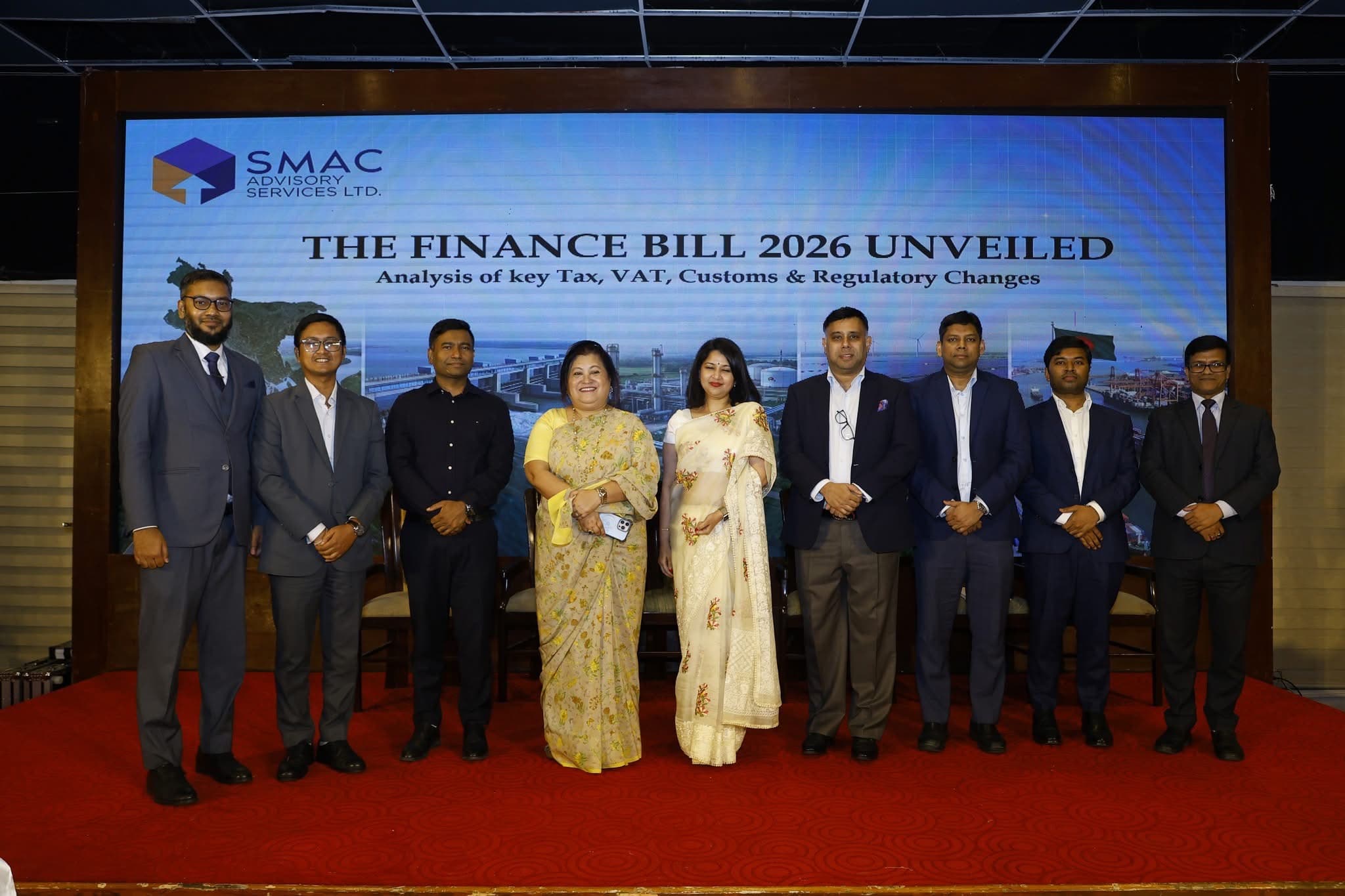
The observations were made at a discussion titled “The Finance Bill 2026 Unveiled” organised by SMAC Advisory Services Ltd at Gulshan Club in Dhaka on Sunday evening.
Policy Exchange Bangladesh founder and CEO Dr. Masrur Reaz said the budget reflects a “green signal” in the current economic context, indicating a broadly supportive and accommodative stance.
“This is a compassionate budget. It has tried to support people and businesses. No major new burdens have been imposed,” he said.
He noted that the budget has attempted to ease pressure on households and businesses through tax measures and policy adjustments, offering some relief amid prolonged economic stress.
Dr. Reaz also described the budget’s policy direction as a “yellow signal,” saying it sends positive messages to investors, although concerns remain over execution and realism of targets.
He said a budget typically performs three key functions—tax and rate adjustments, allocation of public expenditure, and policy signalling.
“We usually expect the budget to solve everything, but in reality, it can only perform these three roles,” he added.
Meanwhile, Foreign Investors' Chamber Of Commerce & Industry (FICCI) President Rupali Chowdhury said listed companies and most industries are already paying multiple layers of taxes and duties depending on their business structure.
She said, “If both revenue and expenditure keep rising, the budget ultimately becomes expenditure-driven.”
She stressed that policy consistency and predictability are essential for business confidence, warning that frequent changes in corporate taxation create uncertainty.
Highlighting investment challenges, she said Bangladesh is competing with countries such as Vietnam, Indonesia and Malaysia for foreign direct investment, making policy efficiency and implementation capacity critical.
She also pointed to long-standing structural bottlenecks, including the lack of an effective one-stop service for investors, bureaucratic procedures across ministries, and infrastructure constraints.
“Our goal should be higher FDI, more employment, and ultimately higher tax revenue. But that requires transparency, accountability and a level playing field,” she said.
She warned that unless structural weaknesses are addressed, economic pressures could intensify, with the tax burden increasingly shifting to compliant taxpayers.
The event was moderated by SMAC Advisory Services Ltd partner Snehasish Barua.
Among others, NBR First Secretary (Customs Policy Wing) Md. Tarique Hassan, Second Secretary (VAT Policy) Bodruzzaman Munshi, and Joint Commissioner of Taxes Bapon Chandra Das also attended the discussion.