
Capital inadequacy has earned Janata Bank's UAE outfit regulatory restrictions on its operations in the gulf state, setting off its headquarters' urge for government bailout, sources say.
They have said the Central Bank of the United Arab Emirates (UAE) has imposed sweeping regulatory restrictions on the UAE operations of the state-owned Janata Bank of Bangladesh after the lender failed to meet the country's minimum capital-requirement criterion.
The bank has been directed to begin a phased winding-down of its business in the wealthy Arab nation.
In view of the brewing crisis, the Janata Bank headquarters has urgently requested the Financial Institutions Division (FID) of the finance ministry to convene a high-level emergency meeting involving Bangladesh Bank (BB), the Ministry of Foreign Affairs (MoA) and diplomatic channels for a bailout.
According to an official letter sent by Janata Bank's Managing Director, Md. Mazibur Rahman, to the finance ministry, the central bank of the UAE issued strongest directives following the bank's failure to meet regulatory capital benchmarks.
The paid-up capital of Janata Bank's UAE branch operations currently stands at 100-million dirham (USD27.23m). However, under UAE regulations, the bank is required to maintain a minimum capital requirement of 400- million dirham to sustain its banking license, leaving an immediate capital deficit of 300 million Dirhams.
Furthermore, the Janata Bank's head office in Bangladesh faces an obligation to maintain 2.0 billion dirham (or equivalent) in capital. While a formal commitment letter signed by the bank's Chairman, M. Fazlur Rahman, was sent to the UAE authorities promising a capital hike, the measures were deemed insufficient to stave off regulatory action.
The UAE central bank has suspended all debit transactions of the bank's UAE operations save payments against verified claims and withdrawals by existing depositors.
"The Central Bank of the U.A.E. has decided to impose controls on debit transactions from the accounts of Janata Bank PLC held with the Central Bank, allowing only debits against customer claims, in order to prioritise depositor protection and to safeguard financial stability," according to the UAE monetary authority.
It added, "Based on this decision, we expect the bank not to engage in new customer relationships and focus on winding down the existing business and obligations, ensuring full fulfillment of all obligations."
The regulator also mentioned: "As of immediate effect, the bank is required to stop any transfer and/or withdrawal from its accounts held with the Central Bank and request approval by email from the Central Bank for all debit transactions related to customer claims from these accounts..."
The UAE central bank has also prohibited the bank from opening new accounts or on boarding new customers and instructed it to take necessary steps to gradually scale down its banking operations in the country.
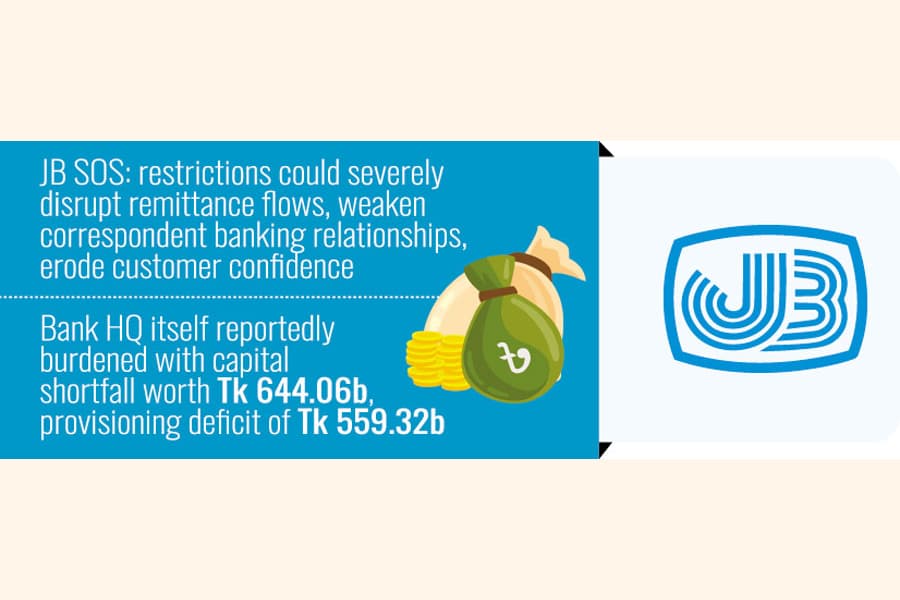
The Janata Bank management has warned that the restrictions could severely disrupt remittance flows from the UAE, weaken correspondent banking relationships and erode customer confidence.
On a further note of alarm, the bank has expressed concern that the development could tarnish not only Janata Bank's international standing but also the reputation of Bangladesh's banking sector.
Following its 894th emergency board meeting, the state-owned bank requested the government to coordinate an urgent national response.
The public-sector bank also has recommended engaging the Bangladesh ambassador to the UAE through diplomatic channels to seek a resolution with the UAE authorities and prevent further deterioration of the situation.
Beyond the crisis in its UAE branches, the overall domestic financial health of the bank is under severe strain, characterized by record losses, a massive bad-loan volume, and a staggering capital deficit.
As of December 2025, Janata's financial health deteriorated sharply as its stock of non-performing loans (NPLs) surged to Tk 725.39 billion, exposing the state-owned lender to an unprecedented balance-sheet crunch.
The mounting volume of unrecovered loans pushed the bank's actual capital shortfall to a record Tk 644.06 billion, while its provisioning deficit-the mandatory reserves required against classified loans-widened to Tk 559.32 billion, according to official financial data.
The bank also posted a staggering net loss of Tk 39.31 billion for 2025. Its core banking operations remained under severe stress, with net interest income staying deeply in the red as interest operations alone incurred a loss of Tk 59.03 billion.
Currently, there are four overseas branches operating In the UAE, including Abu Dhabi, Al Ain, Dubai and Sharjah.
rezamumu@gmail.com