


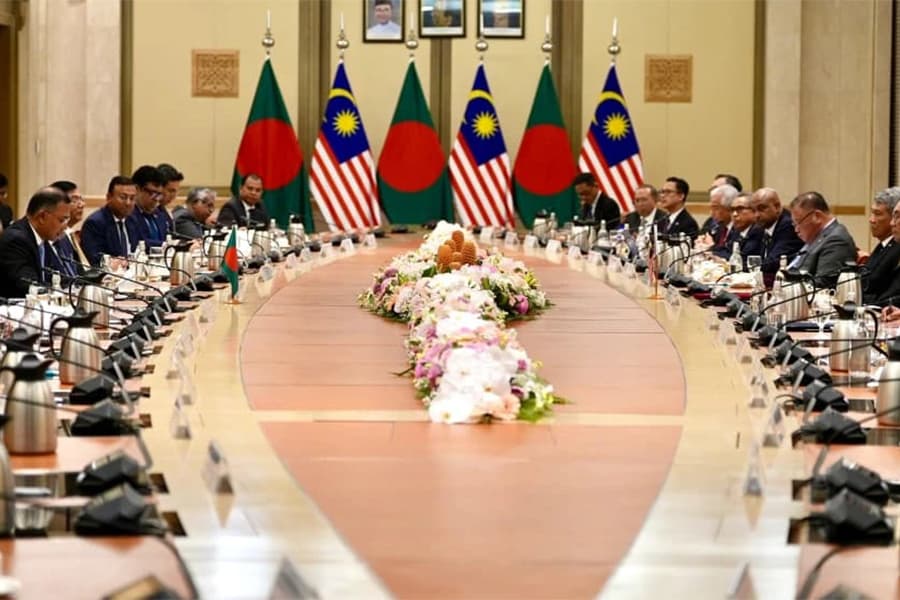
Bangladesh and Malaysia on Monday expressed their commitment to advancing negotiations with a view to concluding a Free Trade Agreement (FTA) between the two countries in 2027, for a "mutually beneficial, comprehensive and forward-looking" agreement that reflects current global trading practices.


The leaders, Prime Minister Tarique Rahman and Malaysian Prime Minister Anwar Ibrahim, welcomed the progress made towards the commencement of negotiations on the FTA between the two countries, UNB reported, citing a joint statement shared by the Ministry of Foreign Affairs.
Both leaders acknowledged the significance of bilateral trade and investment relations, noting that Bangladesh remains Malaysia's second-largest trading partner in South Asia.
They expressed their commitment to further strengthening economic cooperation and facilitating two-way trade and investment.
The two prime ministers welcomed the progress made in the establishment of the Malaysia-Bangladesh Joint Business Council (JBC), which will serve as the key bilateral institutional mechanism for structured dialogue and the exchange of ideas to facilitate active collaboration between the private sectors of the two countries, thereby expanding bilateral economic, trade and investment ties.
Stressing the importance of enhancing trade, investment and sustainable economic partnership, the leaders encouraged greater collaboration across priority sectors including telecommunications, energy, infrastructure (e.g., roads, bridges, elevated expressways and digital public infrastructure), ports and logistics, the halal industry, agro-processing, education and skills development, the digital economy, semiconductors, smart manufacturing and other high-value industries.
The leaders further encouraged closer cooperation between relevant government agencies, investment promotion agencies, industry players and business communities of both countries through investment facilitation, technical cooperation, capacity building, technology transfer, talent development, business matching and strategic partnerships, aiming to foster industrial upgrading, strengthen regional and global value chain participation, and create mutually beneficial investment opportunities for both nations.
They acknowledged the significant commercial potential of the global Islamic economy.
Recognising Malaysia’s expertise and extensive experience in the development of the halal ecosystem, they agreed to strengthen bilateral cooperation in support of Bangladesh’s development of its halal sector.
They acknowledged the Exchange of Notes on Cooperation in the Field of Halal Ecosystem and welcomed ongoing collaboration between the Department of Islamic Development Malaysia (JAKIM) and the relevant regulatory authorities of Bangladesh.
They reaffirmed their commitment to further enhancing cooperation in areas including halal certification, the development of regulatory frameworks, capacity building and training of professionals, research and innovation, as well as institutional strengthening.
Labour Cooperation
In line with Malaysia’s current policy on foreign labour intake, both Bangladesh and Malaysia recognised that approvals for new foreign worker quotas are currently evaluated strictly on a case-by-case basis, contingent upon verified employer requirements and sectoral ceilings.
"For any such approved quotas, both nations reaffirmed their commitment to ensuring the recruitment process is transparent, fair, non-discriminatory, and competitive, utilising only credible and qualified recruitment agencies," according to a joint statement shared by the Ministry of Foreign Affairs.
Both countries have agreed to convene the Joint Working Group (JWG) to ensure the "continued, safe, and mutually beneficial" migration of Bangladeshi workers to Malaysia.
The meeting will focus on evaluating the existing Memorandum of Understanding (MoU) and laying the groundwork for drafting a new, updated MoU that meets the current needs of both nations.
Malaysia acknowledged Bangladesh’s proposal regarding the recruitment of workers.
The leaders, Prime Minister Tarique Rahman and Malaysian Prime Minister Anwar Ibrahim, recognised the importance of people-to-people connectivity and welcomed the contribution of Bangladeshi workers to the development of Malaysia.
They noted that the Bangladeshi expatriate community plays a part in fostering bilateral exchanges and shared economic activities between Malaysia and Bangladesh.
Education and Tourism Cooperation
Recognising the presence of around 11,000 Bangladeshi students in Malaysia, and their positive contribution to academic exchange and socio-economic linkages between Bangladesh and Malaysia, as well as the value they bring upon returning to Bangladesh, both leaders agreed to strengthen cooperation in the field of education, including through university-to-university partnerships and joint research programmes, focusing on technical and vocational education and training (TVET).
Both sides emphasised the importance of expanding mutually recognised qualifications, joint degree programmes and flexible learning pathways.
The leaders also stressed the importance of aligning academic programmes with labour market needs and priority sectors in both countries, with particular focus on graduate mobility and skills development.
Both leaders expressed optimism about expanding tourism cooperation, particularly in light of Malaysia’s "Visit Malaysia 2026" (VM2026) and "Malaysia Year of Medical Tourism 2026" (MYMT2026) campaigns.
Malaysia extended a warm welcome to Bangladeshi travellers, and the leaders agreed to enhance tourism promotion and cultural exchanges between the two countries.