


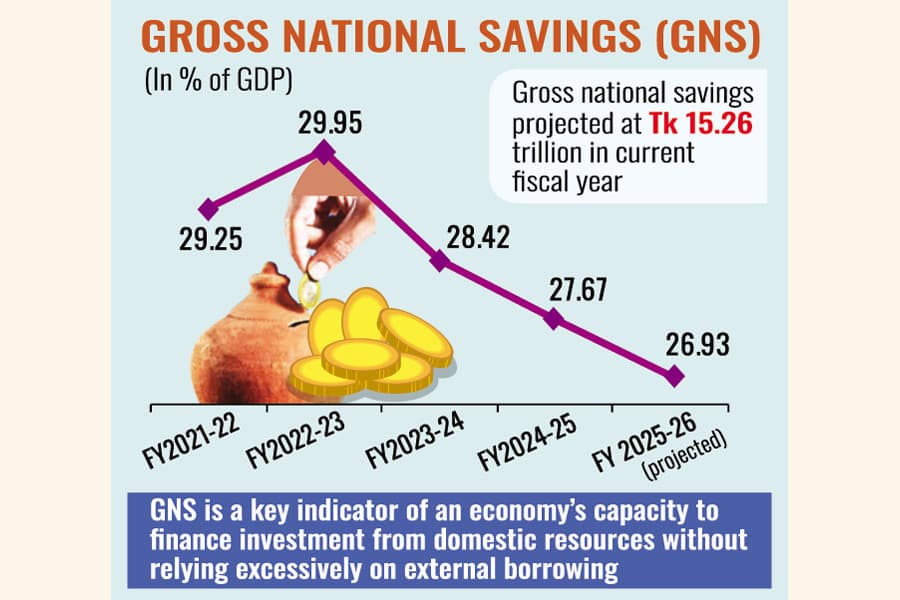
Bangladesh's gross national savings (GNS) are projected to decline to 26.93 per cent of gross domestic product (GDP) in the outgoing fiscal year-hitting a five-year low,


The latest savings figure collated by Bangladesh Bureau of Statistics (BBS) marks a decline of 0.74-percentage points from the estimated 27.67 per cent recorded in the past FY2024-25, extending a downward trend that began after the post-pandemic peak.
Economists attribute the fall in national savings to mounting pressure on household finances amid persistently high inflation, slower income growth and subdued private-sector investment.
The country's GNS stood at 29.25 per cent of GDP in FY2021-22 before rising to a five-year-high 29.95 per cent in FY2022-23.
Since then, it has steadily declined to 28.42 per cent in FY2023-24, 27.67 per cent in FY2024-25 and an estimated 26.93 per cent in FY2025-26.
In terms of volume, gross national savings are estimated at Tk 15.26 trillion in the current fiscal year.
Gross national savings measure the portion of national disposable income that remains after total consumption expenditure is deducted.
It is a key indicator of an economy's capacity to finance investment from domestic resources without relying excessively on external borrowing.
Economists say the dip in savings reflects deeper structural challenges facing the economy.
"Households are increasingly spending a larger share of their income on essential goods and services because of prolonged inflationary pressure," Dr Zahid Hussain, former lead economist at the World Bank's Dhaka office, told The Financial Express.
"When inflation remains elevated for a prolonged period, particularly since the outbreak of the Ukraine war, families dip into their savings to maintain consumption. As a result, aggregate national savings tend to decline."
Bangladesh has experienced inflation above the government's comfort range for several years. Rising food, transport and utility costs have significantly eroded purchasing power, particularly among low- and middle-income households.
Weak private investment has also contributed to the decline in savings.
Economists note that savings and investment are closely linked. Lower profitability, an uncertain business environment, foreign-exchange constraints and higher borrowing costs have discouraged fresh private investment, reducing incentives for businesses and households to save.
Dr Mohammad Yunus, research director at Bangladesh Institute of Development Studies (BIDS), told the FE that actual household savings could be much lower as a significant share of national savings comes from corporate entities and autonomous and semi-autonomous government organisations.
He says the decline in savings should serve as a warning for policymakers.
"A sustained decline in national savings reduces the pool of domestic resources available for investment. If investment demand recovers while savings remain weak, the economy may become increasingly dependent on foreign borrowing," he notes.
The latest figures also highlight a widening gap between Bangladesh's long-term development ambitions and current macroeconomic realities.
Historically, high domestic savings have been a key driver of rapid economic growth across Asia. Countries such as China, South Korea and Vietnam maintained high savings rates during their industrialisation, enabling them to finance large-scale investment programmes.
Although Bangladesh's savings rate remains comparatively strong by regional standards, the recent decline suggests growing stress in the economy.
Dr M Masrur Reaz, chairman and chief executive officer of Policy Exchange Bangladesh, thinks restoring macroeconomic stability would be crucial to reversing the trend.
"Bringing inflation under control, improving investor confidence, ensuring stable energy supplies and strengthening financial-sector governance are among the measures needed to improve the situation," he suggests.
He adds that there is a direct relationship between macroeconomic stability and household saving behaviour.
"When people are confident about future income prospects and inflation is moderate, they are more likely to save. Conversely, prolonged uncertainty discourages savings and long-term investment decisions."
The government and Bangladesh Bank have recently adopted tighter monetary and fiscal measures aimed at containing inflation and stabilising the external sector.
Dr Md Ezazul Islam, director-general of Bangladesh Institute of Bank Management (BIBM), says inflation could have been much higher without the central bank's tight policy stance.
"We believe these tighter policy measures will help ease inflationary pressures in the coming months."
For now, however, the provisional BBS estimates suggest Bangladesh's domestic savings base is under increasing pressure, stoking concerns about the economy's ability to sustain investment-led growth without greater reliance on external financing.
jasimharoon@yahoo.com