


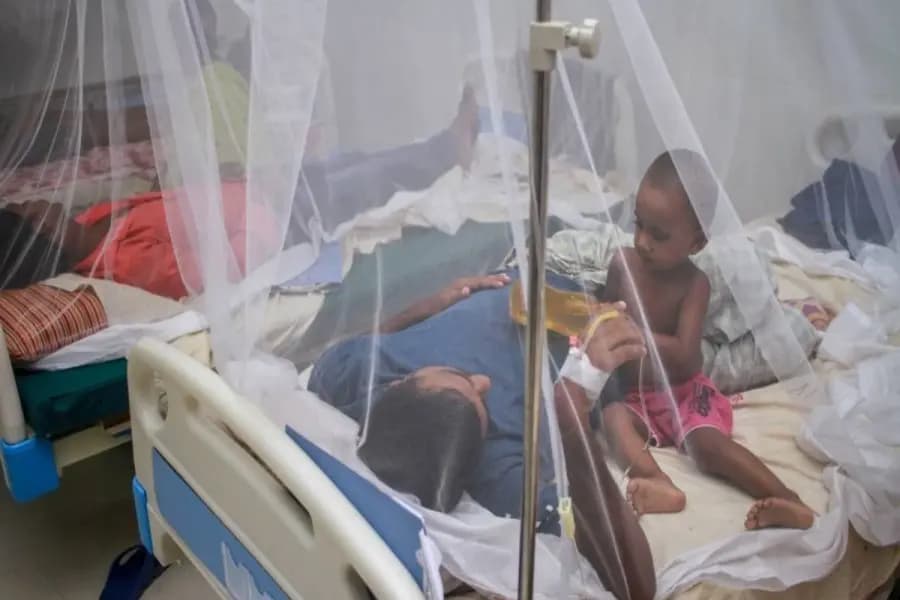
The dual outbreak of dengue and measles has placed an overwhelming strain on Bangladesh's healthcare system as it has resulted in a combined burden of over 803 measles-related deaths and 38 dengue fatalities, with both diseases heavily impacting vulnerable children and straining nationwide hospital resources, according to the Directorate General of Health Services (DGHS) bulletin as of July 22. Clearly, the ever-rising number of deaths from the confirmed as well as suspected-measle cases has proved the health and family welfare minister wrong. That is because more than three months ago in April he told a press briefing that the situation arising from the outbreak of measles would come under control with the nationwide vaccination campaign started from the third week of April. The stock of every type of vaccine, he assured, was then sufficient to run the immunisation programme smoothly up to June.


However, since the measles have yet to come under control even by the end of July, serious question arises about the government's preparedness for combating measles. Now that the monsoon rains have caused water to stagnate across the country, it has created the ideal condition for the dengue vector, Aedes mosquito, to spread, raising again the spectre of dengue reaching epidemic proportions as in 2023 when record-breaking 1,705 fatalities occurred. The crisis continued as an ongoing epidemic with over 100,000 cases being reported both in 2024 and 2025. Now the late July of 2026 is witnessing an accelerated surge of dengue infections crossing 11,500 nationwide since the beginning of the year, with a reported sharp spike in daily hospitalisations. Meanwhile, health experts have been warning that dengue infections can multiply significantly in August and September. Evidently, it is a double, or might it be termed, a multiple, whammy, for the government as it is now faced with two different kinds of epidemics, one from the uncontrolled measles, while the other from the surging infections from dengue.? The health minister did try to assure the public of managing the measles though with little success so far. So far, the government's nationwide cleanliness drives, public awareness campaign and the establishment of a special task force, namely, National Committee on the Prevention of Dengue and Other Mosquito-Borne Diseases, supervised by the LGRD ministry have failed to prevent the reported spike in dengue cases.
True, instructions have been given to the hospitals to reserve at least 10 per cent of their beds for dengue patients, while the health ministry did extend free NS 1 testing facility for dengue at all public hospitals. But unless the prevention of dengue is ensured through eradication of the mosquito, it is not possible to eliminate the threat from vector-borne disease entirely. But the said task force is yet to report on coming up with any groundbreaking idea or method for successfully exterminating larvae of the dengue vector or altogether sterililising or controlling the reproduction cycle of Aedes mosquito. Since chemical agents to eliminate adult Aedes mosquitoes or their larvae have been proving ineffective against the adapting mosquitoes, biological options like the one indicated by the research organisation icddr,b could be considered.
Notably, a study done by icddr,b, for instance, found that releasing the vectors infected with the Wolbachia bacteria could reduce Aedes mosquito's ability to transmit the dengue virus by 92 per cent in lab settings. With two epidemics raging on simultaneously, it is time the government moved decisively to put in place a health regime capable of combatting both the diseases of measles and dengue.