



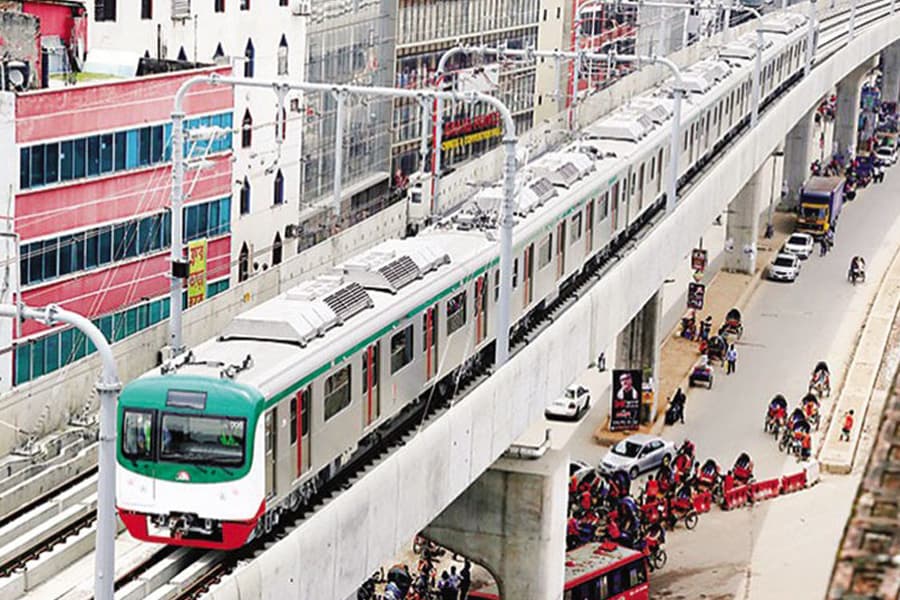
The unearthing of serious structural deficiencies in Dhaka's MRT Line-6 has understandably caused widespread concern. Barely 30 months after the country's first metro rail system entered service, questions are now being raised not only about the quality of the ride but, more importantly, about the dependability of the infrastructure itself. Report of an independent technical committee indicates that more than one-fifth of the bearing pads installed along the elevated corridor have been found defective, forcing the Dhaka Mass Transit Company Limited (DMTCL) to impose speed restrictions at several locations. Trains that were designed to operate at speeds exceeding 100 kilometres per hour are now compelled to slow down, while commuters increasingly complain of uncomfortable jerks and bumps during their journeys. Such inconveniences may appear minor at a first glance, but they often signal deeper engineering concerns that deserve immediate and transparent attention.
The committee was constituted following a High Court directive after a bearing pad fell from an elevated pier near Farmgate last October, killing a pedestrian. An earlier incident of a similar nature had occurred only weeks before, fortunately without causing casualties. Such occurrences are exceptionally uncommon in modern metro systems worldwide, making their recurrence on Bangladesh's first metro line particularly disquieting. The report also raises broader questions about project implementation. It observes that portions of MRT Line-6 were opened before the entire corridor had been completed and before operations and maintenance teams had attained full preparedness. More alarmingly, the committee documented cracks in pier heads, concrete bases and box girders, excessive train-induced vibration, abnormal wheel wear, deficiencies in dynamic performance assessments, inadequate third-party verification and an alarming absence of a permanent structural health monitoring system. It also highlighted shortages of maintenance equipment, spare parts and institutional capacity. Perhaps the most sobering aspect of the investigation report is its conclusion that these are not isolated maintenance failures. Rather, they point to a broader pattern of weaknesses spanning design assurance, construction quality control, independent verification, dynamic performance validation, maintenance preparedness and operational oversight.
The recommendations offered by the committee deserve urgent implementation. Immediate replacement of defective bearing pads, repair of damaged structural elements, elimination of operational hazards, completion of independent third-party verification, installation of a permanent structural health monitoring system and strengthening of maintenance capacity should proceed without delay. Equally important is the proposal to engage an internationally accredited independent auditor to verify the safety and structural integrity of the entire system.
Dhaka's metro rail remains one of the country's most transformative investments, offering immense economic, environmental and social benefits. Its long-term success, however, will depend less on its engineering ambition than on the integrity with which it is maintained. The current findings should therefore be viewed not as an embarrassment to be downplayed but as an opportunity to rectify shortcomings, strengthen institutional accountability and establish a culture where safety always takes precedence over speed of delivery. Public trust, once shaken, can only be rebuilt through transparency, professionalism and an unwavering commitment to excellence.