



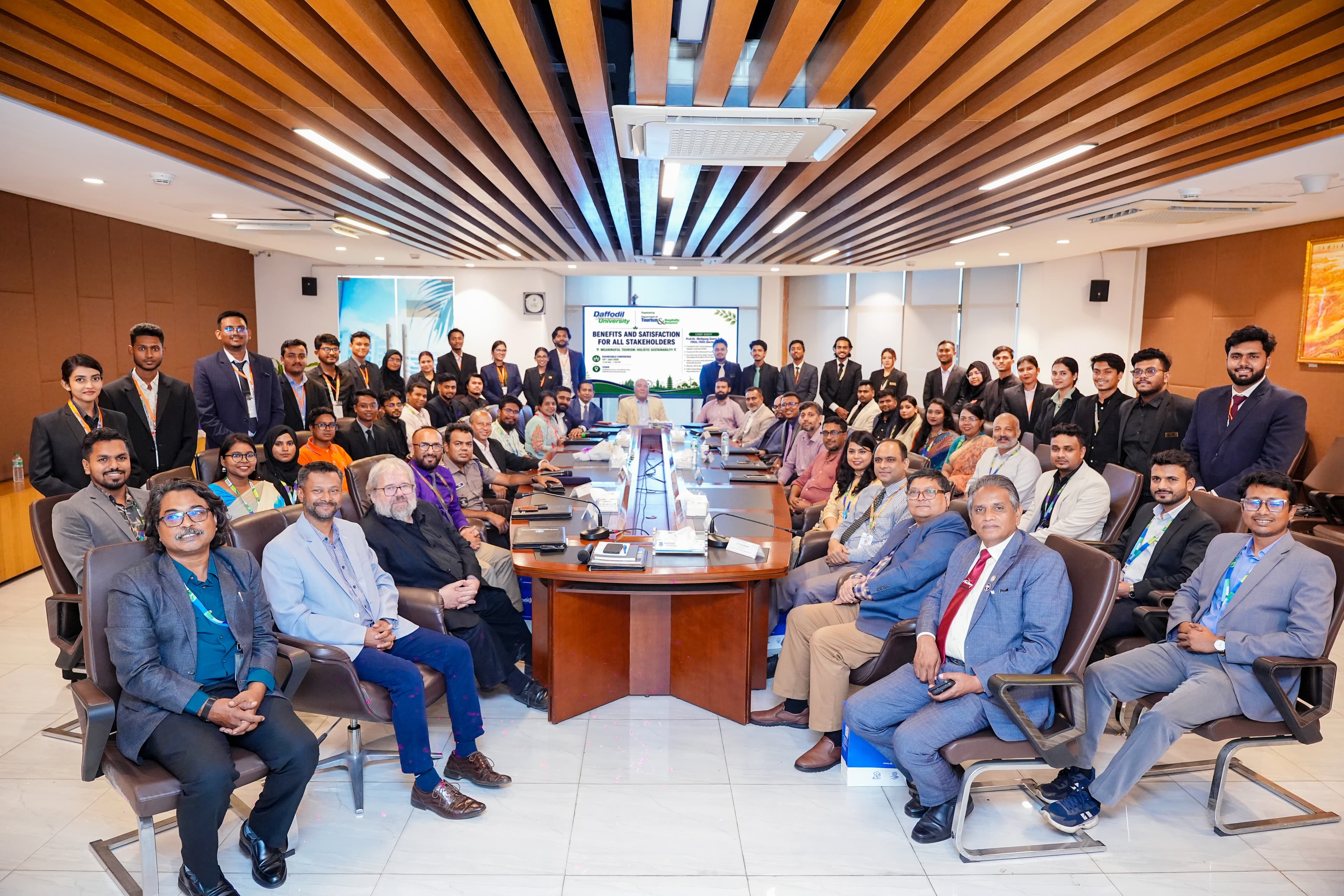
A national roundtable discussion titled "Meaningful Tourism: Perspectives on Planning and Sustainability," involving key stakeholders from the country's tourism sector, was held today, July 14, 2026, at the International Conference Room of Daffodil International University at Birulia, Savar, Dhaka.
Professor Dr. Wolfgang Georg Arlt (FRGS, FRAS)—an internationally renowned tourism expert from Germany presented the keynote paper and offered significant guidance during a meaningful discussion on the future of Bangladesh's tourism sector, according to a media release.
The objective of this roundtable discussion is to highlight the concept of ‘Meaningful Tourism’ as a powerful tool capable of ensuring the development of the tourism and hospitality sectors—development that yields tangible benefits and spiritual fulfillment for all stakeholders.
The session commenced with a welcome address by Professor Dr. Mohammad Rakibul Kabir, Dean of the Faculty of Business and Entrepreneurship of Daffodil International University, and was moderated by Associate Professor Mahabub Parvez from the same faculty.
Participants included Mohammad Hanif, President of the Tour Operators Association of Bangladesh (TOAB); Md. Ziaul Haque Howlader, General Manager of the Bangladesh Tourism Corporation; Md. Jalal Uddin Tipu of the Association of Travel Agents of Bangladesh (ATAB); Md. Tawfiq Rahman, Secretary General of PATA Bangladesh; Mofizur Rahman, Managing Director of Novoair; Rizwan Maruf, Director (Marketing) of InterContinental Dhaka; Md. Sakhawat Hossain, CEO of The Westin Dhaka; and prominent leaders of the tourism industry.
Speakers at the roundtable discussion noted that the world is changing, and the tourism sector is evolving alongside it.
Factors such as climate change, artificial intelligence (AI), and shifting tourist demands and behaviors are rendering many traditional business models obsolete; yet, they are simultaneously creating opportunities to develop new services and destinations.
Currently, the influx of international tourists into Bangladesh is negligible; in terms of per capita tourist numbers, the country ranks among the lowest globally.
If both the public and private sectors remain vigilant and learn from the mistakes made by other tourist destinations—such as damage to nature and culture, the strain of over-tourism, and the outflow of the lion's share of tourism revenue abroad—it is possible to transform this challenge into an opportunity.
Speakers noted that despite its rich culture, diverse landscapes, and vibrant biodiversity, Bangladesh has not been able to fully harness its potential as a tourism destination; for instance, in 2025, only 650,000 foreign tourists visited the country, spending 440 million US dollars.
Although home to more than 2 percent of the global population, Bangladesh has managed to attract only 0.05 percent of international tourists.
Yet, half the world's population lives within just a four-hour flight from Bangladesh. By prioritizing service quality over sheer visitor numbers—and specifically by offering specialized services tailored to regional source markets—Bangladesh has a tremendous opportunity to significantly enhance its stature as a global tourism destination in the second half of the twenty-first century, the release adds.