


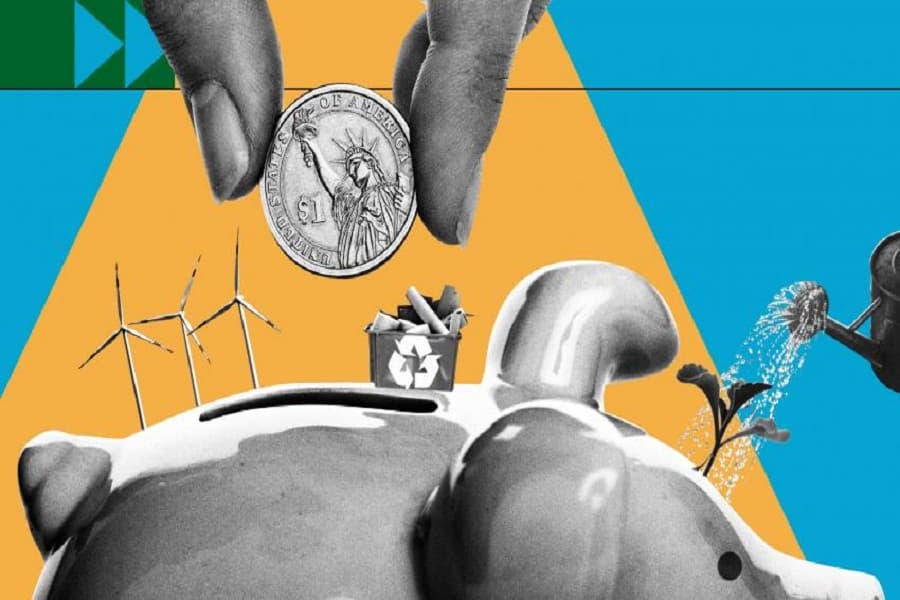
The severity of climate change warrants efforts on two fronts. One is targeted towards mitigating Climate Change and its impacts, and the other focuses on adapting to the changing climate. The goals of both measures are quite the same, that is, ushering in a more sustainable and greener world.
An analogy that makes the situation abundantly clear follows. Suppose you are on a boat in the middle of the sea, and suddenly there’s a leakage. Consequently, quite a bit of water has rushed in. Now, you have to do two things. You have to plug the hole and remove the water that has already rushed in. Mitigation and adaptation are quite like that, activities that complement each other.
But even so, according to Climate Policy Institute, private financing to adaptation is 0.33% of the financing that goes to mitigation.
Again, adaptation funds only consisted of 10% of total climate financing worldwide. And the existing adaptation funds go primarily to affluent countries, not poorer nations who actually need the support.
While the rich countries continue to miss their promised yearly $100 billion pledge (by far too, that is, Oxfam states only 20-22 per cent actually meet climate financing criteria), it is important for us to understand why the gap exists and what the impacts of that are.
Why the gap exists between adaptation and mitigation
The first major reason adaptation funding is so neglected is its impacts are difficult to track. Mitigatory steps have a very trackable metric, which is the amount of carbon emitted. There are many good scientific ways to measure this emission, and consequently, the impact that those steps are having can also be measured.
However, adaptation cannot be measured like this. Because adaptation is context specific, some of its impacts may take years to materialise.
For instance, building a stronger shelter for a coastal family can be an adaptive practice. Its actual impact cannot be measured right away. The impact of adaptive efforts on carbon reduction is hard to quantify. Predicting and quantifying the damage done by disasters is also tricky and unreliable.
Oftentimes, mitigatory steps are for-profit practices, especially from the private sector. They are targeted at creating new industries, employment opportunities and new frontiers. However, Adaptative measures seldom have opportunities for commercialised industries, as they are mostly humanitarian efforts.
Mischaracterisation of funds
There are specific markers designating the difference between climate financing and development financing. The OECD DAC Rio markers are the most widely used set of characterisation used by countries. The climate change adaptation marker specifically identifies projects and programs aimed at reducing the vulnerability of communities and ecosystems to the impacts of climate change and improving their resilience.
However, development fund is often mischaracterised and passed off as climate funding. Funding for building roads, bridges and other infrastructure in a non-vulnerable area does not count as climate funding.
Many donors abuse the established characterisation, resulting in a vast amount of funds being mischaracterised. This explains why Oxfam puts that only 20% of the fund provided by developed countries meet the proper criteria.
Most of the funds come in the form of loans, not grants. This is especially problematic when considering that most of the funding is intended towards developing economies, which cannot sustain growing debt levels.
The need for adaptation finance
The impacts of Adaptive steps take time to become visible. Adaptation ensures safety and security for vulnerable communities and their future generations. It enables access to education, healthcare and many other fundamental rights for these communities.
According to UNEP Adaptation Finance GAP Report, adaptation needs may reach up to $300 billion yearly worldwide in this decade. But right now, only 17 per cent of that need is actually being met.
The impact of climate change can be reduced from 50-90 per cent in regions around the world, according to UNFCCC, by adaptive measures. While globally, adaptation can achieve a damage reduction of roughly $35 trillion at the cost of US$3 trillion within the next two centuries. Adaptation will continue to be the primary cost reducer till 2100, after which the mitigatory steps we are taking now will inhibit the most damage.
While the world is increasingly becoming more aware of climate change, shifting to renewable alternatives and energy sources, we must also stop for a moment and acknowledge what exactly all these measures amount to. Because a greener world will do no good if no one isn’t anyone left alive. And as things stand, Bangladesh still is, among the highly populated countries, the ground zero for climate change.
sabitanan007@gmail.com