


A few years ago, Nil Komol, a farmer in Shyamnagar upazila of Satkhira, was considering abandoning agriculture.
Successive cyclones, rising soil salinity and an acute shortage of freshwater had sharply reduced the productivity of his land.
Traditional rice varieties no longer yielded satisfactory harvests, while rising production costs and increasingly erratic weather made farming an uncertain livelihood.
"There were years when I wondered whether farming still had a future here," Nil Komol said, adding, "Many people from our area left for cities because agriculture was becoming too difficult."
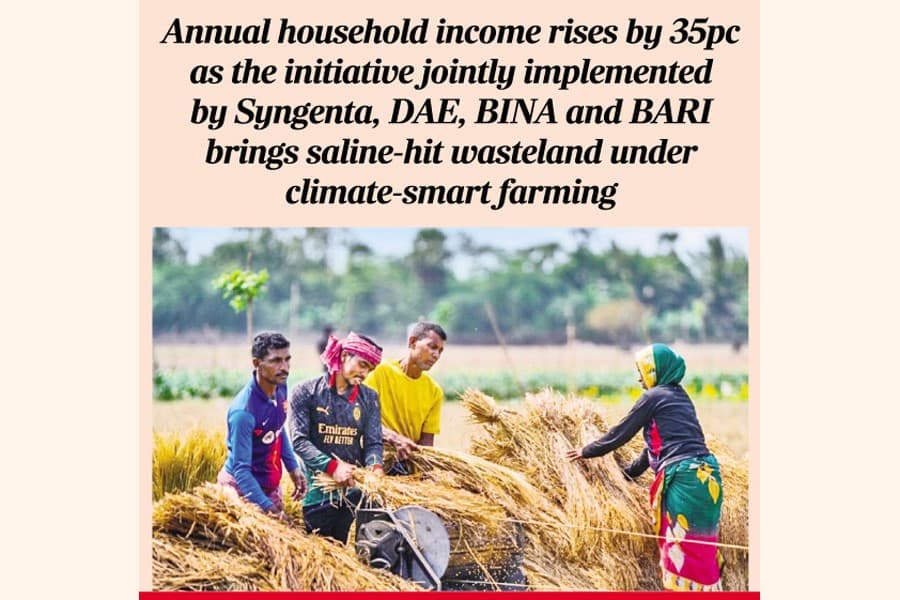
Today, his fields present a striking contrast. He cultivates salt-tolerant rice and vegetables, irrigates crops with harvested rainwater and follows improved soil-management practices that have restored productivity on land once considered unsuitable for farming.
His experience reflects a broader transformation taking place across parts of Bangladesh's climate-vulnerable coastal belt under GoGrow: Enriching the Livelihood of Coastal Belt Farmers, an initiative implemented by Syngenta Bangladesh in collaboration with the Department of Agricultural Extension (DAE), Bangladesh Institute of Nuclear Agriculture (BINA), Bangladesh Agricultural Research Institute (BARI).
Shyamnagar is among the country's most climate-exposed areas, where sea-level rise, saline water intrusion, erratic rainfall, floods and cyclones continue to threaten agriculture and rural livelihoods.
"Salinity has become one of the biggest constraints to agricultural production in the coastal region," said Waliul Islam, Upazila Agriculture Officer of Shyamnagar.
"Farmers need integrated solutions involving water management, climate-resilient crops and improved farming practices if productivity is to be sustained," he added.
Rather than focusing solely on increasing production, the GoGrow initiative was designed to strengthen farmers' resilience to climate change.
The programme began by assessing soil condition, water availability and livelihood vulnerabilities before introducing saline- and drought-tolerant crop varieties developed by BINA and other research organisations.
More than 23 diversified crops, including rice, maize, sunflower, mustard, pulses and vegetables, have been promoted under the programme, reducing farmers' dependence on single-season rice cultivation.
Addressing freshwater scarcity has been another major priority.
The project has established 35 rainwater-harvesting reservoirs and restored 6.7 kilometres of canals to capture and conserve rainwater for irrigation during the dry season.
Solar-powered irrigation systems have also been introduced, reducing dependence on diesel-operated pumps and lowering production costs.
For Popy Rani, another beneficiary of the project, improved access to irrigation has transformed farming opportunities.
"Previously, we could cultivate only one crop because freshwater was unavailable for the rest of the year," she said. "Now we can grow vegetables and other crops after the rice season, which has increased our household income."
According to project data, the initiative has directly benefited more than 410 farming families and supported climate-smart cultivation on over 250 acres of land.
Farmers reported yield increases of 25 to 30 percent, while annual household incomes have risen by around 35 percent, according to the project data.
The programme has also helped reduce migration from vulnerable communities, with project officials estimating that nearly 80 per cent of potential migration among participating households has been prevented as farming becomes more profitable and sustainable.
Beyond boosting crop production, GoGrow promotes regenerative agriculture aimed at restoring soil health and improving environmental sustainability.
Farmers receive training on mulching, zero tillage, vermicomposting, balanced fertiliser use and the safe application of crop protection products.
Three vermicompost plants established under the initiative now produce around 25 tonnes of organic fertiliser annually, while more than 5,000 tree saplings have been distributed among farmers and school students to enhance biodiversity.
Capacity building remains a key component of the programme. More than 80 training sessions have covered climate-smart farming, agronomy, livestock management, financial literacy, health and nutrition. A lead-farmer network has also been established to encourage peer learning and sustain project outcomes.
The initiative further integrates fisheries and livestock into household farming systems.
Livestock vaccination campaigns have supported more than 350 animals, while fish cultivation in 35 reservoirs has created an annual production capacity of around 2.8 tonnes.
Health, nutrition and telemedicine services have also been extended to hundreds of farming families.
Dr Babul Akhter, principal scientific officer at BINA, said integrated approaches are essential for safeguarding coastal agriculture against climate change.
"The future of coastal agriculture depends on building resilience," he said. "Projects that combine water management, soil restoration, renewable energy and farmer capacity-building offer a sustainable pathway for the sector."
tonmoy.wardad@gmail.com