


Prime Minister Tarique Rahman Wednesday announced a landmark initiative bringing all government welfare programmes onto a single platform through the introduction of 'Universal Card' for greater social and financial security for working people, marginal farmers and disadvantaged communities.
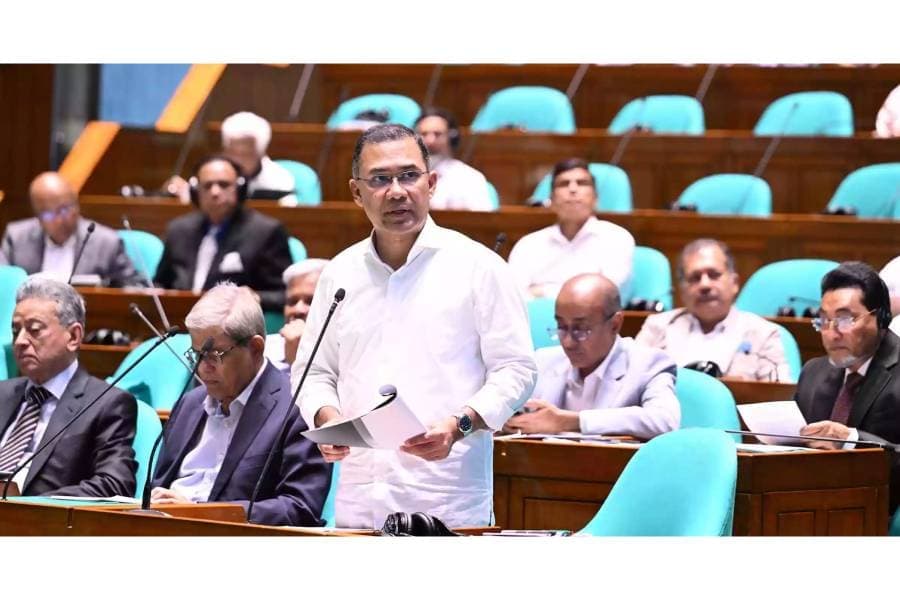
Delivering his closing speech at the second session and first budget session of the Jatiya Sangsad, the prime minister said the government plans to gradually integrate all existing welfare cards into one universal identity card through which citizens will be able to access all state benefits.
"The state has a responsibility towards its citizens. If it fails to fulfill that responsibility, both the people and the state become weaker," he told parliament in his valedictory speech.
Rahman said the benefits provided through Family Card, Farmer Card, Sports Card, Expatriate Card, and special cards for imams, muezzins and religious leaders are not acts of charity by the government rather the state's obligation towards its citizens.
"As part of fulfilling that responsibility, all these separate cards will eventually be integrated into a single Universal Card, allowing citizens to receive every government benefit through one unified identity."
The prime minister also stressed that both the government and the opposition remained united in preventing return of authoritarian rule and resisting foreign influence.
"I believe both the government and the opposition are always united in preventing the recurrence of authoritarianism and resisting foreign subservience," he said.
A significant portion of Rahman's address focused on agriculture and the welfare of marginal farmers.
Describing himself as the son of a farmer, he said a large majority of Bangladesh's population is directly or indirectly dependent on agriculture, making the economic emancipation of farmers essential for the country's overall development.
He recalls that before the last general election, the Bangladesh Nationalist Party (BNP) had pledged to write off agricultural loans of up to Tk10,000, including accrued interest, for marginal farmers if it formed the government.
The prime minister informed parliament that the first cabinet meeting after assuming office approved the implementation of that commitment.
"As a result, nearly 1.3 million marginal farmers across the country whose agricultural loans were up to Tk10,000 have had their outstanding loans, including interest, fully waived," he said, adding that farmers have already started reaping the benefits of the decision.
Rahman also underscored the importance of social-protection programmes and political consensus in supporting the country's vulnerable population.
He noted that he was encouraged when an opposition lawmaker asked in parliament when Family Card would be introduced in his constituency.
The prime minister thanked the opposition leader and opposition lawmakers for supporting welfare-oriented social policies such as the family-card programme.
"There may be differences between the government and the opposition on national and international issues, but when it comes to improving the lives of the country's marginalised people, everyone must work together."
He adds that preventing the return of authoritarianism and foreign dependence requires building a politically and economically self-reliant nation, with reducing economic inequality among disadvantaged communities being the first step towards that goal.
Outlining the government's broader economic vision, Rahman said the administration is determined to transform Bangladesh from a debt-dependent economy into a sustainable investment-driven economy.
Prime Minister Rahman said the government is implementing a long-term economic master plan aimed at transforming Bangladesh into a near-US$1.0- trillion economy by 2034, with increased investment and large-scale employment generation serving as its principal driving forces.
The government is determined to convert the country's vast working-age population into productive national assets rather than leaving young people unemployed.
Under the long-term strategy, the government has set a target of creating 90 million jobs across various productive sectors. This includes one million jobs in the information technology sector and another one million in the blue economy and eco-tourism sectors, alongside employment opportunities in other industries.
Rahman also said the government is rapidly expanding language training, skills- development programmes and modern career centres across the country to equip young people with the qualifications required in overseas labour markets.
Alongside economic and social development, the prime minister announced an ambitious green-employment programme to address climate change and environmental protection.
"Our goal is not only to strengthen Bangladesh politically and economically but also to make the country livable for future generations by confronting the global challenge of climate change," he said.
To that end, the government has launched a five-year megaproject under which 250 million trees will be planted nationwide through voluntary participation and government initiatives. The programme aims to plant an average of 50 million saplings annually.
To support the initiative, the government plans to establish 10,000 new nursery entrepreneurs, creating employment opportunities for approximately 250,000 young men and women, the prime minister said.
Rahman added that earlier in the day, he had formally inaugurated the nationwide tree-planting campaign by participating in an event with primary school students and joining programmes virtually with upazilas across the country, where nearly 200,000 saplings were planted simultaneously.
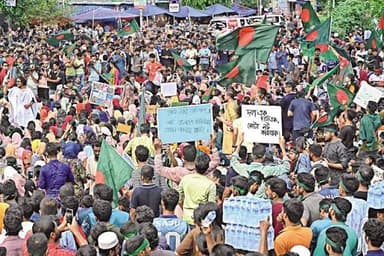
The prime minister also paid tribute to the martyrs of the July Mass Uprising and reaffirmed the government's commitment to establishing people's rule.
He said the 31-point reform agenda, unveiled three years ago following extensive consultations with people at the upazila, district and village levels, has now become a charter for the nation's aspirations.
"The people endorsed this 31-point programme in the last general election. As a result, it is no longer merely the political agenda of the BNP; it has become the aspiration of Bangladesh's 180 million people."
Rahman further said the government remains fully committed to implementing every provision of the July Charter, which was signed before the election by almost all political parties at the South Plaza of the National Parliament.
He said the government is gradually implementing a series of landmark reforms, including the restructuring of constitutional institutions, transforming law- enforcement agencies into fully professional forces, and recruiting 10,000 new police constables to strengthen public security.
Concluding his remarks, the prime minister expressed confidence that through the collective efforts of parliament and the people, Bangladesh would honour the sacrifices of the martyrs and emerge as an egalitarian, extremism-free and genuinely democratic welfare state.
mirmostafiz@yahoo.com