



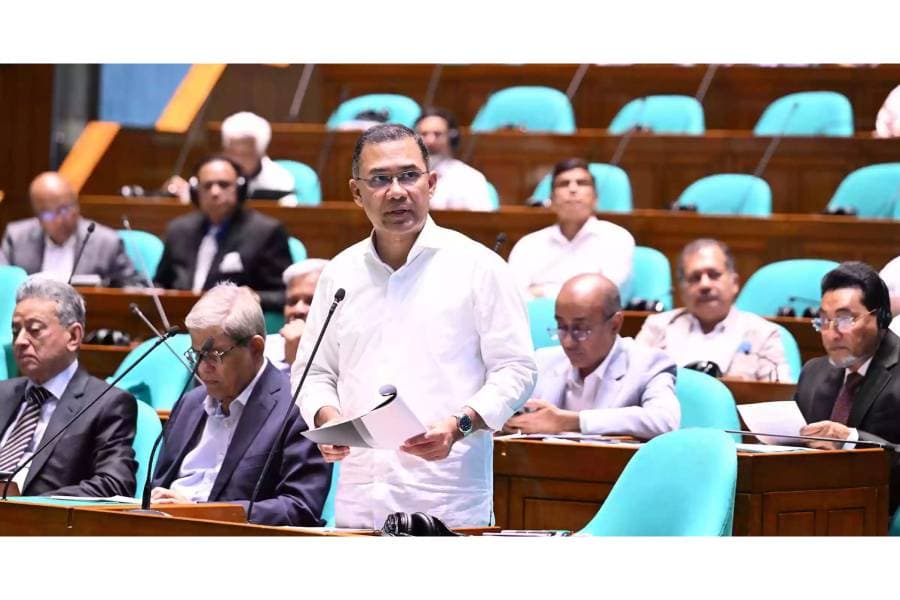
Prime Minister Tarique Rahman on Wednesday announced plans to introduce a Universal Card to bring all government welfare programmes under a single platform, while outlining an ambitious roadmap to create 90 million jobs and transform Bangladesh into a trillion-dollar economy by 2034.
Delivering his winding-up speech at the concluding sitting of the second and budget session of the 13th Jatiya Sangsad, he also reaffirmed his government’s zero-tolerance policy on corruption and extremism, saying decisive steps are being taken to build professional law enforcement agencies, strengthen public safety and protect state resources.
“We have already started implementing programmes such as the Family Card, Farmers’ Card, Sports Card and honorariums for imams, muezzins and other religious leaders. Eventually, all these services will be brought under a single Universal Card,” the Prime Minister told Parliament.
He said welfare benefits should not be viewed as charity from the state but as the rightful entitlement of citizens. “These are not acts of compassion by the state. These are the state’s responsibilities towards its citizens,” he said.
Tarique Rahman said the government’s priority is not only to provide financial assistance for disadvantaged groups but also to create sustainable employment opportunities for the country’s workforce.
He said the government has drawn up sector-based plans with the goal of creating employment for 9 crore people in phases.
As part of that strategy, the Prime Minister said, the government plans to create 10 lakh jobs in the information technology sector and another 10 lakh jobs through the blue economy, including marine resource development and eco-tourism.
He said language and skills training programmes have also been launched to improve overseas employment opportunities, while demand-driven training and career centres are being established in higher educational institutions.
Tarique Rahman reiterated the government’s commitment to shifting Bangladesh from a debt-driven economy to an investment-led one. “Our goal is to transform the economy from one driven by debt to one driven by investment, which will create wealth and employment,” he said.
He expressed hope that the country’s economy will approach the one-trillion-dollar mark by 2034 through investment-led growth.
250 million trees, 10,000 nurseries
Highlighting the government’s climate agenda, the Prime Minister said a nationwide programme has been undertaken to plant 250 million trees over the next five years through joint public participation and government initiatives.
He said around 2 lakh saplings were planted across the country on Wednesday as part of a tree plantation campaign involving primary school students and educational institutions.
To support the programme, Tarique Rahman said the government plans to establish 10,000 new nurseries, which are expected to generate employment for around 250,000 people.
He said the government is also advancing plans in land management, port management, rural and urban infrastructure development, technology-based education, multilingual learning, internal security and a modern defence strategy.
Govt won’t tolerate corruption, extremism
The Prime Minister reaffirmed his government’s zero-tolerance policy on corruption and extremism.
He said the government wants to build professional law enforcement agencies to ensure a safe environment for citizens.
Alleging that about US$16 billion had been siphoned out of the country annually during the previous regime, Tarique Rahman said corruption was one of the main reasons behind many of the country’s development problems. “The government is determined to curb corruption by any means necessary,” he said.
To enhance public safety, he said the government has taken a plan to recruit 10,000 new police constables as part of efforts to build a professional law enforcement force.
The Prime Minister also reiterated that the government will not tolerate any form of extremism or militancy, and expressed confidence that it will receive the opposition’s support in maintaining a united stance against such threats.
Commitment to election pledges
Tarique Rahman also said the government remains committed to implementing every pledge made in the BNP’s 31-point reform agenda, saying the manifesto has now become “the people’s mandate” following the party’s election victory.
He further reaffirmed the government’s commitment to implementing every provision of the July Charter, signed by political parties ahead of the election.
The Prime Minister also criticised the previous Awami League regime over the education sector, alleging that it had undermined academic standards by encouraging cheating and introducing automatic promotions, and said the government is working to improve education through better teacher training and other reforms.