


Transparency International Bangladesh (TIB) on Monday noted that despite an announcement to establish the practice of disclosing the asset statements of members of the Council of Advisers and government employees, they failed to set a positive example.


According to the TIB report, the growth and influence of religion-based politics were visible, and in many cases, gender, religious, cultural, and ethnic diversity were under threat due to violence and the use of force, which is contradictory to the spirit of anti-discrimination.
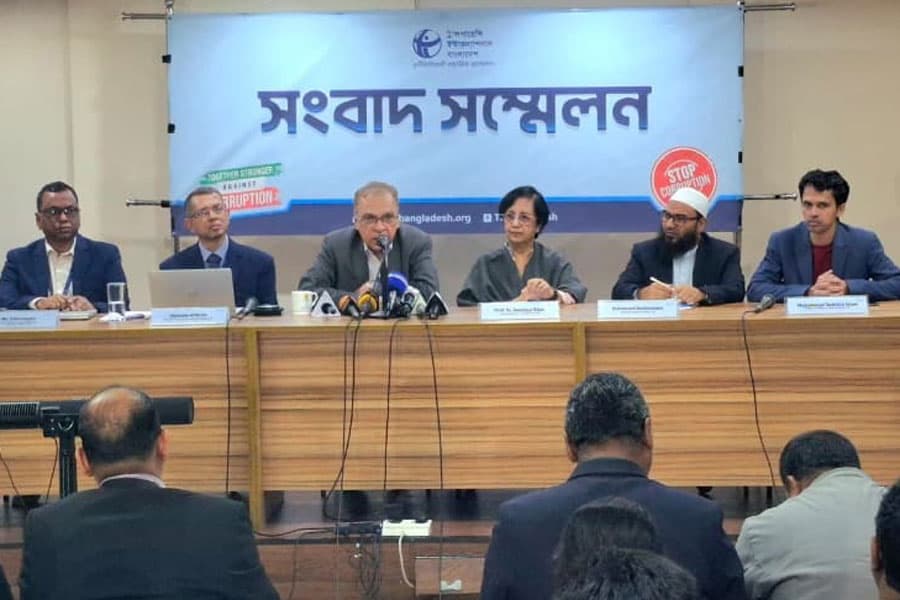
The organisation shared these observations during a press conference organised on the occasion of the publication of an observation-based research report titled “One and Half Years after the Fall of the Authoritarian Regime: Expectations and Realities.”
There was a failure on the part of the government to ensure equality, human dignity, justice, equal rights for all, and freedom of expression for all, TIB said.
In some cases, TIB said, the empowerment of bigots occurred due to the government's inaction or appeasement.
TIB said the free flow of information in state institutions was not ensured and there was a tendency to conceal information in government offices.
It said the issue did not receive importance in ensuring the free flow of information and the people's right to information.
One and a half years after the fall of authoritarianism, the foundation for state reform has not been strengthened; rather, the shortfall is significantly greater than the achievements, TIB said.
At the same time, it said, a failure to establish the foundation for a well-governed, corruption-free, and accountable government has been observed during this period. Furthermore, initiatives taken in the name of reform have missed their mark in almost all cases, and in some instances, the opposite has occurred relative to expectations.
Moreover, although there was a public aspiration to be committed to the people through the establishment of democracy and good governance among new and old political parties as part of a new political settlement, no visible examples of fulfilling this expectation have been observed.
Above all, TIB said political parties and the bureaucracy have not learned any lessons from the July movement.
TIB Executive Director Dr Iftekharuzzaman, Advisor-Executive Management Professor Dr Sumaiya Khair, Director of Research and Policy Division Muhammad Badiuzzaman, and Director of Outreach and Communication Division Mohammad Tauhidul Islam were present.
The report was jointly presented by Senior Research Fellows of the Research and Policy Division, Shahzada M. Akram and Md. Julkarnayeen.
According to TIB’s observations, despite various internal and external adversities, significant initiatives and decisions were taken in the fields of justice, reform, elections, and state governance during the interim period, and the infrastructure for state reform, justice, and elections was created.
However, because this infrastructure was not sufficiently strong, the foundation of state reform in these three areas did not become as robust as it could have been.
While reaching a consensus with political parties on several fundamental issues of state reform in the July Charter was a significant achievement, the foundation of reform was weakened due to resistance from various influential political parties regarding essential provisions for the ultimate goal of establishing an accountable government.
Subsequently, the government's surrender to the subversive and reactionary forces of the resistant circles, particularly the influential sections of the bureaucracy, in matters of ordinances and government decisions led to the reforms missing their mark.
Additionally, there was a failure by the government to achieve progress in immediately implementable reforms, and there were no significant initiatives to implement the recommendations of the reform commissions outside the scope of the July Charter.
Furthermore, TIB said, due to a lack of interest in analyzing the risks posed by those resisting reform, the government had to surrender to these resistant forces.
Highlighting the fundamental weaknesses in various ordinances formulated by the interim government, TIB Executive Director Dr Iftekharuzzaman said recommendations helpful for establishing an accountable government were purposefully excluded from almost every important ordinance.
He said one of the main reasons for this is the government's surrender to the reform-averse bureaucracy.
Initiatives were taken to depoliticize by removing high-level officials in the name of administrative and institutional reform, but in reality, instead of the monopoly influence of one party, a tripartite influence prevails in the bureaucracy: consisting of a section of beneficiaries of the fallen authoritarian government and those blessed by the two currently active major political parties, Dr Zaman said.
Overall, an ad-hoc and “pick and choose” tendency was observed in the interim government’s decision-making process regarding reforms; on the other hand, indecision or a lack of firmness in implementing decisions was prevalent.
Additionally, he said, a lack of coordination among state-responsible forces was seen, which created a sense of insecurity among the public.
Noting that the interim government considered the responsibility of establishing the foundation of reform only as fulfilling an expectation from the beginning, and did not analyze the adverse situations and risks or seek ways to resolve them during implementation, he said, the government could not implement the proposals for immediate action within its jurisdiction as promised; those that were done were superficial.
Dr Zaman said the position of political forces against the establishment of an accountable government system during the formulation process of the July Charter has been reflected in the ordinances approved by interim government.
“Commendable progress has been made in the reform of the judicial system. On the other hand, alongside the slow pace and procedural weaknesses in the judicial process, the line between justice and revenge has become blurred,” he said.
As a result, Dr Zaman said, while the right to a fair trial for the accused is being curtailed indiscriminately on one hand, the possibility of holding the actual criminals accountable is becoming slim on the other.
The TIB Executive Director said in terms of achieving the goals of the new political and social settlement, the weight of the shortcoming is heavier than the progress.
The July Charter has been weakened and the possibility of implementation has been jeopardized due to the uncompromisingly hostile position of the major political parties regarding the proposed recommendations in most fundamental sectors of reform, particularly in ensuring accountability to the people.
In response to a question, describing the picture of the last one and a half years in ensuring media freedom and the safety of media personnel and institutions as deeply disappointing, Dr. Zaman said, the institutional security of the media has come under more severe pressure than before and has faced pressure from quarters outside the state machinery.
The government has failed to take timely steps to prevent this, and has even given impunity to forces opposing media freedom.
Additionally, he said, the interim government has failed to take a stand and adopt strict measures in favor of ensuring equal rights and coexistence for all citizens regardless of gender, religious, ethnic, and cultural identity.
In particular, the government devalued the report of the Women’s Commission by publicly denying its involvement with the report and over-empowered those forces who are against women's empowerment.’
On the issue of the role of civil society, it was seen that while special importance was given to civil society in various reform activities at the beginning of the interim government, a tendency to ignore them was observed later. Recommendations from civil society were ignored in various reforms.
On the other hand, although a significant portion of civil society was within the government, they failed to play the expected role, resulting in a negative perception of civil society among the general public.
Additionally, alongside challenges to media freedom, there was a visible failure to ensure the security of journalists and media institutions during the interim government's tenure.
The freedom and security of the media are now held hostage by over-empowered non-state forces alongside the state. On the other hand, the existence of internal enemies within the media also persists.