


Bangladesh’s macroeconomic implies external stability but domestic fragility. According to Bangladesh Bank, the country’s economy is fragile.
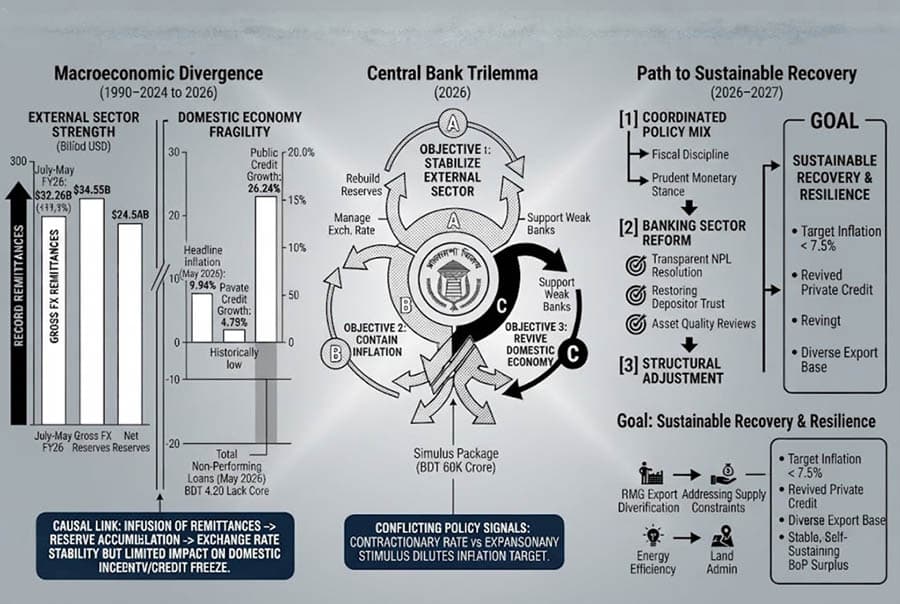
External sector: High volumes of remittances and improved balance of payments have stabilised the sector. However, a major concern is that double-digit inflation over the restructuring and consolidation of weak commercial banks has pulled in food. But private sector lending is still at historically low levels, and there are severe structural problems in the banking system, which continue to drag on overall economic development. However, the remittances continued to grow strongly, reaching a new record high. The revival in Bangladesh translated into a boom in worker remittances. The Inflow grew by 19.09 per cent YoY to USD 32.76 billion in Jul-May of FY26. In May 2026, remittances increased by 15.34 per cent to $3.43 billion compared to May 2025. The rising trend suggests monthly remittance inflows could surpass the previous record of $4.0 billion in the coming months, central bank officials estimated.
Geographic diversification: Saudi Arabia is the leading supplier with 16.13 per cent of total remittance inflows, followed by the United Kingdom (14.28 per cent) and the United Arab Emirates (13.06 per cent). The GCC countries accounted for 46.42 per cent of the total remittances, followed by the Malaysia (9.84 per cent) and the USA (8.50 per cent). Strong remittance inflows helped boost the country's foreign exchange reserves.
Gross Reserves: Gross foreign exchange reserves stood at $34.55 billion in May 2026 ($29.84 billion on an IMF BPM6 basis). Net borrowings of commercial banks were $6.14 billion in July-May FY26.
Market Intervention: Excess liquidity was absorbed by Bangladesh Bank to smooth volatility. The local currency saw less pressure as a planned buying of dollars between July and May FY26 led to a slight loss of 0.10 per cent of the Bangladesh Taka (BDT) against the US dollar.
External adjustment: The improvement in the balance of payments reflects an improvement in the balance of payments. The current account deficit during July-April FY26 stood at $1.073 billion compared to $1.636 billion during the same period of FY25. The financial account recorded a $4.47 billion surplus, mainly reflecting the repatriation of capital movements.
The overall balance of payments improved to over $3.741 billion from a massive deficit of $655 million in July-April FY25. Exports in July-May FY26 fell 1.67 per cent to $44.20 billion compared to the same period last year. The loss was mostly attributed to the ready-made garment (RMG) business, which accounts for 80.45 per cent of the export earnings. Knitted products declined by 3.58 per cent, while woven clothing fell 1.49 per cent. Niche exports recorded strong growth, but unexpected places are turning out to be tougher than anyone thought. Exports of technology products rose 28.23 per cent. Chemicals exports rose 6.66 per cent while plastics exports increased 6.35 per cent.
Meanwhile, for the last 16 months, around 500 RMG factories were closed, and 260,000 people lost their jobs, according to a local Bangla newspaper. Total imports for July-April FY26 rose by 5.92 per cent year-on-year. Higher imports of intermediate industrial products, capital machinery and crude petroleum suggest continued industrial activity and improving business confidence.
The biggest barrier to domestic economic resurgence is the inflation. Headline inflation picked up to 9.42 per cent y/y in May 2026, the quickest pace since early 2025. It was 9.04 per cent in April. After a short period of calm, the rate has jumped to 8.63 per cent on a 12-month moving average basis.
Supply-side constraints: high import tariffs, supply chain disruptions, and inefficiencies in domestic distribution.
Real policy rate remains too accommodative: The central bank has left the policy (repo) rate unchanged at 10.00 per cent since October 2024. This implies a moderately positive real policy rate against headline inflation.
Sectoral pressures: The non-food component is driven mainly by spending in the food and services sub-sectors, especially recreation (10.09 per cent) and hotels/restaurants (11.24 per cent).
The banking system is in trouble, and private sector lending is slowing down. Loans to the private sector increased at an annualised rate of 4.75 per cent in April 2026, a record low and below the central bank’s objective of 8.5 per cent. Statement on the Financial Stability Report 1: The total amount of non-performing loans (NPLs) in the banking industry rose to BDT 4.20 lakh crore in March 2025 from BDT 1.82 lakh crore in March 2024, a massive growth of 130.77 per cent. Strong Credit & Liquidity Gap: The gap of 5.72 per cent between the high rate of loans of 11.96 per cent and the deposit rate of 6.24 per cent discourages potential borrowers. Investor excitement: Investor optimism has been muted by fears of energy shortages and complicated limitations. Concerns over energy shortages and complicated limitations have cooled investor excitement. Concerns over restructuring and consolidation of weak commercial banks drew away capital from the formal banking industry to BDT 2.93 lakh crore in May 2026. Commercial banks sought emergency liquidity support of BDT 75,903 crore from the central bank in the face of structural liquidity issues.
The credit gap worsened further as government borrowing from the domestic banking industry increased to BDT 104,410 crore in April 2026 from BDT 30,405 crore in the previous fiscal year, up 26.24 per cent YoY. The strong credit absorption by the populace negates the inflationary impact of the contractionary monetary policy of the Bangladesh Bank. The BB has a big macroeconomic dilemma of policy declarations, confusion and the trilemma of balancing currency stability, inflation control, failed commercial banks support and economic growth. The central bank faces a major macroeconomic issue. It is designed to preserve the stability of currency rates, to check inflation, to save failing commercial banks, and, at the same time, to promote economic growth. Contractionary Stance: The policy rate is kept at the elevated level of 10.00 per cent to support credit expansion. At the same time, the Bangladesh bank unveiled a Tk 60,000 crore (USD 4.9 billion) industrial stimulus and refinancing initiative to resume halted manufacturing operations.
Programmes that include subsidised and below-market loans are inconsistent with the goal of managing inflation, and the larger macroeconomic policy framework is looser than the nominal policy rate would imply. Structural reform: medium-term perspective vs sense of urgency. Short-term outlook (up until mid-2027). Trade and External Buffers: The business chambers like MCCI anticipated exports at $4.0 billion and $4.15 billion each month till mid-2026. Remittance inflows are expected to average between $3.1 billion and $3.3 billion each month, which would enable gross reserves to rise to roughly $31.3 billion by the end of the fiscal year. More price pressures ahead. Independent projections point to 9.45 per cent in June 2026. Headline inflation is expected to cool to 8.9 per cent in December 2026 and 8.6 per cent in June 2027, but remain above the government's 7.5 per cent target.
In Dhaka, the Apartment Society’s Executive Committee has been charging a huge amount per month without proper documentation for a long period. There is no one to look after this. Rajuk is ineffective, and they are becoming new Zamindars. Meanwhile, developers of apartments are not keeping their promises. This has a negative impact on purchasers. Most of the middle-class families are aware of the developers of apartments. No strict rules during long time period. The imbalances have pushed the government to intervene, and the economy is now undergoing a monetary tightening in Bangladesh. Fiscal discipline: Cutting back the state’s dependence on bank borrowing will lower public deficits and the crowding out of private investment, thus reducing domestic demand-pull inflation.
The banking system needs to restore depositors' confidence and solve the problem of non-performing loans through asset quality inspections, transparent bank mergers and acquisitions and stringent implementation of regulatory constraints on lending. Supply-side structural reforms: Consider removing energy constraints, strengthening trade facilities and diversifying exports away from readymade clothes towards engineering and plastics for long-term economic stability. To tackle the macroeconomic imbalance, a holistic plan covering all sectors of Bangladesh is needed. A comprehensive approach from all sectors of Bangladesh is needed to address the macroeconomic imbalance. The government and the central bank should move from separate policies to a common framework. This would require a strong monetary policy to manage inflation and a firm fiscal discipline to reduce government borrowing and the crowding out of private investment.
In an effort to restore the confidence of depositors in the banking system, rigorous inspections of asset quality, openness in dealing with non-performing loans (NPLs) and greater corporate governance in the public and private financial sectors are necessary structural adjustments. On the supply side, the focus should be on boosting energy efficiency and on diversification of RMG exports towards high-growth industries such as engineering and plastics. This should be led by the private sector and industrial authorities. Law must be developed against the developers of the apartments who failed to deliver the apartments in due time after registration of the flat and illegal shops violating the Rajuk permission. The apartment executive committee must refrain from illegal imposition of rent-seeking or face the rule under the country’s existing rules. Rajuk must be stronger. The NGOs and development agencies might also help to build financial literacy at the grassroots level, promote microbusinesses and expand the social safety nets to shield the needy from the recurring food inflation. This multi-faceted approach will spur sustainable development and build economic resilience. Empowering local communities and fostering innovation help stakeholders build a stronger framework for long-term development and stability. This strategy should be supported by the Family Card. The Government believes that the family is the basic unit of development. Female empowerment, direct card distribution leads to a rise in spending on food, health and children's education. In 2026-27, the government would send 41 lakh Family Cards with a BDT 2,500 monthly cash stipend to their phones or bank accounts over G2P technology. Every year, Tk 14,000 crore comes to this Bangladeshi social safety net plan. By 2030, the government will issue a “Universal Social ID Card” for every resident to replace fragmented social security systems.KajerBinimoyeKhadyaKormoshuchi (Food for Work) should be used in its own particular conditions locally. ‘Food for Work’ creates short-term jobs and infrastructure for government and development partners. "Khal Khannan” (digging canals). Recent calls for the Family Card extension emphasise that cash transfer recipients should not be offered social safety net benefits. Food for Work programs can protect able-bodied persons without Family Cards. In the Eastern Flood, the WFP rebuilt embankments and roadways through unconditional cash transfers and cash-for-work. Non-Family Card holders can purchase food and construct infrastructure.
Muhammad Mahboob Ali is a professor of Economics at the Bangladesh University of Business and Technology, an academic auditor at the Bangladesh Accreditation Council, and a former vice chancellor of Presidency University
Email: pipulbd@gmail.com