


Aslam Mia, a middle-aged local businessman, is a testament to the resilience of artists in Bangladesh. Despite the hurdles of daily life, he continues to add splashes of colour to his artbook sitting on the streets of Malitola in Old Dhaka, his love for floral painting shining through every brushstroke.


On holidays, you might see him outside, creating vibrant artwork on the roads, or perhaps at home, lost in the intricate beauty of his floral designs. Though Aslam once dreamed of becoming a professional artist, there needed to be more opportunities that held him back. Like many artists in Bangladesh, he finds himself at a crossroads, torn between pursuing his passion and facing the harsh realities of survival.
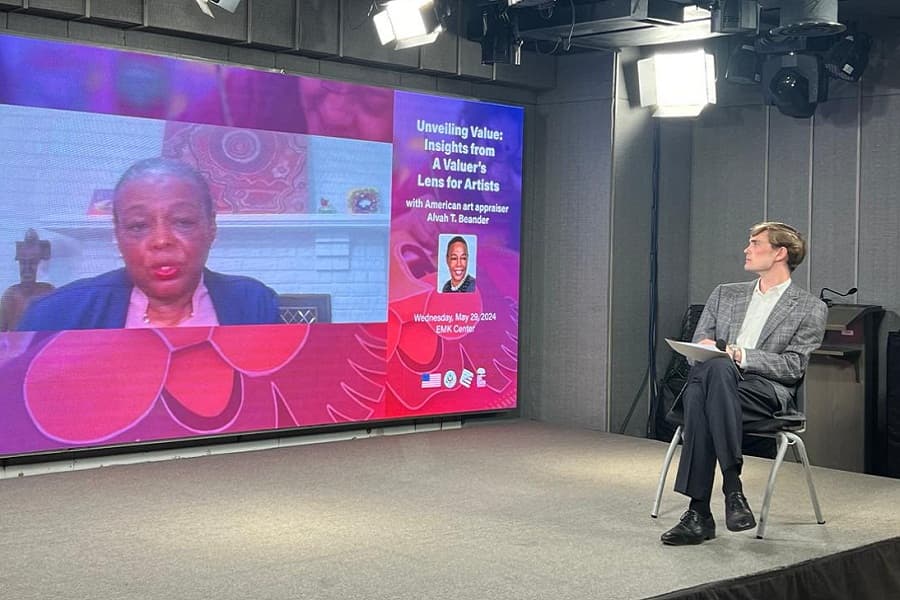
For artists like Aslam, who are grappling with these challenges, a ray of hope appeared on Wednesday, May 29, 2024. The U.S. Embassy organized a discussion program titled "Unveiling Value: Insights from A Valuer's Lens for Artists."
The event featured American art appraiser Alvah T. Beander, whose expertise and insights aimed to shed light on the creative economy and inspire artists with the potential for income generation through their art.
Art has always been an intrinsic part of human history, from the ancient cave paintings in the Amazon to the intricate carvings in the mountains of Norway. It has served as a testament to human existence, evolving from mere self-expression to a skilled profession. However, with the commodification of art, artists began to see it as a career path, bringing its survival challenges.
Alvah T. Beander, a distinguished personal property valuer specializing in African, African American, and African Diaspora art, brought her wealth of knowledge to the session.
Since 2001, she has complied with the Uniform Standards of Professional Appraisal Practice (USPAP) and is the president of Melanin Art Appraisals, LLC.
Alvah is also an Adjunct Business, Management, Entrepreneurship, and Ethics professor. In 2005, she developed and taught a course for career artists, 'The Business of Art,' at Northern Virginia Community College (NVCC).
During the event, Alvah presented strategies for artists to turn their passion into a viable career. She emphasized that artists should not merely aim to survive but aspire to earn a sustainable livelihood from their art.
Addressing a crucial question about whether artists need grooming to sell their artworks, she responded, "Artists can take business courses. Several good platforms provide relevant business materials. Artists can learn from these courses."
Alvah encouraged artists to showcase their work confidently and boldly; "I am an artist. Here is my work." She advised that with confidence and a well-crafted, detailed note about their art, artists can pitch their work in relevant areas and seize opportunities.
Despite these insights, artists' struggle to earn a livelihood persists. Historically, they have faced numerous challenges, from affording materials to finding platforms for their work.
Today, a new adversary has emerged in the form of Artificial Intelligence (AI). AI is increasingly taking over jobs traditionally held by graphic artists, adding another layer of difficulty for artists like Aslam Mia, who must now compete with technology and economic hardship.
Addressing this concern, Alvah T. Beander advocated for the separation of human-created art and AI-generated art in platforms, events, and competitions. She highlighted that some organizations have already started implementing this differentiation. For instance, Facebook has introduced an 'AI label' option, allowing users to mark content generated with the help of AI.
However, the question remains, How can Bangladeshi artists survive solely on their art? Do they have access to enough schools and platforms to showcase their work? This concern needs collective attention. Ensuring artists have the resources and opportunities to thrive is crucial for preserving and growing Bangladesh's rich artistic heritage.