



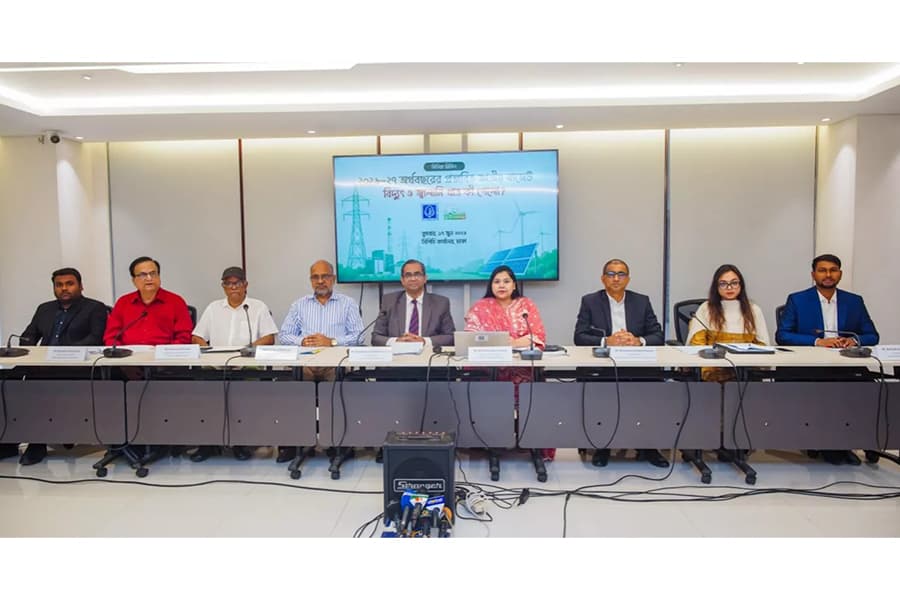
Centre for Policy Dialogue (CPD) on Wednesday said the proposed national budget for FY2026-27 has taken several commendable steps to promote renewable energy, but fossil fuels continue to enjoy discriminatory fiscal advantages, potentially undermining the country's energy transition objectives.
CPD Senior Research Associate Helen Mashiyat Preoty came up with the observation while presenting a paper titled "Proposed National Budget for FY2026-27: What is there in the Power and Energy Sector?"
CPD Research Director Khondaker Golam Moazzem chaired the presentation event at its Dhanmondi office.
The Ministry of Power, Energy and Mineral Resources received a total allocation of Tk 173.45 billion (Tk 17,345 crore) in the proposed budget, a modest 2.3 per cent increase from the revised budget for FY2025-26. Of this, the development budget stands at Tk 171.93 billion (Tk 17,193 crore), while operational expenditure is Tk 1.52 billion (Tk 152 crore), up 7.8 per cent.
The think tank flagged a worrying downward trend, noting that the sector's share of the total national budget has declined steadily from 6.87 per cent in FY2015-16 to just 1.85 per cent in the proposed FY2026-27 budget.
The Power Division received Tk 149.96 billion (Tk 14,996 crore), a 3.9 per cent decline from the revised allocation, while the Energy and Mineral Resources Division saw a sharp 72 per cent jump to Tk 23.49 billion (Tk 2,349 crore), driven largely by increased development expenditure.
CPD acknowledged that, for the first time, the proposed budget has offered substantial fiscal support for solar-based electricity generation.
The government has proposed a zero per cent tax rate for the solar power sector until 2035, a 5 per cent tax rebate for consumers paying solar electricity bills, and the elimination of import duty, regulatory duty, supplementary duty and advance tax on essential solar components until June 2030.
Tax incidence on assembled solar panels has been proposed to drop from 28.7 per cent to 22.2 per cent, while that on lithium-ion batteries, critical for energy storage, is set to come down sharply from 61.8 per cent to 26.3 per cent.
However, CPD cautioned that the benefits are tied to a restrictive set of conditions, primarily benefiting select solar power generation companies and firms operating under the RESCO model.
This effectively excludes 63 per cent of the country's electricity consumers, including residential users, small business owners and rural solar irrigation farmers.
"The proposed budget will encourage the private sector to move towards renewable energy transition; however, restructuring the fiscal treatment may be needed to ensure end-user benefits," the paper noted.
Despite the government's stated ambition to reduce dependence on imported fossil fuels, CPD pointed out that LNG imports continue to enjoy full VAT exemption, resulting in a total tax incidence (TTI) of only 9.5 per cent for key LNG products.
Besides, coal imports by power plants will continue to enjoy concessionary duty benefits extended until June 2030.
CPD recommended that the full VAT exemption on LNG be withdrawn and VAT restored to 15 per cent, arguing that the current arrangement artificially keeps LNG competitive and causes significant revenue losses for the National Board of Revenue (NBR).
The think tank also raised concerns over the budget speech's renewed emphasis on domestic coal exploration, including setting a production target of 600,000 metric tonnes for FY2026-27 and undertaking new projects for the Barapukuria Second Phase and Dighipara Coal Field.
"Such fiscal favours given to dirty coal are nothing but a hindrance to energy transition," the paper stated.
Analysing the Annual Development Programme (ADP) for FY2026-27, CPD found that fossil fuel projects account for 98 per cent of total generation-sector allocations, compared to a mere 2 per cent for renewable energy projects.
In the current ADP, only five renewable energy-related projects received allocations — three under the Power Division and two under the Energy Division. Notably, no new solar or renewable energy projects have been added to the current ADP, a development CPD described as concerning.
Eleven renewable energy projects remain unapproved, including seven solar projects with a combined capacity of 640 MW, three grid modernisation projects and a 25 MWh Battery Energy Storage System (BESS) pilot project.
CPD warned that this trajectory makes the government's target of achieving 20 per cent renewable energy by 2030 extremely difficult, as it would require installing 1,662 MW of solar capacity annually between January 2026 and December 2030.
CPD said grid and transmission equipment continue to face some of the highest tax burdens in the energy sector, with TTI ranging from 33.6 per cent to as high as 93.2 per cent. The budget has proposed tariff reductions for only two components out of the full range of grid infrastructure items.
Critical assets such as transformers, conductors, towers and meters remain subject to multiple layers of taxation.
The think tank urged the government to reduce import, customs, supplementary and regulatory duties on all grid infrastructure components to zero, noting that doing so would lower the TTI by roughly 30 percentage points and reduce the cost of grid expansion needed for renewable integration.
The budget has significantly reduced the tax burden on electric vehicles (EVs), with import duties reduced from 93 per cent to 64-80 per cent depending on vehicle price and type. Import duties on EV charging equipment have been reduced from 39.75 per cent to zero, a move CPD described as highly commendable.
Annual income taxes on EVs have also been drastically reduced from a uniform Tk 200,000 to between Tk 25,000 and Tk 100,000 based on power capacity.
Conversely, taxes on internal combustion engine (ICE) vehicles have been increased to discourage their use, with one category of reconditioned cars now facing a TTI of 159.8 per cent.
CPD expressed disappointment that the budget has placed little emphasis on solar irrigation for marginal farmers.
The budget speech only mentions the installation of 98 solar-powered irrigation pumps and 27 solar-powered dug wells. One solar irrigation project, with a 40 per cent completion rate, received no allocation in the current ADP.
"There is not much for solar irrigation in the proposed national budget for FY2026-27," the paper concluded.
The budget proposes Tk 370 billion (Tk 37,000 crore) in electricity subsidies, up from Tk 360 billion (Tk 36,000 crore) in the revised FY2026 budget, primarily to offset Bangladesh Power Development Board losses from purchasing electricity from IPPs, rental and quick-rental plants.
CPD warned that while the government has signalled plans to rationalise electricity subsidies in the coming years, the burden must not be passed on to consumers through tariff hikes. Instead, the government should phase out capacity payments to fossil fuel plants.
CPD called on the government to increase allocations in the revised budget for projects nearing completion, approve more renewable energy projects through the revised ADP, shift NBR's fiscal approach from a restrictive entity-based model to an open, component-based zero-tariff framework, introduce targeted subsidies for solar irrigation farmers, and incorporate dedicated green grants for energy transition and smart-grid development in the national budget.