


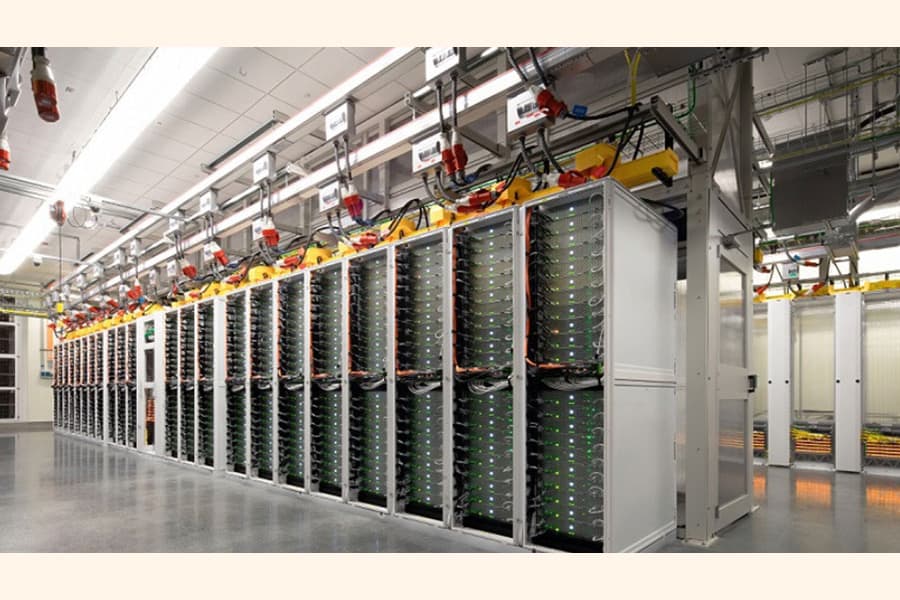


Bangladesh is quietly approaching a digital inflection point. Mobile penetration is high, 4G coverage reaches 98.9 per cent of the population, and a youth cohort comprising 28 per cent of the country makes for a large digital consumer base. Yet, the nation's data centres -- the physical facilities that store, process, and transmit digital information -- are insufficient for the economy being built atop them.


As organisations increasingly rely on third-party data centres rather than investing the substantial capital, technical expertise, and time required to build and operate their own facilities, domestic capacity is struggling to keep pace. While the financial sector alone is projected to require roughly 100 megawatts (MW) of computing capacity, total domestic third-party data centre capacity is expected to reach just 30 MW by 2026, leaving a 70 MW shortfall even before accounting for accelerating demand from e-commerce, mobile financial services, government digitisation, and AI-driven applications.
Closing this gap requires patient, long-tenor, risk-appropriate capital. However, Bangladesh's financial system, like those of many developing economies, falls structurally short. Based on qualitative interviews with data centre operators, technical experts, commercial bankers, the central bank, and multilateral development bank representatives, this article diagnoses these financing barriers and proposes actionable remedies.
REGULATORY IMPERATIVE FOR LOCAL CAPACITY: Before addressing the financing problem, it is worth establishing why domestic capacity matters, because the demand is not merely market-driven. Bangladesh Bank's 2023 Cloud Computing Guidelines (BRPD Circular No. 5) prohibit financial institutions from storing customer data on foreign cloud platforms without prior regulatory approval, which is rarely granted in practice. Data localization mandates of this kind are not uniquely Bangladeshi; India and Russia have enacted comparable sectoral rules, while the European Union pursues similar sovereignty goals through cloud-certification and data-protection regimes rather than blanket localisation, but in Bangladesh these requirements create structural demand for local infrastructure that will only intensify as the digital economy expands.
The economic case reinforces the regulatory imperative. Bangladesh's international bandwidth is projected to expand dramatically -- from the existing 8.9 terabits per second (Tbps) to 60 Tbps by 2027 -- through new subsea cable additions, including the SEA-ME-WE 6 cable and a major private consortium initiative. Yet bandwidth without local processing infrastructure is essentially an import. Data generated domestically would be routed offshore for storage and computation, returning as a service - generating foreign currency outflows, subjecting sensitive information to foreign jurisdictions, and surrendering the economic value of advanced analytics.
There is also a significant opportunity cost to inaction. India's data centre industry expanded from 350 MW in 2019 to over 1,000 MW by 2024, with projected investment exceeding US$ 100 billion by 2027. Early signals, such as Starlink's partnership with local provider Felicity IDC to host ground station infrastructure, suggest Bangladesh could position itself as a regional data transit hub. This opportunity is highly time-sensitive.
HOW THE BANKING SYSTEM FALLS SHORT: Data centres are long-duration infrastructure assets. Construction is capital-intensive upfront, requiring significant initial outlays. For instance, my interviews with operators place the average capital expenditure for a modern Tier III facility in Bangladesh at roughly US$ 80,000 per rack, or up to US$ 8 million per MW of IT power capacity. Miniature or Small and Medium-sized Enterprise-focused deployments can still demand upward of BDT 500 million (approx. US$ 4.25 million) for entry-level footprints. Equipment - servers, cooling systems, power infrastructure - carries useful lives of 10 to 15 years; facilities may operate for 20 years or more.
Because of this intense frontend capital expenditure and extended asset life, the baseline payback period (PBP) for core data centre infrastructure typically spans 7 to 9 years. While the foundational infrastructure payback remains long-term, some operators achieve operational profitability within their very first year of launch by successfully securing high-volume anchor tenants or early enterprise buyers. In project finance terms, these characteristics call for long-tenor debt, debt-service coverage ratios calibrated to contracted revenue streams, and collateral frameworks that reflect the asset's earnings capacity rather than its liquidation value.
My interviews with commercial bankers revealed a system that offers none of this. Local banks structure data centre loans with tenors of two to five years -- maturities appropriate for trade finance or working capital, not infrastructure. The underlying cause is structural: Bangladesh's banks are funded predominantly by short-term deposits, and customers show little appetite for lower-yield products that would allow banks to fund longer. Banks cannot prudently lend long-term when their funding is short-term. Yet, banks overwhelmingly dominate financing in Bangladesh because the country's capital markets remain heavily underdeveloped, leaving businesses with few alternative funding options.
Compounding the tenor problem is a classification failure that my research surfaced consistently across financial institutions. Bank credit officers frequently conflate the data centre business model with that of internet service providers (ISPs) -- a sector with a meaningfully weaker credit history in Bangladesh, and apply undue conservatism as a result. In project finance terms, a data centre with contracted collocation revenues and long-lived physical assets is a very different credit proposition from an ISP. Misclassification produces mispricing, and mispricing produces underinvestment. The irony, noted by multiple interviewees, is striking: several banks that declined to finance data centre expansions are themselves heavy users of those facilities, co-locating their own servers in the very buildings they will not lend against. One operator described difficulty obtaining a bank guarantee of a few dozen crore taka from institutions that host several hundred crore taka of their own IT equipment on his premises.
MULTILATERAL DEVELOPMENT FINANCE & THE SCALE MISMATCH: Multilateral development banks (MDBs) -- such as the World Bank and Asian Development Bank -- are positioned to bridge such market failures through long tenors, risk appetite on nascent sectors, and a reputational catalyst that attracts private co-investors. The International Finance Corporation - a member of the World Bank Group - offers the canonical regional example. Its 2013 equity investment in bKash, now Bangladesh's dominant mobile financial services platform and the country's first unicorn, paired development capital with governance standards and international validation - a combination that subsequently drew major institutional investors including the Gates Foundation and Ant International.
Interactions with MDB representatives confirmed significant structural constraints on replicating this model of direct investment at scale in the data centre industry. Environmental, social, technical, and legal due diligence typically spans eight to ten months and carries fixed compliance costs that make transactions below approximately US$ 10 million economically impractical for MDBs to execute directly. Most of Bangladesh's privately-led data centre projects fall below this threshold. A typical domestic facility might generate 70 per cent of its revenue from traditional co-location (priced at roughly Tk 100,000 to Tk 160,000 per month for a standard 2kilowatt (kW) to 7 kW rack) and 30 per cent from higher-margin public cloud infrastructure (such as open-source platforms). Because these businesses scale incrementally, they do not always trigger the massive, single-tranche capital thresholds required by MDBs.
Consequently, MDB engagement concentrates at the top of the market -- often stepping in to finance multi-million dollar projects alongside local banks and heavy equity commitments. In these cases, the largest operators pursue involvement primarily for reputational validation and rigorous international compliance standards rather than raw capital access. The multiplier effect MDBs are designed to create -- several dollars of private capital mobilised per dollar of development finance -- is not achieved if domestic banks lack the sectoral knowledge to participate in blended or syndicated structures alongside them. My research found this knowledge gap to be substantial and largely unaddressed.
ENERGY INTENSITY: One dimension that warrants forward planning is energy. Data centres are among the most electricity-intensive commercial assets in operation -- electricity typically accounts for 40 per cent of operating expenses in optimised, large-scale facilities and up to 70 per cent in legacy or highly distributed multi-city footprints; and their energy demand scales with digital growth. A key measure of efficiency is Power Usage Effectiveness (PUE), which compares a facility's total energy consumption to the energy used by its IT equipment; the closer the ratio is to 1.0, the less power is wasted on cooling, power conversion, and other supporting systems. Bangladesh's average PUE is approximately 1.9, meaning that for every unit of electricity consumed by servers, an additional 0.9 units are spent on overhead. This is significantly above the global target of 1.65 and reflects transmission losses in the national grid as well as conservative clients demanding excess cooling and redundancy capacity. When grid power fluctuates, operators must fall back on expensive diesel generation or deploy capital-intensive lithium-ion battery backups to maintain compliance with zero-downtime expectations. As Bangladesh expands its data centre base, the question of where that power comes from becomes a long-term energy security issue rather than merely an environmental one.
One operator interviewed for this research had already integrated a 450-kilowatt peak rooftop solar installation -- self-financed and battery-free to minimise upfront costs -- and now sells surplus generation back to the grid. The Renewable Energy Policy 2025 introduces a merchant Power Purchase Agreement framework that would allow data centres to contract directly with renewable generators at market prices. These are the instruments that could eventually decouple digital growth from grid dependency and deserve regulatory operationalisation in parallel with financing reforms.
However, deploying renewable energy and efficiency improvements at scale requires patient, long-term capital. Data centre operators seeking to improve energy efficiency or integrate renewable energy sources often require financing that is not always readily available from commercial banks, whose funding structures, as discussed above, typically favour shorter-tenor lending. Institutions such as Infrastructure Development Company Limited (IDCOL) -- a government-owned specialised financial institution that finances infrastructure and renewable energy projects -- help bridge this gap by offering concessional financing with longer repayment periods and lower borrowing costs. However, accessing such financing can be challenging. Funding facilities often require substantial Bank Guarantees (BGs), under which a commercial bank agrees to compensate the lender if the borrower fails to meet its obligations. In practice, local banks are frequently reluctant to issue large BGs, even when the same operator is already hosting hundreds of crores of taka worth of the bank's own proprietary core banking infrastructure. This disconnect highlights how existing financing structures can constrain investment in energy-efficient digital infrastructure despite its growing importance to both the economy and the financial system.
In addition, Bangladesh Bank has proactively developed a comprehensive sustainable finance framework, including the Green Transformation Fund capitalised at US$ 200 million, EUR 200 million, and Tk 5,000 crore, which provides low-cost credit to help industries adopt energy-saving and eco-friendly machinery. Alongside a requirement for banks to allocate a minimum of 5 per cent of their loan portfolios to green finance, with broader sustainable finance targets raised from 20 to 40 per cent, this financing mechanism directly supports the country's industrial transition. These are meaningful commitments by any regional standard and reflect a central bank that understands climate risk as a systemic financial stability issue, not merely an environmental one.
The practical obstacle, which my interviews with bank credit officers confirmed, is definitional: data centres are not explicitly enumerated among the GTF's eligible sectors. That single omission creates sufficient ambiguity for conservative underwriters to default to exclusion. Concessional capital designed to catalyse green and digital investment sits partially under deployed. Eligible projects go unfinanced at commercial rates, or are not pursued at all. The remedy is a cost-neutral regulatory amendment -- formally adding data centres to the GTF's eligible sectors list -- that requires no new capital injection, only a reprioritisation of existing concessional financing. Beyond expanding access to finance, such a designation would send a clear policy signal that sustainably designed data centres are recognised as strategic infrastructure, reducing regulatory uncertainty and stimulating private investment.
WHAT THE FINANCIAL SYSTEM NEEDS TO DO: Three interventions would meaningfully shift the investment landscape, none requiring substantial public expenditure. First, the formal inclusion of data centres in the refinancing schemes' list of eligible sectors, resolving the current classification ambiguity that prevents local banks from confidently deploying concessional capital to energy-intensive digital infrastructure. Second, the adoption of IFRS Sustainability Disclosure Standards (S1/S2), which would create market incentives for financial institutions to quantify and report financed emissions, improving the relative economics of sustainability-aligned infrastructure lending through market discipline rather than mandate. Third, a targeted programme of technical assistance -- coordinated by Bangladesh Bank with ADB and IFC -- to build genuine sectoral underwriting competence among local commercial bank credit officers, creating the institutional capacity for domestic banks to participate in blended financing structures alongside MDBs.
Ultimately, digital infrastructure is the new utility infrastructure -- as essential to economic productivity as the roads we build and the power grids we rely on. If Bangladesh is to truly transition into a competitive digital economy, its financial landscape must evolve to treat computation as a foundational asset rather than a short-term gamble. Globally, institutional capital is flooding into digital infrastructure because it offers stable, long-term, yield-generating characteristics akin to real estate, backed by an insatiable demand for computation. Bangladesh possesses the entrepreneurial potential to match this shift. What it needs now is the financial precision to structure these capital-intensive assets - and that is the work of finance professionals, not legislators alone.
Tanha Kate is a banking professional with BSc degrees in Computer Science and Politics and an MPhil in Development Studies from the University of Cambridge. tanha.kate@protonmail.com
[This article draws on primary qualitative research conducted in fulfilment of the 5th 'Clean Energy & Power' seminar series at Centre for Policy Dialogue. All responses were anonymised.]