


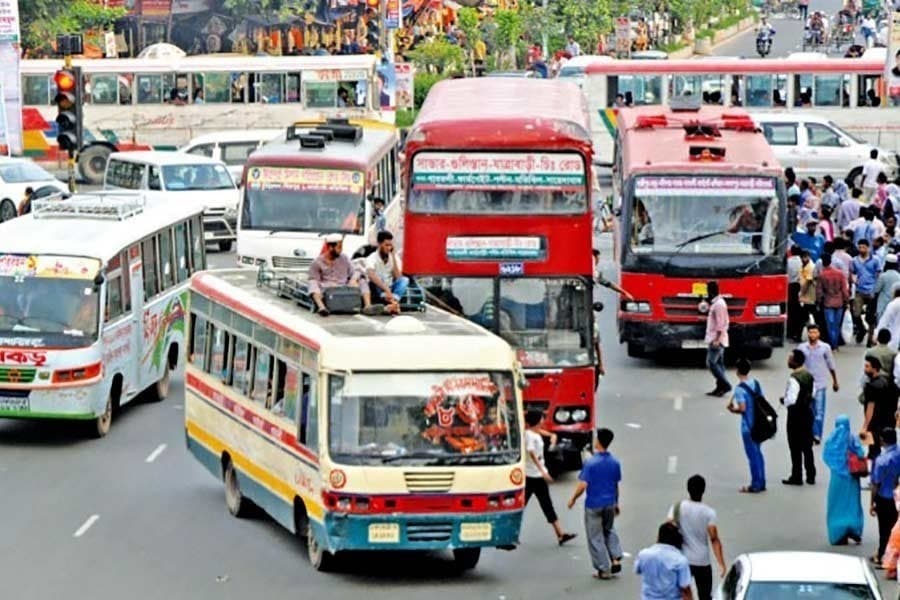
Traffic congestion in Dhaka has become so severe that it wastes a major portion of the working hours of the commuters. Depending on the distance between their houses and workplaces, they need to start commuting much earlier than they would require in a normal traffic ecosystem. Many of them need to wake up before sunrise and get back late at night. But years after years of deliberation and promise by the authorities, Dhaka has not been able to find a solution to its problem.
Dhaka can never address its traffic congestion through accommodation of additional automobiles. Instead, what is needed is to create a highly efficient and reasonably priced mass transit system. Unfortunately, Dhaka has been heading in the exact opposite direction.
According to data provided by the Washington-based Democracy International, roughly 6.0 per cent of the population in Dhaka use private vehicles but they occupy as much as 76 per cent of the total road space. Everyone else is forced to depend on public transportation while sharing the remaining limited space.
There is evidently a mismatch here. Any transport system using most of its limited space for a handful of individuals is not economically sound, socially justifiable or even sustainable for that matter. This issue gets worse in a city like Dhaka where road network only covers a negligible percentage of the overall urban space compared to international standards.
The economic impact of traffic chaos is mind-boggling. Several sources estimate daily loss in productivity due to traffic congestion ranging from 3.2 to 5.0 million hours. Some sources put this number even higher and say the daily average is around 8.2 million hours during peak congestion periods. The overall economic losses caused by traffic congestion are estimated anywhere between Tk 370 billion and Tk 600 billion annually.
The problem led to loss of business opportunities, decline in productivity, wastage of fuel, rise in costs and decline in quality of life for many citizens. The problem also contributes to significant air pollution and stress-induced illnesses.
Urban planners and transportation experts have continuously maintained that the only viable approach in Dhaka is the improvement of public transportation. Many other cities that have faced a similar situation in the past have validated this fact. Cities like Singapore, Tokyo and Hong Kong have been able to reduce their reliance on personal automobiles because of their efficient use of public transportation systems. Their experience has shown that when public transportation is efficient and predictable, people prefer it. Our experience regarding the Metro Rail also corroborated the fact. The infrastructure has proven how keen the citizens are for using efficient and modern modes of transportation.
The authorities have tried to adopt several other measures in the past aimed at improving public transportation, including bus route restructuring schemes, dedicated lanes for buses, mass transit systems and even transport master plans. The reform attempts have, however, mostly faltered due to opposition from influential interest groups. In particular, owners and transport workers resisted any reforms which were likely to change their existing arrangements. Successive governments lacked the political will to confront the interest groups and implement reform initiatives.
The situation leads to problems of fragmented bus systems, overlapping routes, unhealthy competition among the providers and lack of proper regulation.
Integrated planning is necessary for developing a successful public transportation system. All forms of public transport such as metro rails, bus rapid transit, normal buses, railways, and non-motorised transport need to be integrated into coordinated system. Integration of ticketing is also necessary. Route planning should focus more on passengers' convenience than that of transport companies. The reliability of transports should be such that even the middle and upper classes find it convenient.
Equally important is to dissuade people from using private transport indiscriminately. Private transport does not need to be banned outright. But an environment needs to be created where public transport appears more sensible as a mode of travel.
Dhaka stands at a crossroads. One path is to continue relying on private transport with all its implications and the alternative one is to improve the public transport system fit for the twenty-first century.
The choice should be obvious. The city does not require additional private vehicles. Instead, it needs more reliable buses, a network of metro rail, improved coordination and regulation and the political will to act in the interests of all. Only then can Dhaka's endless traffic anarchy cease to take its toll.
rahmansrdk@gmail.com