


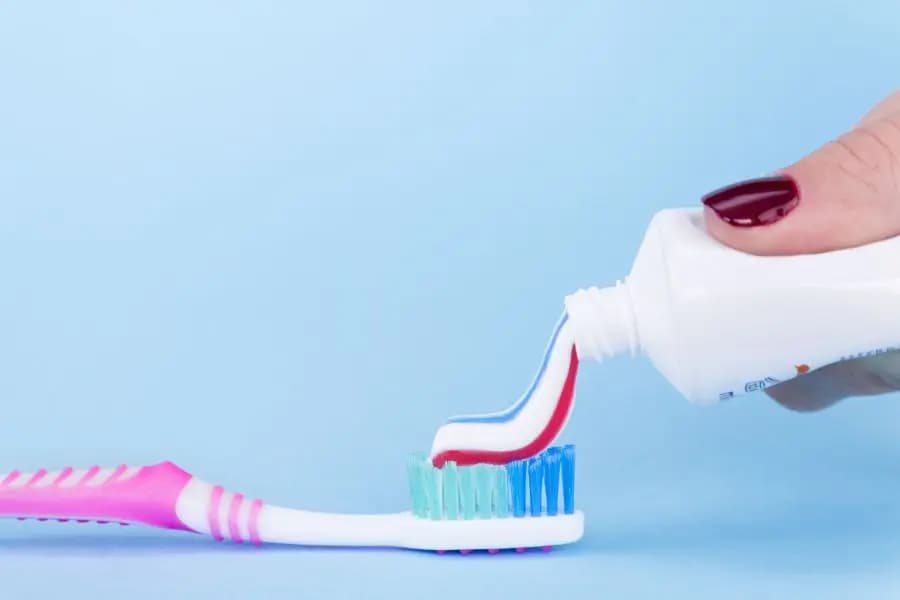
A year-long study by a Non-Government Organisation (NGO) found microplastics in 26 out of 34 toothpaste samples representing 19 brands. Notably, 22 of 25 locally manufactured samples and four of six children's products tested positive for microplastics. Counts ranged from 20 to 320 particles per 100 gram. But why should plastic be present at all in a product meant to clean the mouth? More importantly, where do the particles go after millions of people finish brushing every day? Microplastics are generally plastic particles smaller than five millimetres. Some are manufactured in that size, while others form when discarded bags, bottles, packets, fishing nets, synthetic fabrics and tyres gradually break down. According to the World Bank, annual per capita plastic consumption in urban Bangladesh tripled from 3 kilograms in 2005 to 9 kilograms in 2020. Of the 977,000 tonnes consumed in 2020, only 31 per cent was recycled. Much of the remainder ended up in landfills, drains, water bodies and rivers. In that case, toothpaste is only one small tributary feeding a far larger stream of plastic pollution.


Evidence of that pollution is already before us. A Buriganga study detected microplastics in every surface-water and sediment sample examined and found that some carried heavy metals including lead, cadmium and chromium. Research on the Karnaphuli estuary similarly found every sampling site polluted. Another study detected microplastics in all coarse-salt samples taken from eight salt pans beside the Maheshkhali Channel. Researchers have also found them in the water, sediment and fish of Dhaka's urban lakes. So, the journey is not hard to follow: plastic moves from households, markets and industries into rivers and the sea, enters aquatic organisms and returns through fish, salt and water.
The ecological consequences cannot be ignored. The particles may be swallowed by plankton, insects, fish, crabs and snails and then travel through the food web. They may affect feeding, growth and reproduction of aquatic organisms. For Bangladesh, whose rivers, wetlands and the Bay of Bengal support fisheries, farming, tourism and millions of livelihoods, ecosystem degradation is also an economic and food-security issue. Particles carried by irrigation water or sewage sludge may further reach farmland. Once widely dispersed, they are almost impossible to retrieve. Public health is the other side of the problem. People may be exposed through food, water, air and daily-use products, toothpaste providing a direct oral route. Laboratory studies suggest microplastics may cause inflammation and disruptions of immune and other biological functions. However, the World Health Organization has stressed that major uncertainties remain and more quality-controlled research is needed. This should prevent panic, but not action. The finding of microplastics in toothpaste is not an isolated consumer scare. It is another warning that tiny plastic particles are spreading through Bangladesh's environment, ecosystems and food chain.
Absence of final proof of disease cannot be treated as proof of safety, especially where children face repeated exposure.
Bangladesh has no specific national standard, permissible limit, mandatory test or labelling requirement for microplastics in toiletries such as toothpaste. Meanwhile, the National Action Plan for Sustainable Plastic Management set targets of recycling 50 per cent of plastics by 2025 and phasing out 90 per cent of targeted single-use plastics by 2026. How much has actually been achieved? The continued presence of banned polythene shopping bags everywhere demonstrates the gulf between policy and enforcement.
In the circumstances, the government must attack the problem at its sources. BSTI should independently test toothpaste and other personal-care products, publish brand-wise findings, require disclosure of synthetic polymers and prohibit intentionally added microplastics where safer substitutes exist. A national monitoring network should regularly test rivers, coastal waters, soil, air, food and drinking water using standard methods. To be frank, occasional clean-up drives and seminars will not remove an invisible pollutant produced every day. Bangladesh needs to reduce plastic at source, redesign products, enforce producer responsibility and invest in waste and wastewater infrastructure. Otherwise, the plastic we throw away will continue returning to us in forms too small to see but too widespread to escape.
sfalim.ds@gmail.com