


The newly-elected government will present its first budget in parliament on Thursday. Most of the proposed measures are already set by the finance minister, with only a few last-minute changes expected. Still, talks about the 2026-27 (FY27) budget are ongoing, and new suggestions are being reviewed. The finance minister says the budget is being prepared keeping the interests of every Bangladeshi in mind. Yet, it is hard to see how one financial plan can address everyone's concerns. The budget can only be called inclusive if it covers many important areas. For instance, if it aims to reform the unregulated public transport sector, the finance minister would be addressing the concerns of many citizens, if not all.
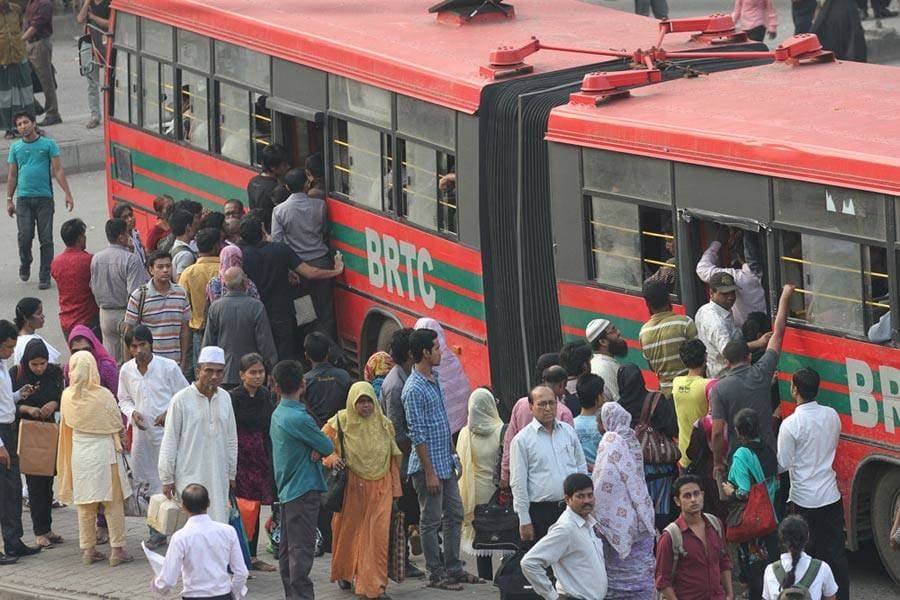
Public transport in the country is in a poor shape because past governments have not tried to make it efficient. In a country with a population load of about 200 million, ensuring smooth mobility is impossible without a good public transport system. Although several projects and programmes have been tried before, they have not reduced traffic jams or improved bus services. As a result, millions still travel in old and unsafe buses that contribute to pollution.
The new government promised in its election manifesto to make public transport more efficient, and the budget offers a chance to start working towards that goal. It is not just about how much money is set aside, but also about having a clear plan for improving public transport as promised. The manifesto said there would be special steps to expand and improve the system to "alleviate traffic congestion and make public transport more effective and accessible in densely populated cities." It also listed several ways to improve public transport. The budget now needs to include funding and clear directions to put these plans into action.
One problem is that public transport might not receive sufficient attention in the budget, given many other priorities and limited resources. The finance minister mainly directs his focus on economic growth and controlling inflation, so his main concerns remain investment and macroeconomic stability. In this context, public transport often becomes just a minor issue, like many others.
The budget for transport and communication rose to Tk 713.44 billion in FY26, up from Tk 605.00 billion in the revised FY25 budget. The original FY25 budget was Tk 829.12 billion. In FY24, the original budget was Tk 876.29 billion, later cut to Tk 752.40 billion, but actual spending was only Tk 591.71 billion. This pattern shows that many plans were not completed, even when money was allocated. It also suggests there is room to adjust the budget and give greater attention to public transport by incorporating new ideas. For example, a low-cost refinancing scheme could help replace old buses with new ones. A modest budgetary allocation to provide loans to the bus owners at a low interest rate for the time being will act as an incentive to replace the buses.
During the regime of Yunus-led interim government, there was a move to introduce electric bus in Dhaka by gradually replacing the old public buses. It did not happen. Later, the interim government allowed a number of companies to launch 690 air-conditioned (AC) buses in Dhaka. Six months have passed and the transport companies have yet to operate the AC buses on the designated routes. Now, the government is stressing on non-AC electric buses. This kind of flip-flop will not help fix the problem of public transport.
A big issue in public transport is widespread criminal activity, especially collection of illegal tolls supported by political parties over the years. To fix this, the government should crack down on illegal tolls, conduct regular vehicle fitness checks and establish an independent oversight group. All these steps, however, need strong political will. The budgetary allocation and direction can give a signal in this direction.
asjadulk@gmail.com