



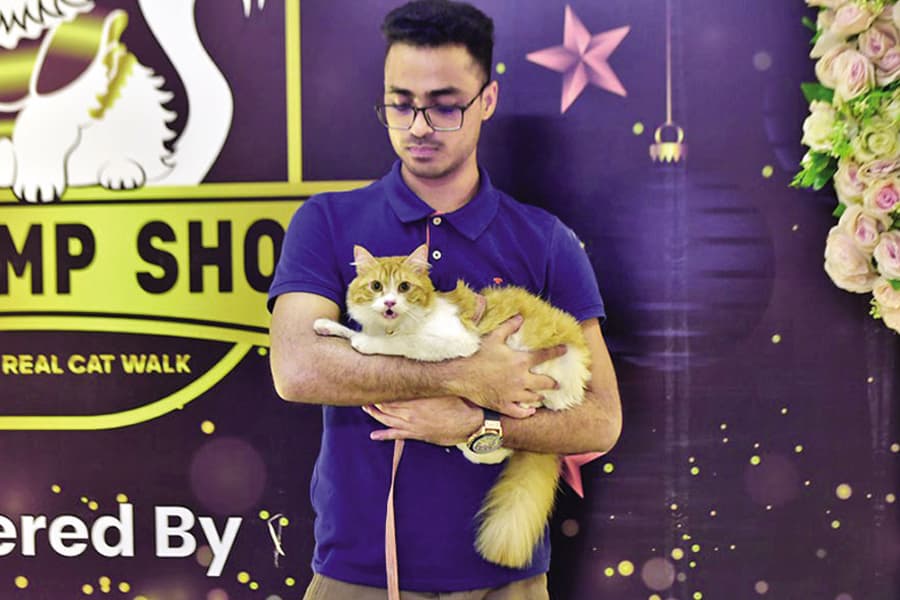
A decade ago, a cat in a Dhaka apartment was an oddity, perhaps a stray taken in out of pity or a child's persistent demand. Today, it is increasingly a Persian or a Scottish Fold, bought for tens of thousands of taka, fed imported kibble, vaccinated at a private clinic, photographed for Facebook or Instagram, and occasionally boarded at a "cat hotel" while its owner travels.
This quiet transformation, modest in scale but rapid in growth, deserves more attention than it usually gets. It is not simply a story about pets. It is a story about who we are becoming.
The numbers, though still small relative to the national economy, are telling. Industry estimates place Bangladesh's cat food market alone at around BDT 5 billion, of which roughly BDT 4 billion is met through imports. The Department of Livestock Services recorded about 32,000 metric tons of cat food imports in the 2024-25 financial year, sourced primarily from China, Thailand and Turkey.
The wider pet food and accessories sector is now estimated to generate annual sales in the range of hundreds of crores of taka, expanding at 10 to 20 per cent a year according to various industry sources, a growth rate that dwarfs Bangladesh's overall GDP expansion. Researchers at ACI Limited have noted that the number of pet owners in the country has roughly doubled over the past three years, with cats accounting for as many as nine in ten pets kept in urban households, largely because apartment living and building restrictions on dogs make cats the more practical companion.
Within the industry, spending breaks down as follows: food commands roughly 57 per cent of the total, followed by medicines at 19 per cent, litter at 16 per cent, and vaccines at 7 per cent. Statista projects Bangladesh's broader pet food market could reach approximately USD 308.5 million by 2028. Of the country's estimated four million cats, just over 560,000 are currently kept formally as household pets, according to ACI Limited estimates, leaving considerable room for expansion.
Globally, the pet care industry was valued at over USD 270 billion in 2025 and is projected to approach USD 500 billion by 2034, growing at roughly 7 per cent annually, according to market research from Grand View Research. Bangladesh's market, expanding at two to three times the rate, is riding a current reshaping of consumption patterns worldwide.
What explains this in a country where national poverty has risen for three consecutive years, from 18.7 per cent in 2022 to 21.4 per cent in 2025, according to the World Bank's 2025 Poverty and Equity Assessment, and where household budgets remain tight for food and essentials? The answer lies less in economics than in sociology.
Bangladesh has urbanised rapidly; more than 40 per cent of its population is now urban, a figure the United Nations Population Division projects will continue to rise as urban dwellers, numbering around 65 million in 2018, reach roughly 118 million by 2050, and Dhaka remains among the most densely populated cities on earth.
Alongside this has come an expanding middle class: development economists analysing Bangladesh Bureau of Statistics household income data estimate the segment earning between two and three dollars a day per capita comprised about 34 million people in recent years, with that share projected to reach roughly 25 per cent of the population, or around 44 million people, climbing further to about 60 million by 2030. It is this expanding, increasingly urban middle class, rather than the population at large, that is driving discretionary spending on companion animals.
Rapid urbanisation has also accompanied a steady erosion of the joint family system. Young professionals, many of them women, entering the workforce in greater numbers than a generation ago, increasingly live alone or in small nuclear households, often far from parents and siblings. In this context, a cat is not simply an animal. It is a companion that fills a particular emotional and social void created by the changing structure of urban life.
This is precisely the kind of shift that sociologist Anthony Giddens anticipated when he argued in Modernity and Self-Identity that under conditions of late modernity, individuals are compelled to actively construct their identities through everyday lifestyle choices rather than inherit them from tradition. Choosing to keep, feed, groom and medically care for a pedigree cat becomes one such choice: a way of narrating who one is, independent of family, religion or profession. The cat, in this sense, is less a possession than a project of selfhood.
Jean Baudrillard's framework in The Consumer Society offers a complementary lens. Baudrillard argued that in advanced consumer societies, goods are purchased not merely for their use value but for what they signify, their capacity to communicate status, taste and belonging.
A Ragdoll or British Shorthair bought for upward of BDT 100,000, along with imported supplements and designer cat trees, precisely performs this signalling function in Dhaka's emerging middle and upper-middle classes. It announces disposable income, cosmopolitan taste and a modern, Westernised sensibility, all without a word being spoken.
Pierre Bourdieu's Distinction sharpens this further. Bourdieu showed that consumption patterns are rarely neutral; they map onto and reproduce social class through what he called cultural capital, the accumulated dispositions and tastes that mark belonging to a particular social stratum.
Knowing which breed is fashionable, which imported cat food brand is "premium," which clinic offers the best diagnostics, and which Facebook group to consult for grooming advice constitutes a cultural literacy distinguishing the new pet-owning class from those for whom an animal, if kept at all, remains a working or street animal rather than a curated companion.
Around this has grown a genuine ecosystem of small enterprises. Veterinary clinics in Dhaka and Chattogram have multiplied, with industry researchers documenting more than 225 private pet clinics nationally, around 70 per cent of which also retail food, litter, and accessories alongside vaccination, surgery, diagnostics, and tele-consultation, drawing young veterinarians who previously would have gravitated toward poultry, livestock, or fisheries work.
Online retailers and Facebook-based businesses, several of which reported tenfold increase in sales since their founding in the late 2010s, now distribute litter, carriers, scratching posts and clothing across the country. Cat boarding, grooming salons, pet taxis and influencer-driven content creation have all appeared, each a small but real addition to urban service employment.
None of this amounts to a major contributor to GDP. Still, it does represent a genuine, if narrow, expansion of the formal and semi-formal service economy, one built almost entirely on consumer choice rather than government policy or industrial planning.
The challenges accompanying this growth are instructive of broader patterns in Bangladesh's economic development. Breeding remains almost entirely informal and unregulated, raising concerns about inbreeding, inadequate health screening and inhumane conditions, problems familiar from other under-regulated consumer sectors.
The near-total dependence on imported food, medicine, and accessories mirrors a broader structural weakness in Bangladesh's consumer goods economy, where rising demand outpaces domestic manufacturing capacity, leaving the country exposed to currency fluctuations and supply shocks, even for something as trivial as cat litter.
And perhaps most uncomfortably, a market for pedigree cats costing more than many households earn in a month sits awkwardly alongside Bangladesh's large population of stray and street cats. These animals receive little institutional care even as urban consumers spend lavishly on their pedigreed cousins. This is a microcosm of a familiar national pattern: pockets of conspicuous consumption coexisting, often within the same city block, with neglect and want.
None of this is a reason to dismiss the cat economy as frivolous. Small, lifestyle-driven sectors of this kind are often early indicators of larger structural shifts in family form, gender roles, urban density and consumption identity that conventional economic indicators are slow to capture.
The fact that a meaningful number of young, university-educated, urban Bangladeshis, disproportionately women in their twenties and thirties, are choosing to spend discretionary income on companion animals rather than on more traditional markers of status tells us something about loneliness, independence and the search for emotional anchoring in a rapidly changing society. It also tells us that as Bangladesh's middle class continues to expand, however unevenly, new categories of demand will keep emerging that planners, regulators and entrepreneurs alike would do well to take seriously rather than treat as curiosities.
If there is a policy lesson here, it is a modest one: bring order to growth before growth outpaces order. Basic standards for breeding and animal welfare, clearer labeling and safety regulation for imported pet food and medicine, given that the Bangladesh Food Safety Authority and the Ministry of Fisheries and Livestock are only beginning to engage with this space, and encouragement of domestic manufacturing to reduce import dependence, would help this small but fast-growing sector mature responsibly.
More broadly, the cat economy is worth watching not because it will rival garments or remittances in scale, but because it offers a clear window into how urbanisation, changing family structures and consumer culture are quietly reshaping everyday life in Bangladesh.
Dr Matiur Rahman is a researcher and development professional.
matiurrahman588@gmail.com