


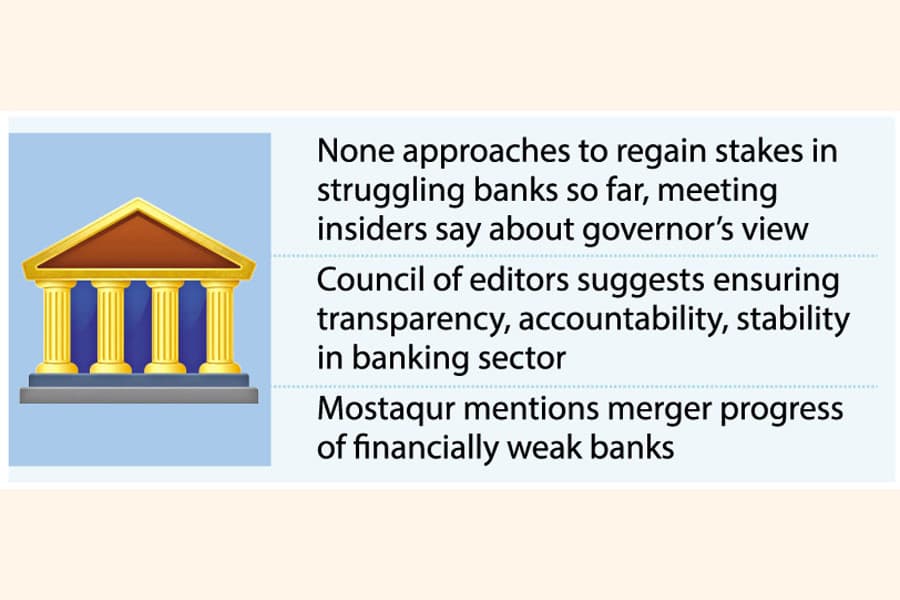
The central bank has found the Section 18(a) of the Bank Resolution Act, which provides for ownership return of the merged troubled banks not 'maintainable' and has recommended its deletion.


Bangladesh Bank Governor Md Mostaqur Rahman expressed such view Monday as Editors' Council in a meeting with him expressed deep concern over the impugned section of the act and stressed the need for its further scrutiny for the sake of the banking sector.
The apex body of editors of the country's leading print-media outlets raised the concern and also listed other financial-sector problems during the meeting with the BB Governor at the central bank's headquarters in Dhaka.
Explaining reasons for suggesting removal of the section, the BB governor said, " There is no scope for application of the provision. The government has already invested nearly Tk. 520 billion in five merged Islamic banks, namely, Sammilita Islamic Bank. These banks in total have Tk. 1.32 trillion depositors' money, Tk. 320 billion performing loans and Tk. 1.64 trillion non-performing loans. It might be possible to recover Tk.200--Tk.300 billion. Thus. There will be a gap of at least Tk 650 billion. None, it seems, would come to reclaim ownership. Already two months have elapsed since adoption of the law. None has showed interest until now."
Members of the council, led by its president and New Age Editor Nurul Kabir, discussed a range of issues affecting the country's banking sector with the leadership of the banking regulator.
The council members also shared their concerns over the challenges facing the banking sector, particularly the rising volume of non-performing loans, the need to establish good governance in banks, the security of depositors' funds, and the current situation on the foreign- exchange market.
Emerging from the meeting, Nurul Kabir said the governor informed them about various reform initiatives and plans undertaken by the central bank to address the sector's problems and assured them that necessary measures would be taken.
The meeting also discussed the recent instability surrounding Islami Bank Bangladesh PLC as well as issues related to inflation control, investment and employment conditions, and various aspects of the proposed new national budget.
The Editors' Council emphasised the need for effective measures to ensure transparency, accountability and stability in the banking sector.
In a press release, the central bank stated that the BB governor briefed the editors on its ongoing reform agenda aimed at strengthening the country's banking sector. Key issues discussed included the management of non-performing loans (NPLs), governance reforms, oversight on weak banks, foreign-exchange market stability, digital transformation, and measures to ensure overall financial-sector stability.
Governor Mostaqur Rahman updated them on the merger progress of financially weak banks, noting that some administrative and management-related changes have already been completed. "The process is expected to gain a momentum following upgradation of the banks' Core Banking Systems (CBS)."
Addressing the challenge of default loans, the governor informed that the amendment and changes in the existing money loan court to ensure faster settlement of the cases linked to defaulted loans got underway.
"Simultaneously", it says, "the governor told them that distressed-asset- management company act will also be formulated to deal with unrecoverable assets more effectively."
The editors have also been informed that the BB's stolen asset-recovery moves helped freeze laundered assets worth $25 million in the United Kingdom (UK), which will be brought back soon.
Emphasizing the importance of "depoliticizing" the banking sector, the governor said the central bank's reform programme "is focused on ensuring professionalism, accountability, and good governance in bank management and lending practices".
Participants were also informed about regulatory measures taken in several large banks, including Islami Bank Bangladesh PLC, involving board restructuring, management changes, and initiatives aimed at protecting depositors' interests.
The governor also disapproved of the owning of any bank by any political party, saying that people from all walks of life should have confidence in the operations of a bank.
On digital transformation, Mr. Rahman said the central bank was working to build an integrated digital financial ecosystem. Planned initiatives include expanding digital-payment services, introducing AI-based credit-assessment systems, broadening agent-banking services, and implementing the "One Citizen, One Identity, One Wallet" concept to enhance access to digital financial services.
The governor further notes that wider adoption of Bangla QR could accelerate cashless transactions, improve transaction security, and contribute to higher government revenue collection.
In cases where patients require foreign currency exceeding the approved limit for medical treatment abroad, the governor said the regulator is providing approval as quickly as possible upon application through the bank concerned.
"In addition, the interest rate on funds used for bill discounting under the UPAS (Usance Payment at Sight) facility has been reduced, which is expected to help lower the prices of goods," the BB statement says.
Other council members who attended the meeting are Editor of The Financial Express Shamsul Huq Zahid, Editor of Bonik Barta Dewan Hanif Mahmud, Editor of Manabzamin Matiur Rahman Chowdhury, Editor of Prothom Alo Matiur Rahman, Editor of Daily Inqilab AMM Bahauddin, Editor of The Daily Samakal Shahed Mohammad Ali and Editor of Agamir Somoy Mustafa Mamun.
jubairfe1980@gmail.com