


Amir Khosru walks a tightrope in making ends meet as he presents today his maiden national budget suiting the BNP-led government's economic priorities amid persistent inflationary pressure, sluggish private investment and weak employment generation.


The fiscal 2026-27 budget also happens to be the first of the BNP-led administration that assumed office following the February-12th general election held against the backdrop of political upheavals and uprising.
The Finance and Planning Minister, Amir Khosru Mahmud Chowdhury, is set to place in parliament at 3:00pm the national budget with a record-high outlay.
It will also be the party's 17th budget since fiscal year 1976-77 and Bangladesh's 55th since independence.
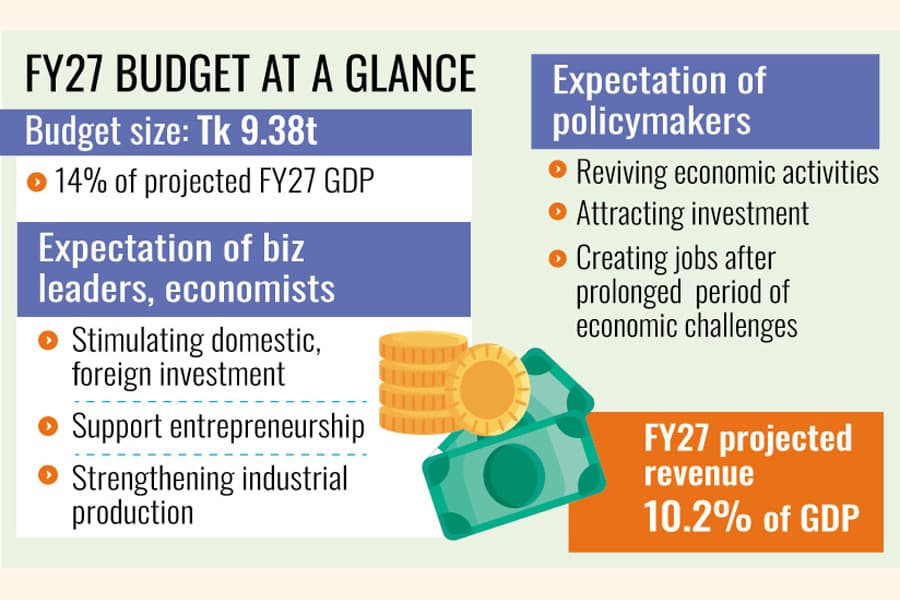
The proposed budget is estimated at Tk 9.38 trillion which is equivalent to around 14 per cent of the country's projected gross domestic product (GDP) for FY2027.
Policymakers are expected to use the budget as key instrument for reviving economic activity, attracting investment and generating employment following a prolonged period of economic challenges from within and without.
The BNP government has repeatedly pledged to restore business confidence by addressing structural bottlenecks and reviving closed industrial units and creating a more investment-friendly environment.
The budget is, therefore, expected to contain a range of fiscal and policy incentives aimed at encouraging both new and existing private-sector enterprises.
Business leaders and economists are closely watching the budget for measures that could stimulate domestic and foreign investment, support entrepreneurship and strengthen industrial production.
Many expect tax incentives, regulatory reforms and sector-specific support programmes to feature prominently in the budget proposals.
At the same time, the government faces a difficult fiscal challenge.
The revenue target for FY2027 is projected at around 10.2 per cent of the GDP, a level many economists believe will be difficult to achieve given the country's historically low tax-to-GDP ratio.
Economists argue that broadening the tax base and revamping tax administration could help increase revenue collection.
However, they caution that achieving a significant jump in revenue within a single fiscal year may prove difficult without comprehensive reforms.
"To my mind, the tax picture might be some brighter once the tax base is widened," says Dr Zahid Hussain, an independent economist.
He also says that borrowing from the banking sector might lead to higher interest rate and crowding-out effect.
While policy measures aim at easing supply-side constraints could help boost investment and employment, "the benefits are unlikely to materialise immediately".
Structural reforms often require time before translating into higher private-sector activity, stronger job creation and sustainable economic growth.
"The budget's broader significance lies in whether it can balance the government's growth ambitions with the need to contain inflation, maintain macroeconomic stability and strengthen public finances," he notes.
The leading economists also say the effectiveness of the proposed measures, rather than their scale alone, will determine whether the government succeeds in reviving business confidence and accelerating economic recovery.
jasimharoon@yahoo.com