


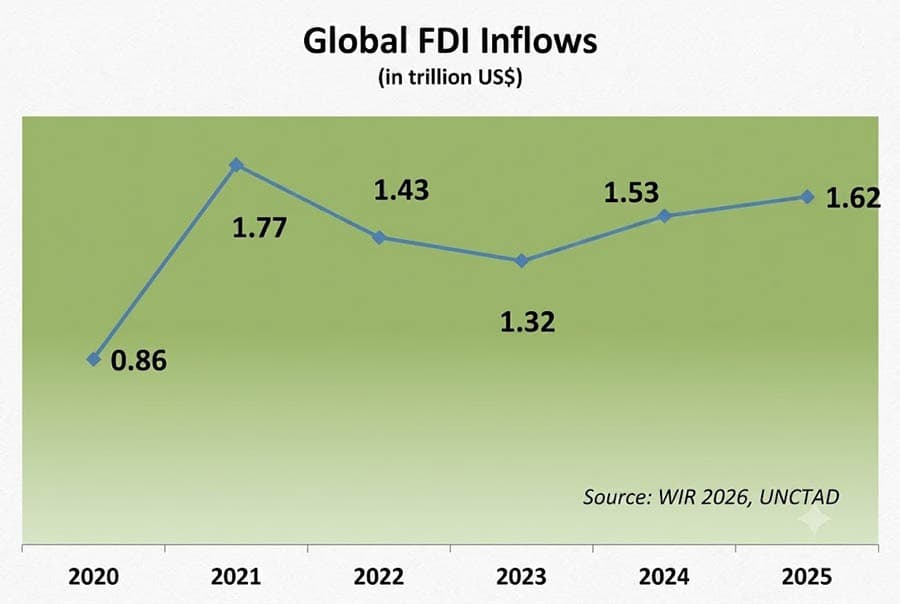
Global inflow of foreign direct investment (FDI) jumped by six per cent in the last year ending two years of decline, according to the World Investment Report (WIR) 2026 that is just released in Geneva on Tuesday morning.


The amount of global FDI stood at $1.62 trillion in 2025 which was $1.53 trillion in 2024 and $1.32 trillion in 2023.
“But the recovery remains narrow, fragile and uneven,” said the report which is prepared and published by UN Trade and Development (UNCTAD).
Inflows of FDI to developed economies rose 11 per cent although developing economies recorded only 2 per cent growth, reaching $901 billion.
“The figures point to a rebound that is not translating evenly into development opportunities,” observed UNCTAD.
“The issue is not only how much capital is moving, but where it is going, what it is building and whether it is expanding productive capacity, creating jobs, strengthening skills and supporting technology transfer,” it continued.
The world's top 20 host economies attracted more than 80 per cent of global FDI in 2025, according to the WIR 2026. The figure underscored a trend: “investment is becoming more concentrated across countries, sectors and projects.”
“The recovery should also be interpreted with caution: headline FDI numbers do not always translate into new factories, infrastructure, jobs or technology transfer,” added the annual flagship report of UNCTAD.
The theme of the latest report is ‘International Investment in a Turbulent Era.’
It also showed that strategic sectors are reshaping flows: they accounted for 44 per cent of greenfield project value, up from 16 per cent in 2020.
“Developing impact remains uneven: what matters is where investment goes, what it builds and who benefits,” WRI 2026 further added. “Policy is becoming more selective, as governments steer investment towards strategic sectors and national priorities.”
Though developing nations received more than half of the global FDI in the last year, growth was modest and uneven across regions. For instance, developing Asia remained the largest recipient region, attracting FDI worth $644 billion, while FDI in Latin America and the Caribbean rose 14 per cent to $188 billion.
Again, Africa received about $70 billion as FDI, which is one third above its 2010–2024 average.
Inflow of FDI in Least developed countries (LDCs) rise 21 per cent to $43 billion, but the group still accounted for only 2.7 per cent of global FDI, with flows concentrated in a small number of mostly resource-rich economies.
“This concentration is particularly visible in industries linked to technology, energy and industrial policy,” said the UNCTAD report.
Strategic sectors such as AI infrastructure, semiconductors, critical minerals and energy-transition technologies and services accounted for 44 per cent of global greenfield project values in 2025, up from 16 per cent in 2020.
“The growth in project values was driven mainly by data centres, followed by oil and gas and semiconductors,” the report explained. “Most other sectors registered declines, including renewable energy, infrastructure and manufacturing, showing how narrow the recovery remains.”
Low-income and lower-middle-income economies attracted only about 10 per cent of strategic-sector investment between 2020 and 2025, compared with more than 20 per cent in other sectors, according to the WIR 2026.
UNCTAD also said that the governments are taking a more active role in shaping investment flows.
“In 2025, countries adopted a record 229 investment policy measures,” it added. “While most remained favourable to investors, many were designed to attract investment into strategic industries, strengthen domestic economic priorities or respond to economic security concerns.”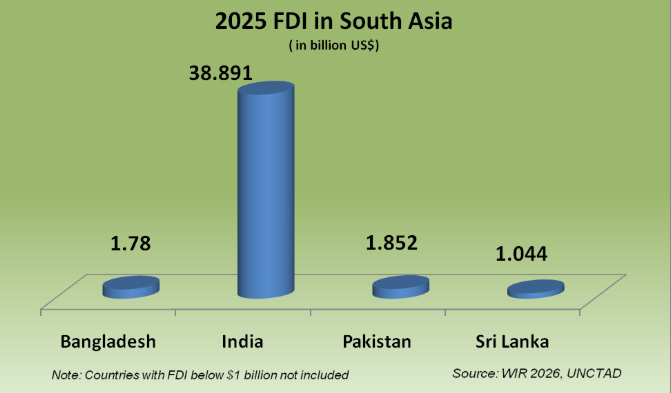
BANGLADESH: Net inflow of FDI in Bangladesh in the last year recorded a phenomenal growth of 44 per cent to $1.78 billion from $1.23 billion in 2024, according to the UNCTAD report.
The amount is highest in the last five years. As a result, FDI as percentage of gross fixed capital stood at 1.40 per cent in the last year which was 0.90 per cent in 2024.
Outstanding stock of FDI reached at $19.63 billion at the end of 2025, according to UNCTAD estimate.
UNCTAD report also showed that outward FDI from Bangladesh to the rest of the world increased by 72.60 per cent to $25 million in the last year from $15 million in 2024.
In South Asia, India attracted the highest amount of FDI in the last year which was $38.89 billion followed by Pakistan where the inflow of FDI stood at $ 1.85 billion.
asjadulk@gmail.com