


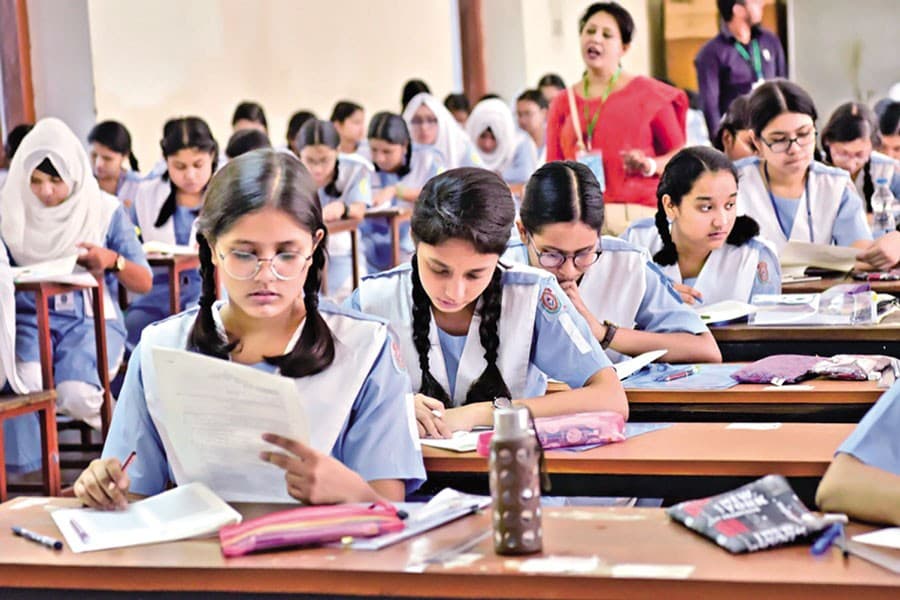
Bangladesh has made remarkable progress in expanding educational opportunities over the past few decades. School enrolment has increased, literacy rates have increased, and the number of universities has continued to grow. Yet a notable question remains: Are we teaching our young generation to think independently, or are we simply preparing them to pass exams? Despite successive reforms, rote learning still dominates our classrooms. Students spend years memorising textbook answers to pass board exams, leaving little space for critical analysis, creativity, or real research. This structural defect is not a recent accident. Rather, it is a direct continuation of a colonial system that was introduced more than a century ago.
The Colonial Blueprint In Education
The historical reality of the transformation of Bengal’s education system during British rule provides insight into why our current system works the way it does. Before colonial administrative intervention, Bengal had a highly decentralised and community-based system of indigenous education. Pathshalas provided effective literacy and numeracy for rural youth, while tolls taught advanced Sanskrit philosophy. In the meantime, maktabs and madrasas taught classical jurisprudence and theology, as well as Arabic and Persian. These places directly reflected local cultural, spiritual, and structural needs.
British policymakers fundamentally transformed this local education system in the interests of Colonial rule. This transformation reached its peak in Thomas Babington Macaulay's famous Minute on Indian Education in 1835, which adhered the state’s financial power entirely to English education and a Western curriculum.
Macaulay famously dismissed the value of conventional Indian literature and openly advocated the "downward filtration theory." The strategy was clear: to educate a narrow social class of native intermediaries to serve as clerks, translators, and subordinate administrators of the British bureaucracy. Its aim was never to consolidate a society of independent philosophers, scientists, or inventors. Its aim was to establish bureaucratic discipline, standardisation, and absolute obedience through strict, state-controlled examinations.
Later, Wood's Dispatch of 1854 established a top-down administrative hierarchy through which standardised teacher training, government inspection, and university structures were introduced. While these measures brought about institutional modernisation and connected Bengal to global scientific discourse, they systematically marginalised the scope of traditional knowledge, replaced Persian as the language of state administration, and created widespread regional and class inequalities.
The Modern Classroom System
Even after decades of Colonial Rule, their administrative structure's legacy still appears in Bangladeshi schools and colleges. Their legacy is absolutely clear in today's classroom system. Teachers are always under pressure to finish the syllabus, students always rush to memorise the guidebooks, and guardians only emphasise scores and GPA to measure the success of education. Coaching centres have become common as the social status of certificates has become more valuable than the depth of understanding.
This process creates certificate-based educated people. But certificates alone can't establish a modern knowledge-based economy. We often notice that the new students of the local universities often hesitate to analyse, do inquiry, explore independent research, critical thinking, and engage in fundamental academic writing. These skills are hardly practiced in the primary section of education.
Meanwhile, the contemporary global employment market is developing rapidly. With the rise of artificial intelligence and automation, the ability to memorise facts has lost its economic value because information is accessible within seconds. Today's employers seek graduates who can solve fluid problems, communicate effectively across cultures, and adapt to shifting technologies. Our current examination-centreed culture is failing to meet these demands.
The Legacy of Social and Educational Division
The Colonial Structure has left deep institutional stratification. In modern Bangladesh, we can observe three distinct streams of education: Bangla-medium, English-medium, and Madrasha education. The resources, curricula, and employment outcomes of each stream differ widely.
This division deeply reflects the historical discrimination of the 19th century, in which those who had early access to Colonial English-medium training received privilege in civil service and state patronage, while indigenous communities lagged behind. In modern Bangladesh, proficiency in the English language is considered a high social status and provides elite professional opportunities, making a language medium a means of social stratification rather than a simple skill.
Pathways to True Decolonisation
Bangladesh does not have to wait for deep institutional reforms to realise its dream of an innovation-based economy. Decolonising our education system does not mean destroying the institutional foundation we inherited, such as the well-organised university system or science-based education system. Rather, it means transformation toward long-standing weaknesses.
To begin with, a radical change is needed in the assessment system. In addition to indigenous and traditional written examination, continuous assessment, research projects, oral presentations, and practical problem-solving tasks and skills must be included. Instead of the ability to reproduce memorised text, exams should measure students' ability to analyse information, think critically, and produce basic ideas.
Secondly, the local curriculum must include South Asian and Bengali historical, scientific, philosophical, and literary contributions along with global modern knowledge. This will reduce the gap between global progress and indigenous cultural identity and eliminate cultural isolation established by the colonial structure.
Furthermore, we need a substantial balance in our language policy. Bengali must serve as the main method of intellectual expression and conceptual learning, while English training must be strengthened to serve as an effective medium of global connection. The two languages must exist as complementary skills, not competing social classes.
Finally, we must invest our opportunities deeply in research and teacher development programs from the grassroots level. Educators need contemporary teaching materials to transform the classroom from teacher-centred lecture rooms to open spaces for discussion and mutual inquiry.
Looking Beyond the Scorecard
The education system of modern Bangladesh is a complex mix of national progress and deep historical roots. Though we successfully opened the path to school for millions of children, the utmost purpose of the classroom structure is still linked to our bureaucratic past.
National development cannot be sustainable based on emphasising scores. Rather, true educational success must be recognised in terms of the ability of our youth to think independently, critically, and to question conventional wisdom. The youth need to contribute to the new knowledge of the world. It is high time we broke away from the colonial educational framework and built a suitable system that teaches our students how to think, not just to be dependent on memorisation.
- The writer is a student of Department of Islamic History and Culture, Jagannath University