


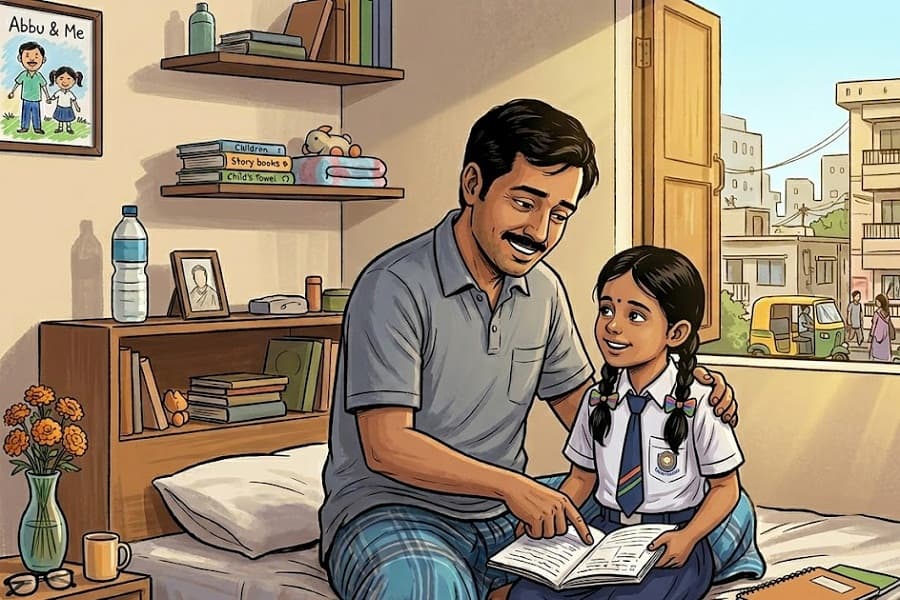
"Baba, ma'am asked me to bring my ammu-abbu for the parents' meeting. What do I tell her?" the son asked his father, sitting at the dinner table.
His father can't find the words to answer his plea. He doesn't have the heart to explain to his child a concept as heavy as death just yet.
Somewhere in Bangladesh, a newly become father helplessly searches for a place to change his baby's diaper. The men's public restrooms do not have facilities like changing stations, nor are there any gender-neutral alternatives, passively sending the message that child-rearing is not a man's work.
These are everyday stories of single fathers across Bangladesh. Whether it's filling out a school form that requires signatures from both parents, relentless questioning from strangers, the lack of inclusive public amenities, or passing remarks, society makes it clear that single fatherhood is an incomplete form of parenthood.
The image of an individual raising their kids as a sole parent is not what most people in this country think of as a family.
Parenting in any context is a Herculean task that requires immense patience and sacrifice. Undertaking this responsibility alone, either by choice or necessity, is intimidating and arduous.
This is made even more difficult by the societal stigma regarding single parenthood, structural obstacles and lack of communal support.
Single-parent households only make up a small fraction of Bangladeshi households at around 5 per cent, according to the World Population Review.
Even among said households, single fathers are a minority, as most of them are led by single mothers. Given the rarity of the community, the struggles faced by single fathers are rarely discussed.
Bangladeshi masculinity, by tradition, is intrinsically rooted in fatherhood. Conventional paternal roles and responsibilities are an important element in the construction of masculine identity in Bangladesh.
The traditional patriarch, expected to provide financially and make major decisions regarding the children, is rarely expected to do the hands-on work of raising children.
Child-rearing is often seen as a predominantly feminine task, and mothers are expected to serve as the primary caregiver.
Feeding, bathing, cleaning, etc., are usually chalked up as motherly responsibilities. These societal expectations of gendered parenthood are so deeply ingrained that when a father tries to take on traditionally 'maternal' responsibilities, they're often met with raised eyebrows and systematic hurdles.
The lack of community and support for childcare is one of the biggest roadblocks to single fatherhood.
Historically, childcare has largely been a communal responsibility shared by extended family, peers, neighbourhoods, etc.
But the age-old adage of 'It takes a village to raise a child' does not apply to today's world.
It is increasingly isolating and individualistic, so the duties of raising a child are mostly borne by parents alone.
This social isolation is much more amplified and harrowing for single parents, especially single fathers. Their abilities and intentions are often met with distrust and scepticism. Therefore, single fathers might lack the social support systems usually afforded to partnered parents, even when they need it the most.
Societal and systematic stigma around single parenthood makes the matter all the more difficult.
The two-parent, child family unit is largely the norm, so individual parents are seen as one half of a whole parental figure by a large chunk of society. Fathers are often seen as 'babysitters' of their own children rather than capable primary caregivers.
Another obstacle commonly faced by single fathers is balancing childcare with work.
A vast majority of single fathers need to work full-time to support themselves and their children. However, most workplaces in Bangladesh make no consideration for fathers.
Bangladesh does not even have any mandatory paternal leave for working fathers, let alone any leeway for other parental responsibilities.
Juggling professional and parental responsibilities remains one of the biggest challenges for working single fathers. Moreover, balancing sole financial responsibility with full-time childcare leaves them little to no time for self-care.
Globally, single fathers experience higher rates of depression and anxiety disorders compared to partnered fathers.
Change, however slow, is still underway. Atypical family units are becoming more visible, and social expectations of family dynamics are shifting in our country.
There is still a long way to go in normalising single-parent families and lending them the support systems they need, but there is hope. Along with changing cultural attitudes, various government and workplace policies could be taken to ease their hardships.
State and local government-assisted childcare subsidies for low to middle-income single-parent households and gender-neutral paid family leave laws would alleviate many of the struggles faced by single fathers.
When the house finally grows quiet and the day's battles are over, many single fathers in Bangladesh are left to shoulder responsibilities few people see. They carry exhaustion, grief and uncertainty. Yet each morning they start again, help with homework, soothe fears and build a future with what they have. The world celebrates International Father's Day on the 21st of June. In this day of commemorating fatherhood, why do we often forget those fathers who are the exception and not the norm?
autoshyrabbani@gmail.com