


All over the world, men and women of all ages remained glued to the small screens of televisions or other digital platforms during the football World Cup matches that began on June 11 and continued o over one month. The fact that the number of countries playing in the latest World Cup was 48 as compared to 32 during the last (2022) meant not only a longer period of the contest but a larger number of audience than before. In Bangladesh, Banglalink’s streaming platform Toffee recorded more than 1.5 billion views across the tournament and the final match alone on July 19 is estimated to have attracted 30 million viewers.
But more than the number of viewers, the passion for favourite teams playing in World Cup remained at a high level of intensity in Bangladesh owing to drumbeat of support in print and social media. As in the past, supporters among viewers were divided between Brazil and Argentina, followed by France, Germany, Spain and England. But measured by adrenaline race and explicit passion of Bangladeshi viewers, no country came near Argentina and Brazil. The jersey of players of these two countries were seen worn by young and old and the national flags of their countries were hoisted or hung from umpteenth number of houses to trees by supporters in cities and towns. The craze for World Cup and favourite teams was not confined to urban population only. Villages were also caught up in the frenzy for World Cup matches with many of their population gripped by passionate support for the two favourite teams. According to newspaper reports, a farmer in Kushtia sold his land to have a giant sized flag of Argentina made while an expatriate in Germany spent all his monthly remittance for the stitching of a flag of Germany to be displayed in his village. Open air viewing in large screens were commonplace events observed in metropolitan cities and small towns alike.
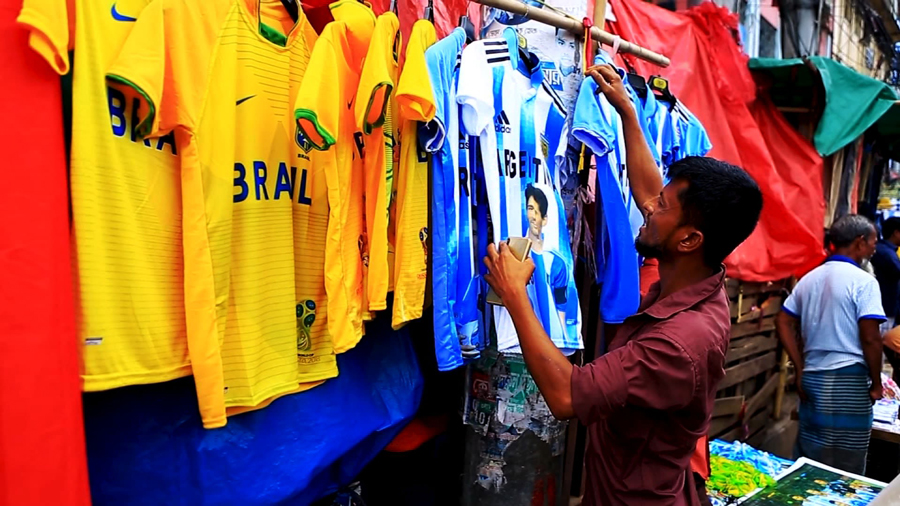
During the entire tournament shops, restaurants and every conceivable public place in Bangladesh bore the signs of the all consuming passion for football. Pictures of football idols like Messi and Neymar were sold in different sizes, while souvenirs of ceramic mugs could be seen in the households of the football fans. Some banks and commercial shops earmarked a corner to display the flags, pictures of star players and posters showing the itinerary of matches. Be it a tea shop or office, mention of matches, scores made and performance by star players constituted the staple of daily conversation of people there. Heated arguments among and falling apart of friends and neighbours over differences of views about the teams and players were part of the scene created by the World Cup. Sometime, the quarrel became ugly and even tragic.
As in the past, during the last World Cup also, football made its mark as the most-watched public sports in Bangladesh, surpassing cricket. The irony is in spite of the adrenaline racing passion seen during the world event, football has been the Cinderella of public sports in Bangladesh. The widespread enthusiasm seen for football matches during the World cup is not matched by prevailing circumstances surrounding the game in the country. It lost its ground to cricket in 1999 when Bangladesh qualified for Cricket World Cup and became a member of ICC the following year. Since then cricket has become the unofficial national sports of Bangladesh attracting attention from sports organisations, commercial patrons, financial sponsors and the government. There is nothing wrong in popularising a modern game like cricket but when it replaces a once popular and commonly seen game like football it cannot but raise questions.
The first question is, did football experience decline because of its inherent weaknesses as a game? Among the possible weaknesses can be the failure of football to attract viewers because of its dull nature. But is football, even the Bangladesh small league type, really uninteresting? Being very fast paced and displaying skills of all players, football played anywhere is anything but dull. Its manner of being played by two competitive teams and the rules and regulations guiding the players is so simple that even an illiterate person can understand why a team wins and the other loses or in some cases both play to a draw. The excitement generated from the very beginning and the ease to understand the game makes for spontaneous popularity. Secondly, football is not only inherently popular as an entertainment, the fact that it requires only a ball and a field of required size with two goal posts make the game all the more popular. Being less costly, it is more accessible to a larger interest group of players and viewers.
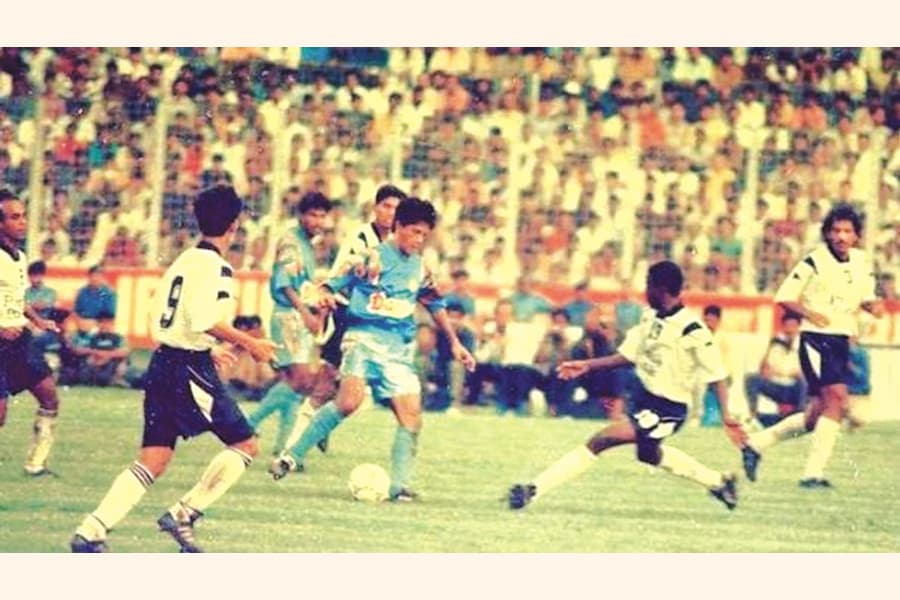
1980s and 1990s were the golden period of football in Bangladesh. At that time, urban and rural viewers waited with great excitement to watch matches between Abahani Krira Chakra and Mohammedan Sporting Club has not faded from memory. If football could instil enthusiasm in urban and rural audience and make them passionate supporters of teams of their choice in the past, it can do the same now. After all, unlike cricket, the popularity of football is not based on an elite class, particularly on educated urbanites. Football was and still remains the game of all classes which cricket is not and never was. Football has declined in importance not because of its inherent weaknesses and deficiencies but due to neglect by government and commercial and financial sponsors.
In the past every school even in mufassil towns had its football ground. Gradually these grounds disappeared and became sites for constructions of various descriptions. Absence of regular play by students of schools and colleges and competition among them led to disuse and misuse of playing grounds. It also accounted for scarcity of good players groomed at grassroots level. In the past, social work and sports activities were promoted locally by individuals with leadership qualities. As government’s role increased, private initiative and leadership in promoting and sustaining social welfare activities and sports dwindled in size and importance. Even though Bangladesh Football Federation (BFF) received government grant it did very little to promote the game at school and college levels. Even government schools and colleges had no sports teacher or coach to groom players at young age. Inter-school or inter-college tournaments disappeared even before these were introduced as regular features.
The Football League organised by BFF involves only a limited number of Dhaka based teams. Last year the number of teams participating in the League was only ten and all of them were based in Dhaka. Even in Africa, many countries have national football league with 15 to 20 teams participating in an average year. The causes for the limited number of teams participating in the League and all being Dhaka-based are the following:
(1) Limited finances. Most clubs rely on a few sponsors or wealthy patrons. Match-day ticket sales and television revenue are very small compared to cricket. (2) Weak football infrastructure. Many districts lack quality stadiums, training facilities, and youth academies. As a result, few clubs are ready for top-level competition at Dhaka or at sub-national levels. (3) Professional standards. A larger league requires clubs to merit licensing requirements regarding finances, physical facilities, youth development and administration. Many clubs do not meet these standards. (4) Promotion and relegation challenges. Below the national level Football League organised by BFF and the second tier Championship League overseen by BFF, the gap is large. Newly promoted clubs often find it difficult to compete financially and technically. (5) Decline of football after the 1990s. As stated earlier, football was once Bangladesh’s most popular sports. Since the late 1990s, cricket’s international success and publicity have attracted much greater public attention, sponsorship, media coverage and government support. As a result, football has almost overnight lost investment and talent.
The above description of causes are mostly behind the decline of football as a public sport. Of all the causes, lack of adequate attention from government and its greater patronage of cricket in recent years have contributed the most to the decline of football. The vicious circle is as follows: government treats football with benign neglect, this leads private sponsors to invest more for cricket which in turn attracts greater media coverage for cricket than football seeing which government tilts further towards cricket.
To break out of the vicious circle, a change in attitude and policy of government for football has to take place. A shift in emphasis in favour of football by government will see a tilt in private sector sponsorship for the game. Greater fund availability from sponsorship will make it possible to build infrastructures (football grounds, stadiums) and promote grooming of players at school and college levels through training and competitions at various levels.
Why should the government promote football and try to revive its old glory? Because it is the public sports that can be participated and enjoyed by the largest section of population than any other sports. By promoting cricket to the neglect of football the government panders to a minority of elite in towns and cities. It squares well with plutocracy but not with democracy.
hasnat.hye5@gmail.com