


A national budget is traditionally presented as a coherent statement of expected revenue, planned expenditure, deficit targets, borrowing needs, and development priorities. Economists debate whether spending is expansionary or contractionary, whether deficits are sustainable, and whether allocations reflect national goals. Yet in Bangladesh and many other developing countries, this formal arithmetic often describes an economy that exists more convincingly on paper than in practice. The approved budget is not the budget that reaches society. Between parliamentary allocation and public benefit lies a long transmission chain involving ministries, bureaucracies, contractors, banks, local authorities, political intermediaries, and regulatory agencies. Along that chain, money may be delayed, diverted, inflated, misallocated, or lost. One taka allocated does not automatically produce one taka of public value. The difference between allocated expenditure and delivered value is the budget realisation gap, a structural distortion that conventional fiscal analysis rarely confronts and that undermines the credibility of development planning itself.


Traditional budget commentary assumes that the transmission process is predictable. In countries with strong institutions, this may be a tolerable approximation. In countries, like Bangladesh, affected by corruption, tax evasion, weak procurement, banking irregularities, administrative inefficiency, inflation, and natural disasters, it becomes profoundly misleading. The central fiscal question is not how much the government intends to spend, but how much of that spending survives the journey from appropriation to social outcome. Bangladesh illustrates the problem clearly. The country has achieved notable economic and social progress, yet its fiscal capacity remains exceptionally narrow. The World Bank reported that Bangladesh's tax to GDP ratio fell below 7 per cent in fiscal year 2025, constraining investment in health, education, infrastructure, and other priorities. When revenue collection is weak and expenditure is simultaneously degraded by leakage, the budget is squeezed from both sides and the state's developmental promise becomes structurally unattainable.
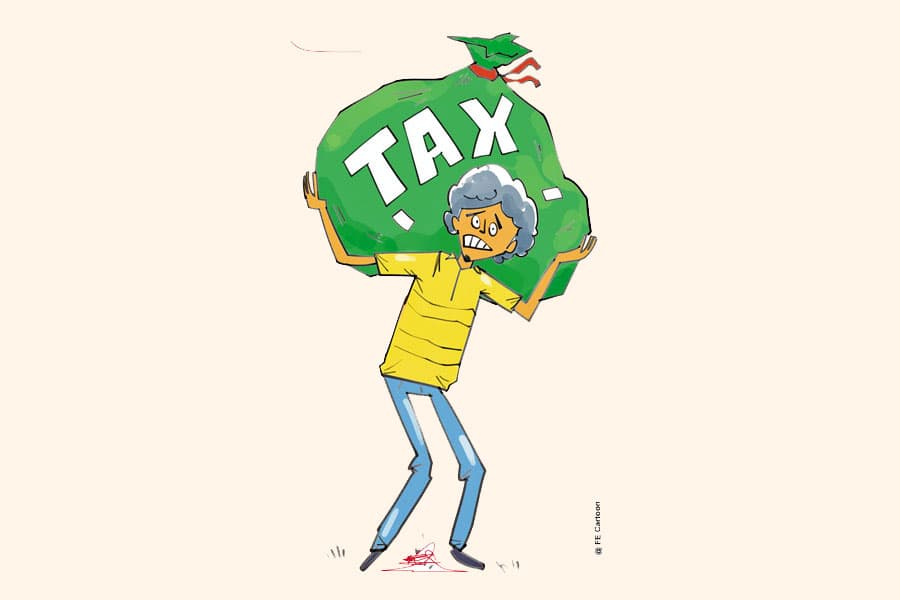
Tax cheating is not merely a revenue shortfall; it reshapes the distributional character of the state. Salaried employees and compliant firms bear visible burdens, while powerful individuals and enterprises exploit exemptions, underreporting, political influence, or informal transactions to avoid comparable obligations. Compliance is penalised, influence rewarded, and the fiscal system becomes both smaller and more unequal. Corruption adds a second distortion. A road may be recorded at its full construction cost even though part of the allocation disappears through inflated contracts, commissions, politically connected subcontracting, inferior materials, or incomplete implementation. The accounts classify the entire amount as development expenditure even though society receives only a fraction of the intended infrastructure. Nominal expenditure is mistaken for productive investment, and the illusion of development replaces its substance.
The same failure appears across sectors. A hospital allocation may produce buildings without doctors, medicine, or functioning equipment. An education budget may finance salaries and construction without improving learning. A subsidy may protect politically favoured producers more than vulnerable consumers. A bank recapitalisation may preserve institutions damaged by connected lending rather than restore productive credit. Public expenditure must therefore be evaluated not by the amount allocated but by the usable social value it creates. Inflation further separates nominal budgets from attainable reality. When the prices of construction materials, imported fuel, food, medicine, or machinery rise after the budget is approved, the purchasing power of an allocation declines. A project that appeared adequately funded becomes underfunded in real terms. Governments then reduce quality, postpone completion, increase borrowing, or approve supplementary expenditure. The budget document remains unchanged, but the project it was supposed to finance has already shrunk.
Exchange rate depreciation creates similar losses when projects depend on imported machinery, energy, technology, or specialised materials. A budget prepared at one exchange rate may no longer finance the same quantity of imports several months later. Natural disasters add another layer of fiscal displacement. Floods, cyclones, droughts, landslides, pandemics, and extreme heat can redirect money from planned development toward emergency relief and reconstruction. Bangladesh is particularly exposed to climate related disruption, but comparable pressures affect Pakistan, India, the Philippines, parts of Africa, and much of Latin America. A budget written before a major disaster may remain legally valid while becoming economically obsolete. The arithmetic of the budget remains intact; the reality it was meant to govern does not.
Despite these realities, budget speeches and much economic commentary continue to discuss allocations as though they were outcomes. Education receives a stated share, infrastructure another, and social protection a third. The numbers generate headlines and political claims, but little attention is given to the probability that allocations will be eroded before producing their promised results. Budget arithmetic usually ends where the real economic process begins. Advanced economies are not free from waste, political favouritism, forecasting errors, or fiscal controversy. Their advantage lies less in moral superiority than in institutional resistance. Sweden combines budgetary targets, an expenditure ceiling, a debt benchmark, a stringent central government budget process, transparency requirements, and external monitoring. Switzerland's constitutionally grounded debt brake links federal expenditure to structural revenue while allowing cyclical adjustment. Germany's experience shows both the discipline and the limits of constitutional borrowing rules: fiscal constraints may require adaptation when defence, infrastructure, stagnation, or other exceptional pressures become unavoidable.
Bangladesh cannot simply transplant Swedish, Swiss, or German institutions. Fiscal systems emerge from political history, administrative capacity, legal enforcement, and social trust. It can, however, adopt the principles underlying them: realistic forecasting, credible expenditure limits, transparent procurement, independent evaluation, enforceable audit findings, and public disclosure of the differences between approved projects and completed results. To make these principles operational rather than aspirational, budget analysis should incorporate a realisation coefficient: the estimated proportion of an allocation likely to become productive public value. If Tk 100 billion is allocated to infrastructure but procurement inflation, delays, corruption, and poor construction reduce the effective value to Tk 65 billion, economic analysis should not continue treating the full Tk 100 billion as productive investment. The nominal budget may be Tk 100 billion; the attainable budget is Tk 65 billion. To avoid overwhelming current bureaucratic capacities, the government can phase in realisation reporting beginning with high spend ministries such as health and infrastructure before expanding nationwide.
The coefficient would vary across sectors and programmes. Digitised cash transfers may have relatively high delivery rates because funds move directly to verified recipients. Large construction projects face greater procurement, land acquisition, and implementation risks. State owned enterprises may absorb resources without producing proportionate returns. Local government projects vary according to administrative capacity and political capture. A single national discount rate would therefore be too crude; sector specific realisation estimates are more informative. Tying these coefficients to concrete verification-such as confirming whether a healthcare allocation results in functional clinics with staffed medical professionals rather than empty concrete shells-prevents systemic blind spots and forces ministries to confront the difference between expenditure and outcome.
Budgets should also contain explicit risk adjustments for inflation, exchange rate depreciation, disasters, revenue shortfalls, implementation delays, and contingent liabilities from banks and state enterprises. These risks already exist. Refusing to quantify them does not make the budget more accurate; it merely makes uncertainty less visible. Scenario ranges would be more honest than a single point forecast presented with artificial precision. Alongside every annual budget, the government should publish a Budget Realisation Report showing what was allocated, what was released, what was spent, what was completed, and what measurable outcome was produced. Cost overruns, delays, abandoned projects, procurement variations, and unresolved audit objections should be presented in accessible form. Parliamentary debate could then move beyond theatrical competition over which ministry received more money and ask a more consequential question: how much public value did the country receive from the money already spent?
Bangladesh's development challenge is not solely a shortage of money. It is a shortage of transmission integrity. Revenue must travel from taxpayers to the treasury, from the treasury to public institutions, and from those institutions to citizens. At every stage, tax evasion, corruption, inefficiency, inflation, disaster, and political interference can weaken the transmission. A budget that ignores these forces is an accounting document, not an attainable economic programme. The arithmetic of development must begin not with what is allocated, but with what actually arrives. Until leakage, tax cheating, inflation, exchange rate risk, disasters, and implementation failure are incorporated into fiscal analysis, governments will continue announcing nominal development while citizens receive only a diminished fraction of it. An attainable budget is not the one written in the document; it is the one that survives the journey through the state.
Dr Abdullah A Dewan, Professor Emeritus of Economics at Eastern Michigan University, USA, formerly a Physicist and Nuclear Engineer, BAEC. aadeone@gmail.com. Asjadul Kibria is an economic journalist.asjadulk@gmail.com